A Neutron Star Built from Holographic Bricks express
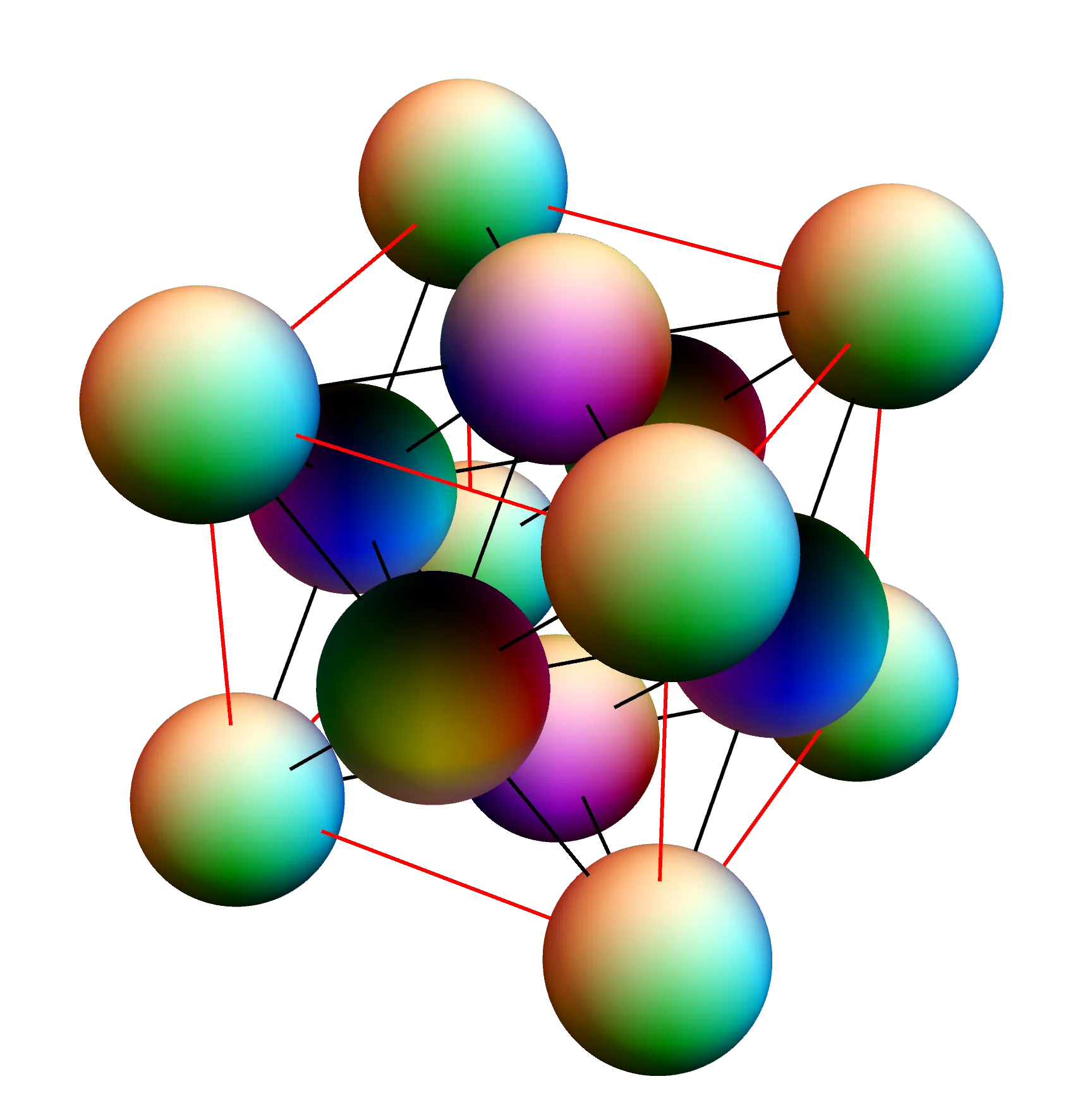
Water in a glass looks continuous, but it's made of molecules. Similarly, physicists have long described the matter inside a neutron star as a uniform soup of protons and neutrons. But real neutron stars are not soup. They are a dense crowd of particles where each neutron feels its neighbors.
The authors of the new work abandoned the uniform picture. They based their approach on an unusual tool — holography. In the holographic approach, strong interactions inside the nucleus are described through the curvature of an extra dimension, like the shadow of a three-dimensional object on a flat wall. Each baryon (proton or neutron) appears as a tiny vortex — a soliton. Two such vortices attract each other in a specific way. The scientists calculated the strength of this attraction and began arranging the vortices into a crystal lattice, like oranges in a crate, but in the densest packing, face to face.
Having built such a lattice, the authors calculated how much energy each baryon carries and how pressure changes with density. They calibrated their model using two anchor points: the saturation density (where nuclei in ordinary atoms stop compressing) and the chemical potential (the energy needed to add another neutron). They then included the mass of pi-mesons — particles that baryons toss to each other like a ball, binding the nucleus. The resulting stiffness of matter turned out to be close to the real one, unlike the uniform approximation.
Next, the authors moved to neutron star matter, where protons and neutrons are mixed with electrons and are in equilibrium. Using known data on symmetry energy (the energy difference between pure neutron and proton-neutron matter), they obtained a hybrid equation of state. With it, neutron stars in calculations come out just as X-ray telescopes see them: a radius of about 12–13 kilometers at a mass of one and a half Suns. This approach, where matter is assembled from individual baryon vortices, for the first time allowed a holographic model to match observations.
Original abstract
as written by the authors arXiv:2607.19125
We construct a nuclear-matter equation of state (EOS) from holographic QCD in the Witten-Sakai-Sugimoto (WSS) model, going beyond the homogeneous ansatz by building dense baryonic matter more directly from the solitonic description of holographic baryons. Employing the two-baryon interaction potential obtained from the linearized soliton tails sourced in the curved background by point-like (core) instantons, we assemble an infinite face-centered cubic (FCC) crystal with nearest neighbors in the most attractive channel as an approximation to the quantum liquid of baryons and compute the energy density $$\mathcal{E}(n_B)$$, the chemical potential $$\mu_B$$, and the pressure $$P$$. We calibrate the symmetric-matter EOS by fixing the 't Hooft coupling $$\lambda$$ and the WSS scale $$M_{\rm KK}$$ to saturation-density and onset-chemical-potential properties, and by including a quark-mass term to reproduce the physical pion mass $$m_\pi=135\,\mathrm{MeV}$$. This fit turns out to remain reasonably close to the parameters required by the vacuum meson sector, while their modification is consistent with Brown-Rho scaling in a dense medium, and the incompressibility at saturation is of the correct order of magnitude, both in clear contrast to the homogeneous approximation. We then extend to beta-equilibrated matter, using phenomenological input for the symmetry energy, and obtain hybrid EOS and neutron-star observables that are compatible with the NICER constraints.
If a neutron star the size of a city were compressed a bit more, it would become a black hole, and its matter would disappear behind the event horizon.
In Robert Forward's novel Dragon's Egg, life on the surface of a neutron star is described, where nuclear reactions happen so fast that a civilization evolves over Earth hours.