A Neutron Star Built from Holographic Bricks express
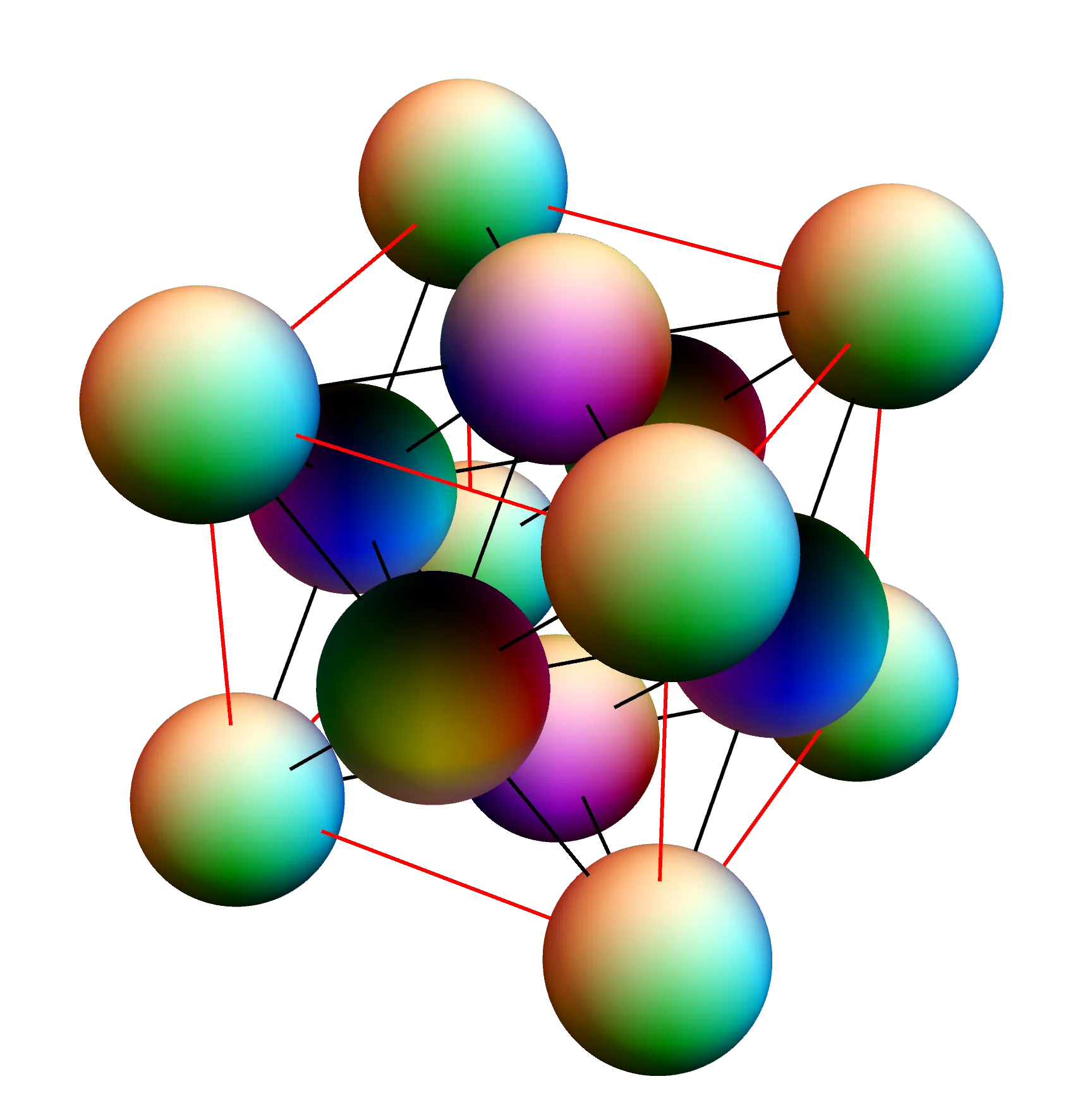
Water in a glass looks continuous, but it's made of molecules. Similarly, physicists have long described the matter inside a neutron star as a uniform soup of protons and neutrons. But real neutron stars are not soup. They are a dense crowd of particles where each neutron feels its neighbors.
The authors of the new work abandoned the uniform picture. They based their approach on an unusual tool — holography. In the holographic approach, strong interactions inside the nucleus are described through the curvature of an extra dimension, like the shadow of a three-dimensional object on a flat wall. Each baryon (proton or neutron) appears as a tiny vortex — a soliton. Two such vortices attract each other in a specific way. The scientists calculated the strength of this attraction and began arranging the vortices into a crystal lattice, like oranges in a crate, but in the densest packing, face to face.
Having built such a lattice, the authors calculated how much energy each baryon carries and how pressure changes with density. They calibrated their model using two anchor points: the saturation density (where nuclei in ordinary atoms stop compressing) and the chemical potential (the energy needed to add another neutron). They then included the mass of pi-mesons — particles that baryons toss to each other like a ball, binding the nucleus. The resulting stiffness of matter turned out to be close to the real one, unlike the uniform approximation.
Next, the authors moved to neutron star matter, where protons and neutrons are mixed with electrons and are in equilibrium. Using known data on symmetry energy (the energy difference between pure neutron and proton-neutron matter), they obtained a hybrid equation of state. With it, neutron stars in calculations come out just as X-ray telescopes see them: a radius of about 12–13 kilometers at a mass of one and a half Suns. This approach, where matter is assembled from individual baryon vortices, for the first time allowed a holographic model to match observations.
If a neutron star the size of a city were compressed a bit more, it would become a black hole, and its matter would disappear behind the event horizon.
In Robert Forward's novel Dragon's Egg, life on the surface of a neutron star is described, where nuclear reactions happen so fast that a civilization evolves over Earth hours.