How Scars on the Disk Reveal a Galaxy's Past express
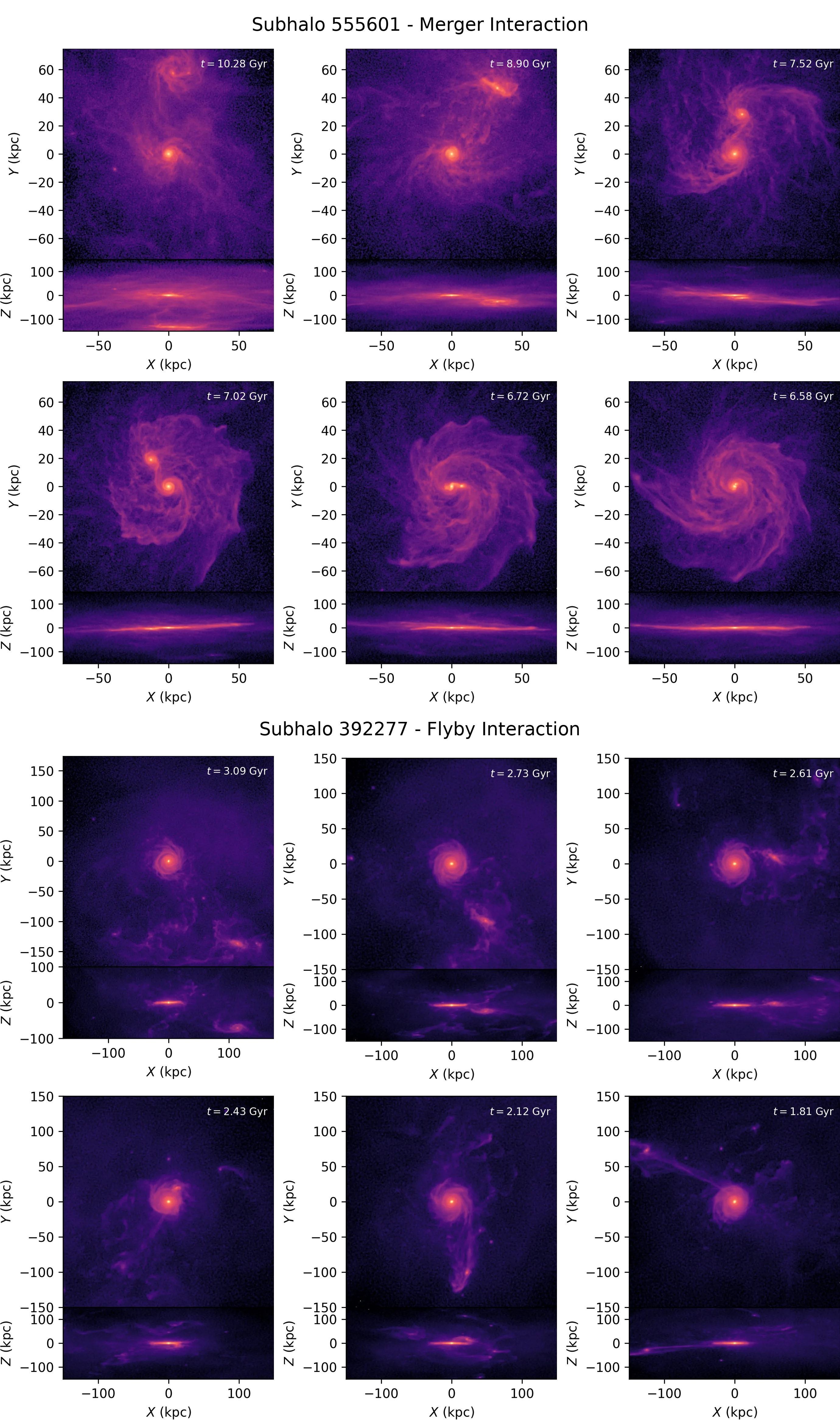
A galactic disk is like a frozen ripple on water: every disturbance leaves a trace that can be read billions of years later. When a dwarf satellite galaxy flies past or a head-on merger occurs, stars in the disk start to oscillate, like bobbers rocked by a wave. Over time these oscillations damp out, but the amplitude of vertical motions remains different for stars of different ages.
In the new work, the team used the TNG50 simulation — a virtual universe where the fate of every stellar particle can be tracked. They selected galaxies similar to the Milky Way and for each one plotted a graph: horizontal axis (stellar age, vertical axis) the spread of their heights above the disk plane (this spread is called Δz). Such a graph works like a seismogram. Major mergers leave sharp steps: the disk first 'puffs up,' then cools and becomes thin again. Flybys, on the other hand, create only small local bumps: new stars are born in the disturbed gas, briefly thickening the disk.
The main advantage of the approach is that it relies only on stellar positions and ages, which can be obtained from observations. No need to measure velocities, no complex dynamical models. With new surveys mapping the Milky Way with high precision, such a 'vertical' analysis could reconstruct the collision chronicle of our Galaxy over the past 10 billion years. And then the frozen ripple on the water will speak — telling of every ancient impact our stellar home has survived.
Original abstract
as written by the authors arXiv:2607.19537
In the hierarchical framework of galaxy formation, disk galaxies are shaped by a sequence of mergers and interactions, yet reconstructing this history from observations remains challenging. We show that the merger history of a galaxy leaves measurable imprints in the vertical structure of its stellar disk. Using Milky Way analogues from the TNG50 simulations, we demonstrate that the Age-thickness relation, quantified by the dispersion of vertical stellar positions ($$\Delta_z$$), encodes both the dynamical heating of pre-existing stars and the birth conditions of stars formed during perturbed phases. Major mergers produce pronounced, step-like features in the Age$$-\Delta_z$$ relation, reflecting strong disk heating and subsequent re-formation of a thin disk, while flyby interactions generate weaker, localized enhancements associated primarily with disturbed star formation. We show that this diagnostic is robust across different locations within the disk and largely insensitive to fractional distance uncertainties lower than 20\%, though its temporal resolution is limited by uncertainties in stellar ages. Because the Age$$-\Delta_z$$ relation relies only on stellar positions and ages, it provides an observationally accessible alternative to traditional kinematic diagnostics. With current and upcoming surveys mapping the Milky Way with unprecedented precision, this framework offers a new avenue for reconstructing the merger history of our Galaxy and probing the dynamical evolution of disk galaxies across cosmic time.
The Sun sits about 50 light-years above the disk's midplane — possibly an echo of an ancient flyby of a dwarf galaxy.
In the novel 'Collision with the Abyss,' a civilization reconstructs its galaxy's history from stellar oscillations to predict the next merger.