Galaxy merger signatures are the observable traces left behind when galaxies collide and merge. These signatures can be seen in the distorted shapes of galaxies, the presence of tidal tails and shells, and the formation of unusual stellar streams. Mergers play a crucial role in galaxy evolution, triggering bursts of star formation, feeding supermassive black holes, and transformingspiral galaxies into ellipticals.
History
The importance of mergers in galaxy evolution was recognized in the 1970s, with the pioneering work of Alar Toomre and Juri Toomre, who showed how interacting galaxies could produce the observed tidal features. The concept of hierarchical merging became a cornerstone of the modern cosmological model in the 1980s.
How it works
When two galaxies merge, their gravitational interaction stretches and distorts their structures, creating tidal tails and bridges of stars and gas. The merger process also funnels gas toward the center, which can ignite intense star formation and activate the central supermassive black hole, producing an active galactic nucleus. Over time, the merged system relaxes into a new, often elliptical, galaxy with a characteristic smooth profile.
In practice
Studying merger signatures helps astronomers trace the assembly history of galaxies, including our own Milky Way, which has been found to have merged with several smaller galaxies over its lifetime, such as the Gaia-Enceladus event.
Fun fact
The Milky Way is currently in the process of merging with the Sagittarius Dwarf Spheroidal Galaxy, and the resulting tidal streams of stars are visible in surveys of the galactic halo.
Two stars circle each other like dancers who come together and drift apart. Over time, one swells, and its outer layers spill onto its neighbor. The star that receives foreign matter looks no different from a single star, but its surface remembers everything.
A galaxy collision is like a slow dance in which two partners gradually draw closer. Hidden at the center of each is a supermassive black hole — an invisible flywheel with a mass of millions or billions of suns.
A galactic disk is like a frozen ripple on water: every disturbance leaves a trace that can be read billions of years later. When a dwarf satellite galaxy flies past or a head-on merger occurs, stars in the disk start to oscillate, like bobbers rocked by a wave.
In 1960, the Tatel radio telescope spent weeks listening to emptiness around Tau Ceti and Epsilon Eridani. Project Ozma was searching for technosignatures — traces of another mind at work.
In the heart of a dense star cluster, a true forge reigns: here stars, like glowing blanks, collide and merge under gravity, and these mergers are not a catastrophe but an opportunity. Each strike of the stellar hammer transfers spin to the future black hole.
Every star is a living archive, and its spectrum a multilayered manuscript. Over billions of years, the history of the galaxy is written into it: the galactic chemical evolution of the Milky Way leaves a smooth trace in elemental abundances.
The mystery of dark matter has puzzled physicists for nearly a century. Among the candidates for its role are primordial black holes (PBHs), born in the fiery embrace of the first moment after the Big Bang.
A detective story unfolded in the GWTC-5 catalog. Hundreds of signals from merging black holes, captured by the detectors of Rainer Weiss and his colleagues, held the secret to the origin of the most massive and rapidly spinning stellar-scale objects.
The birth of planets resembles the workings of a cosmic forge. Rocky blocks collide and fuse together. A powerful impact strikes a spark — material heats to white-hot and glows like cooling metal. Computer simulations show: the flash is visible from days to years, peaking at a tenth of the sun's light.
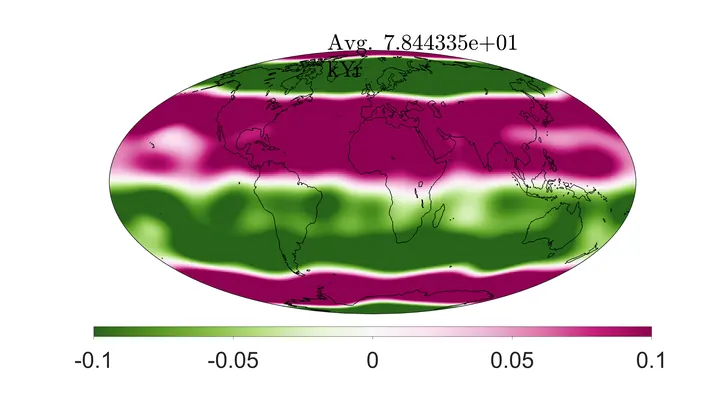
Earth's magnetic field is like an invisible shield that protects us from cosmic radiation. But if you look closely at its long-term averaged pattern, you'll notice that this shield isn't perfectly smooth: it has its own "seams" and "patches." New research using computer simulations of the geodynamo shows that…
In the boundless night of space, galaxies come together in a slow gravitational dance, merging into one. Such collisions are not head-on impacts but rather like fingers moving slowly through water, leaving swirls and tails behind.
Civilizations in the Universe are separated not just by distance, but by the vast gulf of time. Hunting for their traces is like archaeology: instead of palace ruins, we find clouds of cosmic dust.
Drop a stone into a pond, and ripples spread outward. Something similar happens inside compact clumps of dark matter when they encounter a special medium — a scalar field. This field, which pervades everything around us, can spontaneously intensify in the depths of such objects, much like ripples on water growing ever taller and more pronounced.
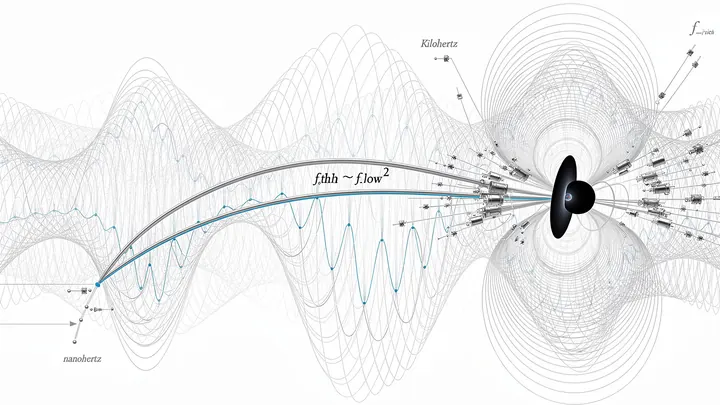
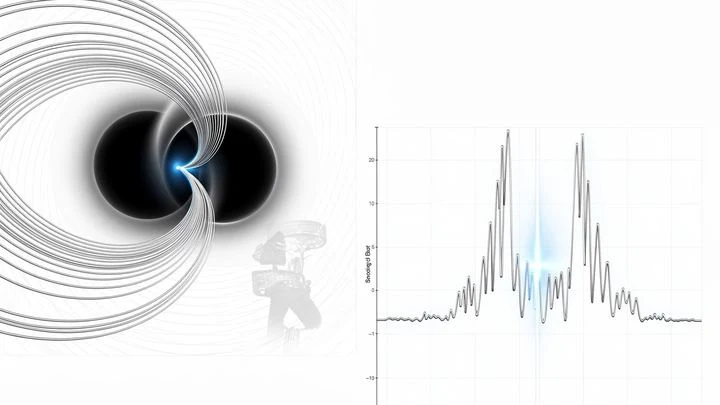
Two black holes smash head-on at full speed — while a third one circles nearby. In ordinary life, such a crash would produce a burst of gravitational waves (ripples in space, like the ripples from a stone thrown into a pond). But here, part of the ripple passes by the massive neighbor, and changes, like light in a funhouse mirror.
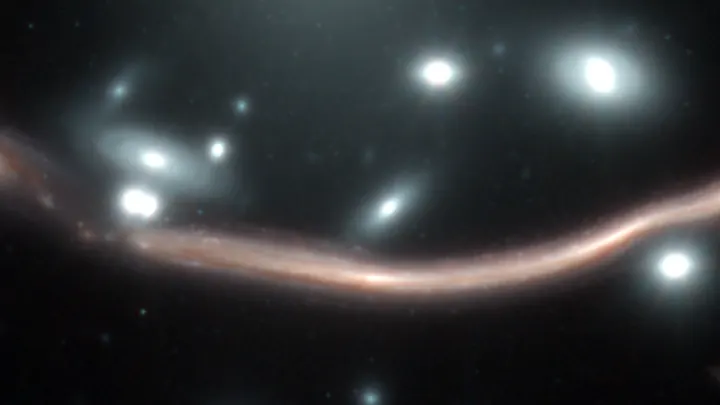
Light from the distant Dragon Galaxy has been traveling toward us for more than seven billion years. On its way, it passes by a huge galaxy cluster whose gravity bends the path of light like a lens. As a result, the galaxy appears brighter and larger than it really is, just as a magnifying glass enlarges fine print.
When two black holes merge, space shudders with gravitational waves, and the newborn hole receives a powerful kick, like a cannon recoiling. In the centers of galaxies, it often slams into a gas disk — a swirling cloud of matter, like a cosmic bullseye.
In the Norma cluster, the nearest rich galaxy cluster to us, astronomers have spotted a shock wave. It arose when one cluster plowed into another, like the bow wave of a ship cutting through water. This wave compressed and heated the gas between the galaxies.
Two galaxies sit right behind the wave front.
On the outskirts of the Virgo Cluster, where galaxies crowd together but haven't yet clumped into a dense mass, lies VCC 693. Outwardly, it's an unremarkable dwarf: a small cloud of stars and gas. But astronomers suspected that behind its calm appearance lurks a turbulent past.
In the Antennae Galaxies, which are crashing into each other, giant gas clouds collided at a speed of 50 kilometers per second. It's like two trains hurtling toward each other — the impact compressed the gas, and it ignited with new stars.
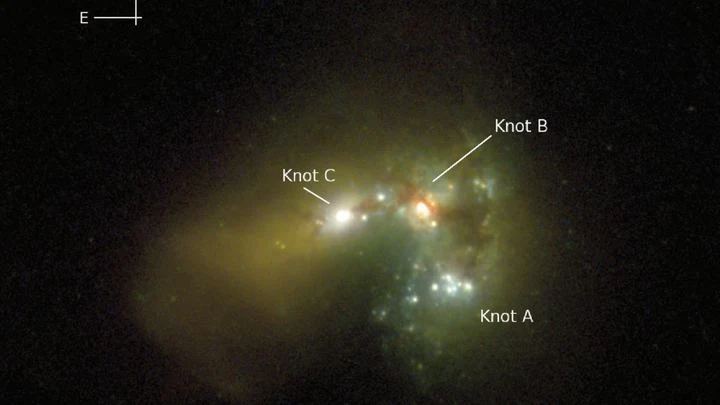
Two galaxies approach each other like a pair of dancers who drift apart and then are drawn back together. At the moment of a particularly close encounter, their gas compresses, and bright ultraviolet light bursts from within. This is exactly what happens in the Haro 11 system — the nearest pair of merging galaxies that lets such light escape.
The early universe was an extremely hot and dense medium. In this medium, like bubbles of steam in boiling water, bubbles of a new state of space spontaneously emerged — regions where physical properties changed abruptly.
In April 2023, the LIGO, Virgo, and KAGRA detectors caught a gravitational wave from the merger of two black holes. With masses of 137 and 103 solar masses, GW231123 became the most massive event ever observed.