Astrochemical synthesis is the study of how complex organic molecules form in the cold, tenuous environments of interstellar space. Far from being empty, the space between stars contains vast clouds of gas and dust, where atoms and simple molecules stick to cold dust grains and react to form increasingly complex species. These include sugars, amino acid precursors, and other molecules essential for life as we know it. The discovery of such molecules in interstellar clouds and in the atmospheres of young stars has profound implications for our understanding of how life's building blocks might be distributed throughout the universe.
History
The field began in the 1930s with the detection of simple molecules like CH and CN in interstellar space, but it was not until the 1970s that the role of dust grains as catalysts was proposed. The detection of amino acid precursors in the 2000s and the recent JWST observations of complex organic molecules in star-forming regions have been major milestones.
How it works
The process typically begins on the surface of tiny dust grains, which act as catalysts. Atoms and simple molecules like hydrogen, carbon monoxide, and water freeze onto these grains at temperatures just a few degrees above absolute zero. There, they can diffuse across the surface and react when they encounter each other, forming more complex molecules. Energy for these reactions can come from cosmic rays, ultraviolet radiation, or the heat released when atoms bind to the surface. Once formed, these molecules can be ejected back into the gas phase by the same radiation, where they can be detected by telescopes via their characteristic spectral signatures. Recent observations with the James Webb Space Telescope have revealed surprisingly complex molecules forming in ice layers on dust grains.
In practice
Astrochemical synthesis informs our search for life beyond Earth by identifying which molecules could serve as biosignatures, and it helps us understand the chemical inventory available to forming planetary systems.
Fun fact
The sugar glycolaldehyde, a key building block for RNA, has been detected in interstellar space, forming in the icy mantles of dust grains.
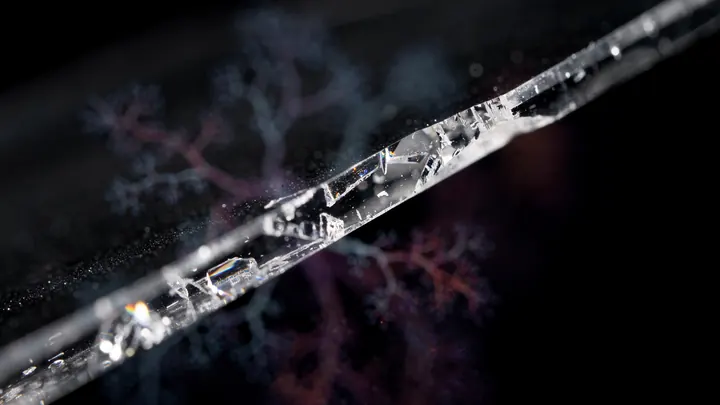
In the coldest, darkest corners of space, dust grains get covered in ice, like a window on a frosty day. This ice isn't just frozen water: it also contains carbon monoxide and carbon dioxide. From such ice, comets and planets may eventually assemble. But until now, it was unclear how the dust grain itself affects the ice that forms on it.
In a dense molecular cloud, at the edge of glowing gas, an invisible assembly line is at work. It takes simple scraps — single atoms and light pairs — and glues them together step by step into long carbon chains and rings. The first piece of this assembly line has long eluded our eyes. Now it has been found.
In the black depths of space, on the surfaces of tiny icy dust grains, a quiet construction is underway. There, where temperatures drop to near absolute zero and harsh radiation abounds, the ordinary amino acid glycine, the simplest protein building block, links up with itself.
The star AB Aur is young, about 4 million years old. Around it swirls a dense disk of gas and dust. Recently, a long gas stream, a flow of material from the surrounding cloud, crashed into it.
A galactic disk is like a frozen ripple on water: every disturbance leaves a trace that can be read billions of years later. When a dwarf satellite galaxy flies past or a head-on merger occurs, stars in the disk start to oscillate, like bobbers rocked by a wave.
A star's age is the key to the galaxy's history. But prying that key from nature is no simple task: unlike a tree, a star doesn't grow annual rings. Yet, its atmosphere holds a chemical code — the ratio of elements that slowly shifted as generations of stars died and new ones were born.
Erwin Schrödinger pondered how life maintains order despite the second law of thermodynamics. He could never have imagined that part of the answer lies hidden in the instability of giant stars.
Spectroscopy has always been a way to hear the unheard. Back in the 19th century, Johann Balmer deciphered the elegant lines of hydrogen — a simple numerical harmony that foreshadowed quantum theory.
In 2019, an unusual visitor, comet 3I/ATLAS, zoomed into the Solar System. It came from another star, and for the first time, astronomers were able to see what its dusty tail is made of.
In the heart of the Milky Way, in the cloud G+0.693, astronomers caught a sweet signal — emission lines of erythrulose, a simple sugar with four carbon atoms and four oxygen atoms.
Imagine a packed orchestra, each musician playing their own part, while you try to pick out the quiet voice of a rare flute: its melody drowns in the sound of violins and trumpets. That's what hunting for molecules in interstellar clouds is like: telescopes pick up the 'radio voices' of countless substances, and picking out the signal you want from the noise is no easy task.
For nearly half a century, astronomers have been searching for glycine, the simplest amino acid and one of the fundamental building blocks of proteins, in the interstellar medium.
A giant cloud of gas and dust, so cold that its warmth barely flickers, just a few degrees above absolute zero. This is TMC-1 in the constellation Taurus, one of the darkest and densest cradles of molecules in our Galaxy. In recent years, it has become a true treasure trove for astrochemists: the number of substances found there has more than doubled.
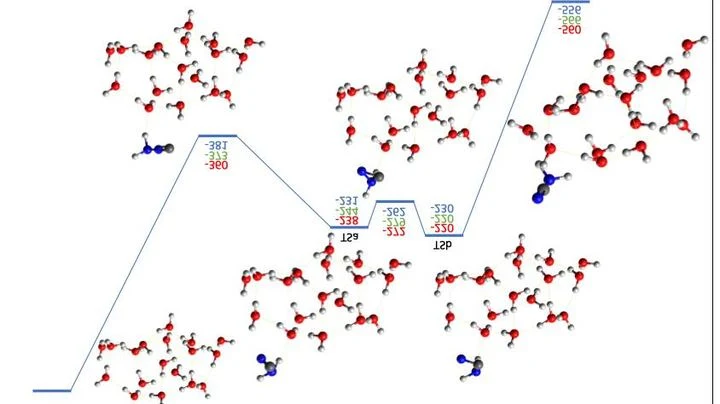
In cold clouds between the stars, dust grains are coated with ice, like windows covered with frost in winter. On this icy crust, chemical reactions take place that do not occur in gas. One such reaction is the encounter between a carbon atom and a nitrogen molecule.
Every molecule is like a set of building blocks: the same pieces can be assembled in different ways. Two assemblies with the same atoms but different geometry are called isomers. If one can be turned into the other by a simple rotation around a bond, they are conformers, like a bent arm versus a straight one.
Radio telescopes detected emissions from the celestial object G358.93-0.03 MM1 — a hot cocoon inside which a massive star is igniting. Within that glow, lines of glycolamide appeared, a delicate carbon molecule.
Long before a star ignites in a gas cloud, chemical life is already bustling. In cold, dense clumps of gas, called starless cores, atoms stick together to form molecules, both simple and complex. To peer into this invisible kitchen, astronomers aimed a 40-meter radio telescope in Yebes at 23 such clouds in the Orion Nebula.
A gas cloud the size of a small galaxy is falling into the Milky Way at hundreds of kilometers per second. Such clouds are called high-velocity clouds, and until now no stars had been found in them — only gas. Now, in one of them, named Complex H, astronomers have spotted a pair of young star clusters.
The kitchen where stars are baked works on a simple recipe: as much flour as you have, that's how many pies you get. For a long time, astronomers saw a strict relation between a galaxy's mass and how fast it forms stars, and they considered it a standalone rule. But a new study of 24,954 nearby galaxies shows that this relation is just a shadow of two more fundamental laws.
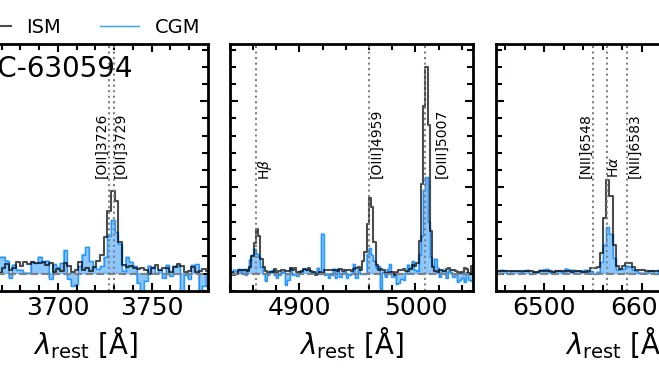
The kitchen of a distant galaxy isn't limited to its bright disk. Around every star system, there's an invisible cloud of gas, like steam above a pot of soup. Astronomers peeked into this steam around galaxies that appear as they were just one and a half billion years after the Big Bang.
When a young star ejects jets of gas, they slam into the surrounding cloud like a fist into a pillow. At the impact site, the gas is compressed and heated — creating a shock wave. In this hot zone, atoms and simple molecules collide and assemble into larger compounds, known as complex organic molecules.
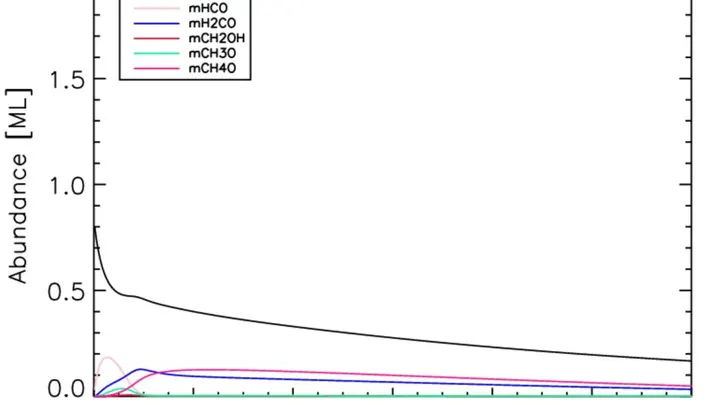
In a dark, cold cloud between the stars, a dust grain a thousandth of a millimeter across catches light molecules. Carbon monoxide and hydrogen stick to its surface like raindrops to glass and react. After a few steps, methanol is produced — the same alcohol found in windshield washer fluid.
In a cloud where massive stars are being born, there is a hot, dense core. Like a crowded kitchen where the heat of the stove makes smells evaporate, here the warmth from young stars evaporates molecules from the surface of cosmic dust grains.
In dark, cold clouds where stars are just beginning to form, dust grains put on icy coats. This ice is not just frozen water: it contains dissolved carbon dioxide, methanol, ammonia, and other molecules.
In the dark, cold clouds where stars are born, dust grains are covered with an icy crust. Across this crust, like on a winter road, individual atoms wander slowly. Calculations show that it is precisely these wandering oxygen and nitrogen atoms that kick off the assembly of the HNSO molecule — a compound of hydrogen, nitrogen, sulfur, and oxygen.
Astronomers using James Webb and spectroscopy (splitting light into colors) peered through dust into the center of galaxy IRAS 07251-0248. There they discovered benzene, acetylene, methane — the same hydrocarbons found in gasoline and plastics.
In a cold gas cloud right at the center of our Galaxy, designated G+0.693-0.027, hides a true chemical laboratory. There, far from stars, on the surfaces of tiny dust grains, about the size of smoke particles, atoms stick together into molecules, like dough on a kitchen counter.
A cosmic dust grain is covered in ice, and on this ice, like in a tiny kitchen, molecules are cooked. One of them is methanol, an alcohol that serves as a building block for more complex compounds in space. Previously, it was thought that methanol only forms when hydrogen atoms stick one by one to a carbon monoxide molecule.