Historical astrophotography is the practice of mining old astronomical photographs and glass plates for new scientific discoveries. These archives, some dating back over a century, contain a unique record of the sky as it appeared long before modern digital detectors. Because they capture the positions and brightnesses of celestial objects at specific moments in the past, they serve as a time machine for studying changes that occur over decades or even a century — timescales that are otherwise inaccessible to contemporary observations.
History
The systematic use of photographic plates in astronomy began in the late 19th century, with major sky surveys like the Carte du Ciel project (1887) and the Harvard College Observatory's collection, which accumulated over 500,000 plates. The scientific exploitation of these archives for new discoveries gained momentum in the late 20th century as digitization projects made them accessible to the broader community.
How it works
Old plates are digitized and compared with modern images of the same regions. Astronomers measure shifts in stellar positions (proper motions), changes in brightness (for variable stars or transients), or the appearance of new objects that were not present in the old images. The key is careful calibration: aligning the plates with modern astrometriccatalogs and correcting for distortions in the original optics and emulsions.
In practice
Used to discover high-proper-motion stars, identify long-period variable stars, find pre-discovery images of supernovae or novae, and constrain the orbits of objects like Kuiper Belt bodies or even hypothetical Planet Nine.
Fun fact
The Harvard plate collection includes images taken by women 'computers' like Henrietta Swan Leavitt, whose analysis of variable stars on these plates led to the cosmic distance ladder.
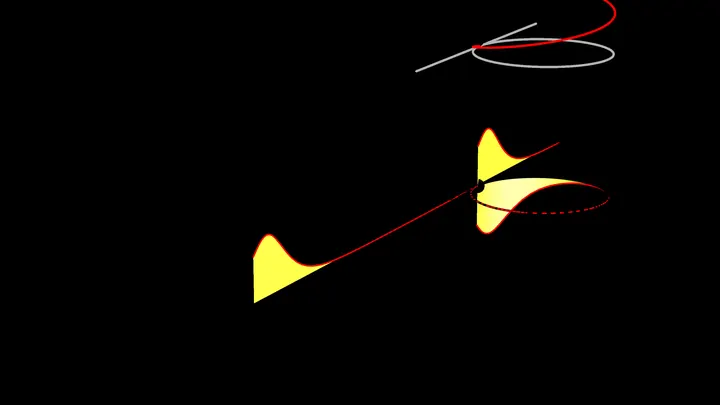
General relativity, which describes the structure of the universe, does not forbid closed timelike curves. But Stephen Hawking put forward the 'chronology protection' conjecture: quantum effects should destroy such curves, making time travel to the past impossible.
A galactic disk is like a frozen ripple on water: every disturbance leaves a trace that can be read billions of years later. When a dwarf satellite galaxy flies past or a head-on merger occurs, stars in the disk start to oscillate, like bobbers rocked by a wave.
In 2019, the world saw the first image of a black hole's shadow — an orange doughnut on a black background, becoming a symbol of scientific progress. But this image wasn't captured by a camera: it was born from mathematical alchemy, where data from eight radio telescopes, which gathered only crumbs of signal, merged into a single picture.
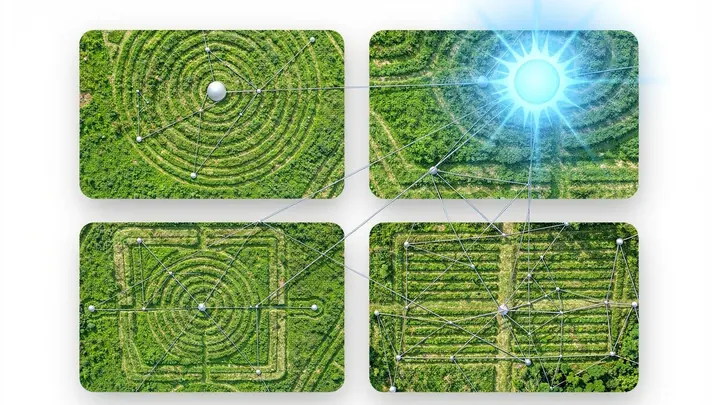
Deep in the Amazon rainforest, beneath a multi-layered canopy of leaves, lie vast earthen figures — squares, rectangles, the occasional rhombus. For decades they teased archaeologists with their silent geometry, until a researcher armed with orbital optics saw them as an astronomical instrument.
The formation of the Milky Way is a grand cosmic performance, in which mergers of satellite galaxies were woven into a single score. Each event left a trace in the dynamics and chemical composition of stars, much like notes capture the composer's intent.
A glowing cloud in a telescope looks like a wisp of fog about to dissipate. Planetary nebulae are gas shells cast off by dying stars. Young nebulae are bright and compact, but as they age, they expand, cool, and become increasingly transparent until they vanish into the interstellar medium.
Globular clusters are dense stellar archives, where the youth of the Galaxy is recorded. But reading this chronicle was hindered by imprecise chronometers: age estimates diverged by a billion years.
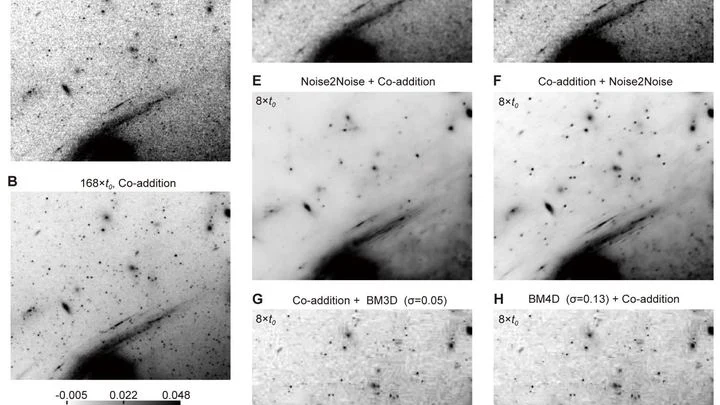
The night sky in a telescope image looks like a photo taken through a fogged-up window: bright stars are visible, but everything faint drowns in a murky haze. That haze is noise — random interference from electronics, heat, and the atmosphere itself.
Old Chinese chronicles are full of weather entries: "no rain in the third month," "the river overflowed its banks." But these are words, not numbers. Until now, turning them into precise precipitation data was nearly impossible.
The new approach works like a translator from the language of chronicles to the language of climatology.
The Universe is filled with invisible mass, dark matter, which reveals itself only through gravity. One hypothesis suggests that dark matter consists of primordial black holes — objects formed in the extreme conditions just after the Big Bang.
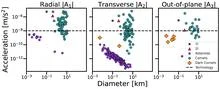
Back in the 18th century, William Herschel was searching for life on Mars. Today, astronomers are targeting not planets but artifacts — for example, alien probes lurking in the Solar System. The problem is that spotting a tiny object next to the blinding Sun is nearly impossible.
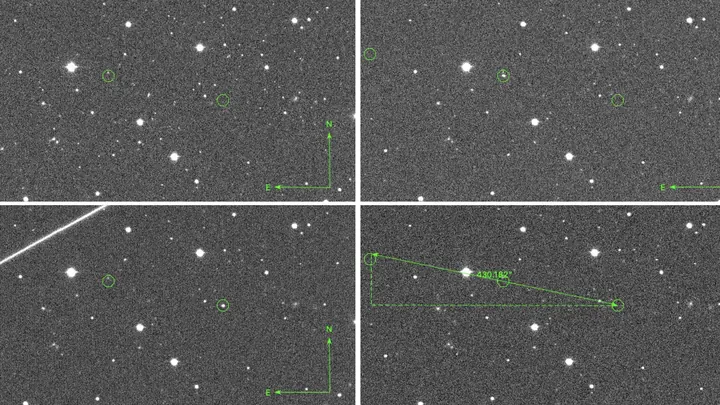
In October 2017, the Pan-STARRS telescope in Hawaii spotted an object moving too fast to belong to the solar system. It was 1I/ʻOumuamua, the first interstellar visitor ever recorded by astronomers. Since then, two more have joined it: comet 2I/Borisov and object 3I/ATLAS.
A firefly blinks for one ten-billionth of a second somewhere above the Siberian taiga. Seeing such a thing is impossible, but the TAIGA-HiSCORE array, spread across a valley in the Tunkinsky district of Buryatia, tried to catch exactly such flashes — not from insects, but from the depths of space.
Two images of the same place: one taken in the morning from a drone, the other in the evening from a satellite. The first shows shadows from trees, the second shows glints on the water. It's like two accounts of the same event in different dialects: the words are similar, but the grammar is different.