The Universe Disagrees with Itself express
Cosmology has landed in an interesting pickle. The two main ways to look back into the universe's past, via the early glow (the cosmic microwave background) and via later objects like supernovae, yield different numbers for the expansion rate (the Hubble constant) and for how clumpy matter is distributed. It's as if two thermometers in the same room showed different temperatures: either the thermometers are lying, or we're missing something about the room itself.
The authors tried a third path — changing the 'recipe' for the dark side of the cosmos. Instead of standard dark energy and dark matter, they used a single substance: an entropic generalized Chaplygin gas. Sounds scary, but the idea is simple: it's a fluid that behaved like dust (dark matter) in the early universe and later like a spring (dark energy), with its behavior tied to thermal properties. The model was fitted to data: supernova explosions, baryon acoustic oscillations (sound waves in the early plasma), and structure growth.
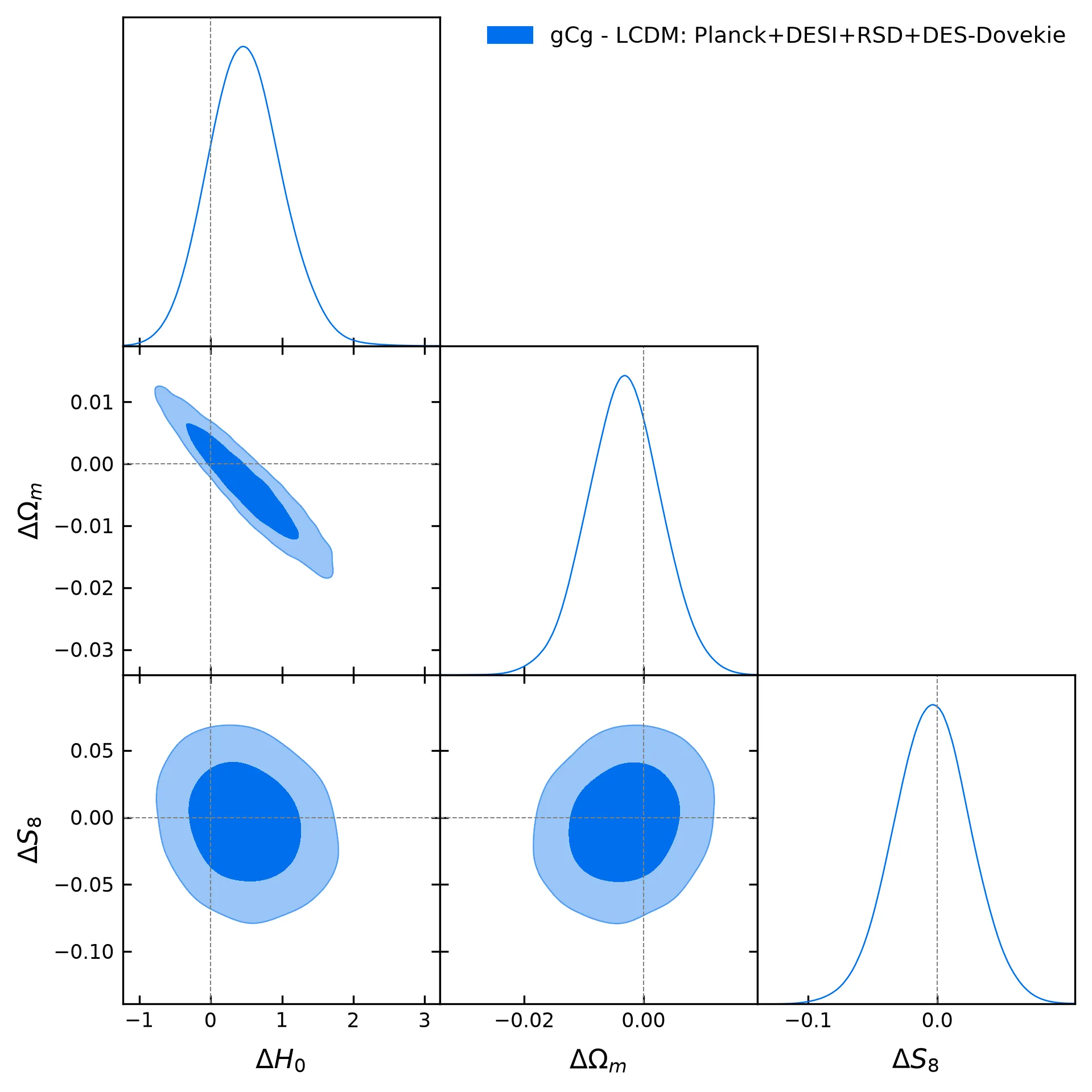
The result is intriguing. The new model barely changes the overall expansion history but introduces a subtle shift in late epochs, like a runner slightly changing pace in the final kilometers of a marathon. That's enough to bring the expansion rate estimates a bit closer. But for 'clumpiness' (the S8 parameter), the trick doesn't work: the disagreement remains almost untouched. A special tool, Tensiometer, showed that the shift in the space of the three main parameters runs along the axis responsible for expansion and barely affects the structure-growth axis.
This suggests an interesting idea: perhaps the two major cosmological 'tensions' live in different physical sectors. One (expansion) is sensitive to how spacetime itself behaves on large scales, while the other (clustering) depends on the properties of dark matter and gravity on small scales. If so, there may be no single cure for both problems — cosmology might need to be fixed piece by piece.
The Hubble constant is sometimes called 'the most inconvenient number in cosmology'—dozens of teams have double-checked the measurements, but the discrepancy persists.
In Carl Sagan's novel 'Contact', the protagonists discover a message hidden in the very expansion of the universe, as if the cosmos itself hints where to look for new physics.