Cosmological data refers to observational measurements from astronomical surveys that probe the universe's large-scale structure, composition, and evolution. This includes data on the cosmic microwave background, galaxy distributions, supernovae, and gravitational waves. Such data are essential for testing cosmological models, such as the Lambda-CDM model, and for investigating mysteries like dark matter, dark energy, and the neutrino mass scale.
History
Modern cosmology began in the early 20th century with Edwin Hubble's discovery of the expanding universe. The field was revolutionized in the 1990s by precise measurements of the cosmic microwave background from the COBE and WMAP satellites, and later by the Planck mission, which provided detailed maps of the early universe.
How it works
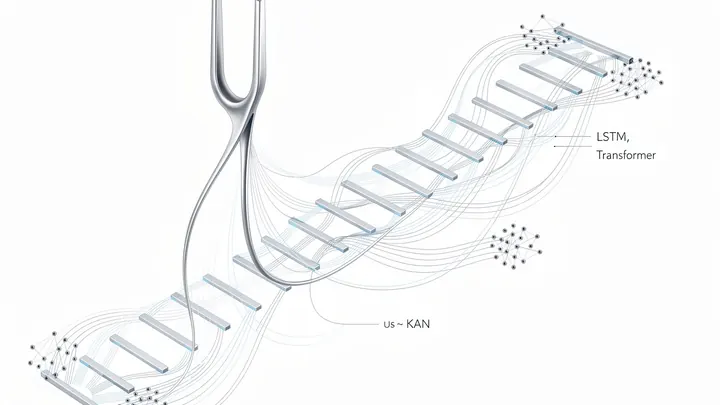
Cosmological data are collected by telescopes and detectors across the electromagnetic spectrum and beyond, including optical, infrared, radio, and gravitational-wave observatories. These observations are processed and analyzed using statistical methods and machine learning to extract parameters like the Hubble constant, matter density, and the equation of state of dark energy. The data are then compared to theoretical predictions to refine our understanding of the universe's history and fate.
In practice
Cosmological data drive the development of large-scale surveys like the Dark Energy Survey and the James Webb Space Telescope, which aim to map the universe's structure and constrain the nature of dark energy. These data also inform models of galaxy formation and the search for primordial gravitational waves.
Fun fact
The cosmic microwave background radiation, a key cosmological dataset, is the oldest light in the universe, emitted about 380,000 years after the Big Bang, and it still permeates space at a temperature of 2.7 Kelvin.
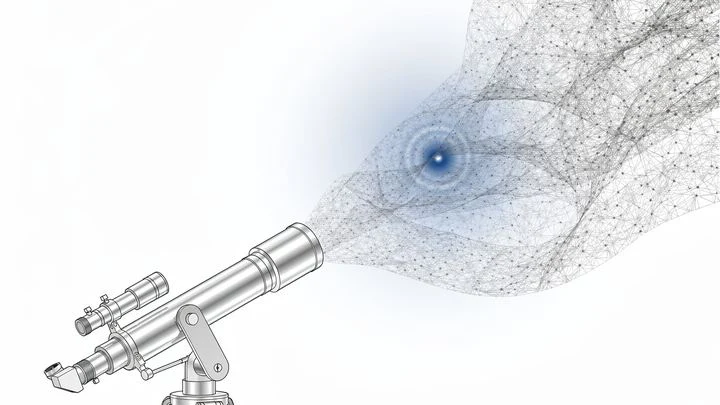
The night sky looks like a random scattering of stars. But zoom out to enormous distances, and the chaos disappears. Galaxies gather into long filaments and flat walls, with colossal voids gaping between them — cosmic voids. This structure is called the cosmic web.
When a star many times heavier than the Sun dies, it collapses and explodes as a supernova. This is not just a flash of light — the entire process, from core collapse to the ejection of the outer layers, makes space itself tremble. These ripples are called gravitational waves.
Right after the Big Bang, space cooled unevenly. In some places, folds could have formed — threads of energy as thin as a hair but incredibly dense. Physicists call them cosmic strings. They oscillate, collide, and emit gravitational waves — ripples in the fabric of space itself.
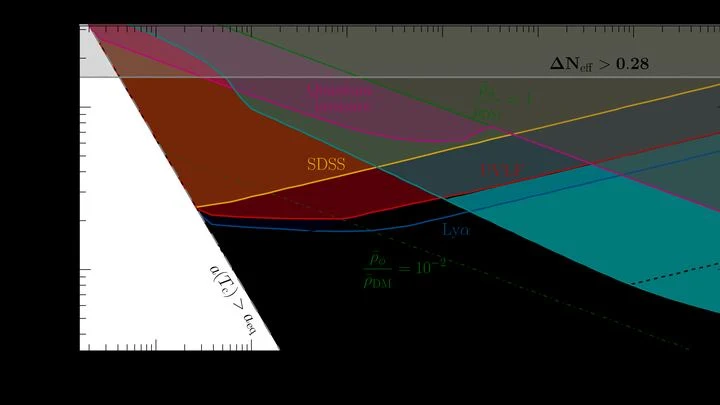
The universe is a vast, dark ocean. We see only the glowing foam on its surface — stars and galaxies. But hidden in the depths are two invisible forces: dark matter, which with its gravity keeps galaxies from flying apart, and dark energy, which, on the contrary, pushes space itself apart, making the universe expand faster and faster.
In 1998, physicists caught neutrinos doing something astonishing: the particle changes its type on the fly. That is only possible if it has mass. This became the only laboratory proof of physics beyond the Standard Model. But exactly how much a neutrino weighs remains a mystery.
Cosmology has landed in an interesting pickle. The two main ways to look back into the universe's past, via the early glow (the cosmic microwave background) and via later objects like supernovae, yield different numbers for the expansion rate (the Hubble constant) and for how clumpy matter is distributed.
380 thousand years after the Big Bang, the universe cooled enough for light to decouple from plasma. That cosmic microwave background still pervades space, like the first chord of a symphony, the echo of a fiery beginning.
2.1 × 10⁻⁹ — that's the temperature variation across the sky, about the same as measuring ripples a fraction of a millimeter high on the ocean surface. This microscopic non-uniformity is imprinted in the cosmic microwave background and tells the story of the very beginning of time.
Modern cosmology has hit a dissonant chord. Local measurements of the Hubble constant from supernovae and Cepheids give around 73 km/s/Mpc, while global constraints from the cosmic microwave background within the standard ΛCDM model point to 67 km/s/Mpc.
The universe is a grand orchestra, with dark energy conducting the expansion. Ten billion years ago, the conductor changed its gesture: the negative pressure that had been holding back galaxy assembly gave way to accelerating expansion — the very phenomenon discovered by [scientist:Saul…
Cosmology is like an orchestra where different sections suddenly start playing out of sync. Measurements of the universe's expansion rate (the Hubble constant) from the early and late universe give different numbers.
Galaxy clusters are the greatest gravitational ensembles in the Universe. In X-ray glow from hot plasma, the story of cosmic expansion, hidden dark matter, and enigmatic dark energy is encoded.
In the late 1990s, the night sky delivered a surprise: Saul Perlmutter and Adam Riess found that the expansion of the Universe is accelerating. Ever since, the greatest riddle has been dark energy — a substance making up nearly 70% of the cosmos, yet evading laboratory study.
From childhood, we're used to thinking of space as infinite and isotropic. But Einstein and Lemaître were already asking: could the Universe be closed in on itself, like a Möbius strip or a 3-torus?
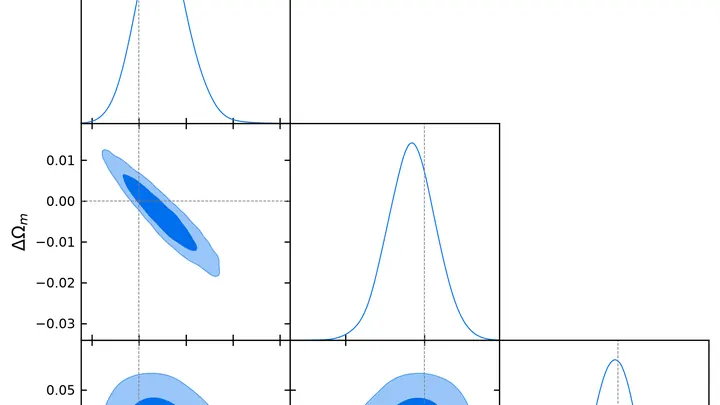
The universe is like a vast warehouse where a strict inventory was taken long ago. The cosmic microwave background is an ancient record of everything in stock 380,000 years after the big bang. According to it, the fraction of matter in the cosmic 'budget' (the parameter Omega_m) is known with high precision.
In 2015, detectors caught a gravitational wave for the first time — a ripple in space that traveled from merging black holes. Since then, such signals have become a new window into the universe for astrophysics. But gravitational waves can do more: they carry the imprint of the very theory of gravity.
An old photograph taken at the moment of the universe's birth has been carrying its light to us for nearly 14 billion years. This snapshot is the cosmic microwave background, the cooled echo of the Big Bang. It captures the tiny inhomogeneities from which galaxies later grew.
The Universe resembles a dense forest: up close, individual galaxy-trees are visible, gathered into groves, but from a distance everything merges into a solid green canopy. The boundary beyond which the cosmos becomes homogeneous is called the angular scale of homogeneity: it's the size of a patch of sky from which galaxies are distributed evenly.
A census that only records the distance between houses misses a lot. You can tell where the cities are and where the villages are, but you can't distinguish a skyscraper from a single-family home. That's roughly how astronomers study the universe with the standard two-point correlation function: they count how many pairs of galaxies are separated by a given distance.
Imagine a huge layered cake, where the layers of dough are space and the filling is a special region resembling an invisible wall. This wall is not made of bricks but of energy, and it could be as thick as the entire universe. If such a wall exists, it should stretch the dough layers differently: those lying along it spread apart faster, while those across it spread slower.
Ancient light, traveling 14 billion years, reaches us from all directions. At first glance, it looks perfectly smooth, but if you look closely, tiny fluctuations appear, like ripples on a still pond. Those ripples aren't random noise; they're an encoded history of the universe.
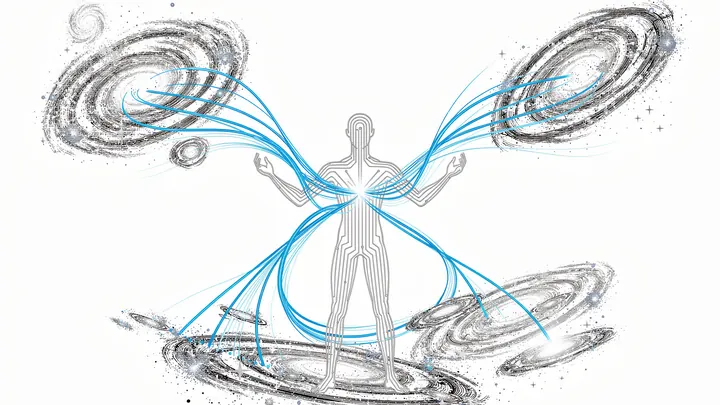
The Universe is a vast city. In it, dark matter is the invisible framework of buildings, and dark energy is the force stretching the streets. For a long time they were considered independent, but new research has caught them in secret communication.
Imagine inflating a balloon. It expands quickly at first, then slows down, and then suddenly speeds up again, as if someone gave the pump another squeeze. That's what seems to be happening to our universe.
When two dead stars collide in a distant galaxy, two messengers bring us the news: a shiver in space, a gravitational wave, and a flash of light. Both messengers race toward us across the entire Universe, but their paths can differ slightly. Light sometimes gets delayed by cosmic dust, while gravitational waves pass through everything almost without noticing obstacles.
Two clocks tell different times. One sits on our desk, the other lies far in the past, in the glow left over from the Big Bang. The first, looking at nearby galaxies, ticks off the expansion rate of the universe — about 73 kilometers per second per megaparsec of distance. The second, peering into ancient light, gives a noticeably lower value — roughly 67.
The trembling of space sounds like an orchestra. Gravitational waves caught by the LIGO and Virgo detectors tell of black hole collisions. Sometimes the music carries off-key notes — tiny deviations from Einstein's score. They might whisper of new physics or simply of dust on the bows.
You are pacing a huge hall in complete darkness. You walk from wall to wall, counting your steps, and suddenly realize that the distances don't add up as they should. It seems as if the floor is not flat but bulging like a hump or hollowed like a bowl. That's roughly what astronomers found when studying distant galaxies and sound waves frozen in the early Universe.
A translator gets distracted by every rustle in the hall, and a one-hour meeting stretches into two. Gluons, the particles that carry the strong force inside protons, behave much the same way. Usually, they dart back and forth, holding quarks together.
Neutrinos are the most abundant massive particles in the universe. Trillions of them pass through us every second, yet they leave barely a trace. Their collective gravity, though tiny, can influence the motion of entire galaxies. Think of two people approaching each other on a busy street; invisible passersby alter their speed.
The universe keeps a tally of every newborn star. Over 13.8 billion years, galaxies have ignited so many stars that their 'census' can reveal the nature of the cosmos itself, just as tree rings reveal past climates.
An album with hundreds of family photos holds countless stories. If you look at each picture on its own, you might easily decide that Uncle is a real giant: that day he happened to stand a step higher than everyone else. But flip through the whole album, and it becomes clear — his height is perfectly ordinary; it's just that a step showed up in a couple of frames.
In the first moments after the Big Bang, the cosmos resembled a giant cooling pond. Just as water, when freezing, becomes covered with a network of cracks, so the cooling universe could have cracked — not into ice, but into the thinnest filaments of pure energy. These filaments are called cosmic strings.
When the first stars ignited, their ultraviolet light began stripping electrons from hydrogen atoms. The universe transformed from a neutral fog into transparent plasma. This process, cosmic reionization, proceeded unevenly: slowly at first, like a fire catching in damp wood, then faster as the flames spread through dry tinder.
Take two heavy balls and place them a meter apart: they attract each other with a force that weakens by a factor of four when you double the distance. Newton discovered this law, and it works in a room, in the solar system, in a galaxy. But does it still hold when we're talking about hundreds of millions of light-years?
Astronomers found a way to test this directly.
If space is a canvas, then brushstrokes cannot be infinitely thin. There's a tiniest segment, shorter than which there's no point in measuring. This quantum 'graininess' alters the geometry itself: the motion of galaxies and the growth of large-scale structures bear its mark.
If you look at a map of distant galaxies, it is not perfectly uniform: on one side of the sky there are slightly more, on the other — slightly fewer. This lopsidedness has been noticed in several sky surveys, and it does not look like a random fluke. Usually, it is explained by the fact that our Galaxy itself is flying somewhere, making distant objects appear shifted.
A galaxy is like a giant merry-go-round: stars and gas whirl around the center, and their speeds reveal how much stuff is on the ride. If we only saw the luminous matter, the outer parts would spin slower than observations show. So there must be invisible mass, dark matter, that holds the galaxy together.
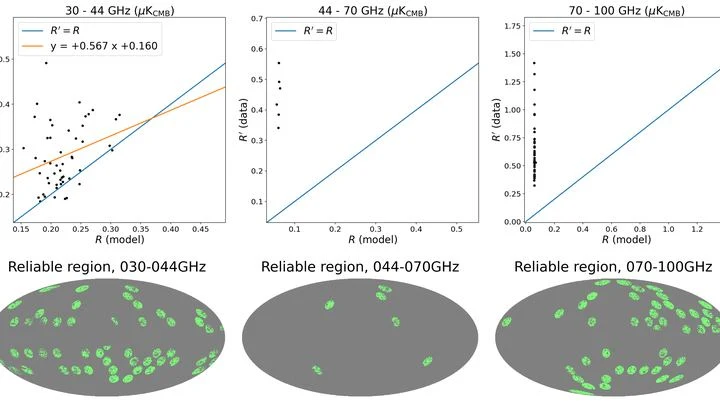
Astronomers are trying to capture the radio echo of the Big Bang — a faint glow that fills the entire universe. But the receiver is choking with noise: our Galaxy is packed with glowing interstellar dust, whose emission can easily be mistaken for a signal from the distant past.
The light of every star is its unique passport, but the entries are written in the language of spectra and colors. For old giants, such documents are almost indistinguishable: their spectra overlap, and deciphering the details by hand was practically impossible.
Light from distant galaxies passes through clumps of matter, and the gravity of those clumps slightly bends its path, like a lens. By measuring how much the images of distant galaxies are distorted, we can infer the distribution of matter and how gravity affects light.