Why the Fault Decides Whether an Earthquake Happens express
Two pieces of sandpaper are pressed tightly together. As you start to slide them, they first catch on the rough spots, then suddenly slip. A fault in the Earth behaves much the same way during an earthquake. But there's a crucial detail: how far do you need to push the edges before the grip gives way? This distance is called the critical slip distance. Until now, it was considered something like a constant material property, like hardness or density.
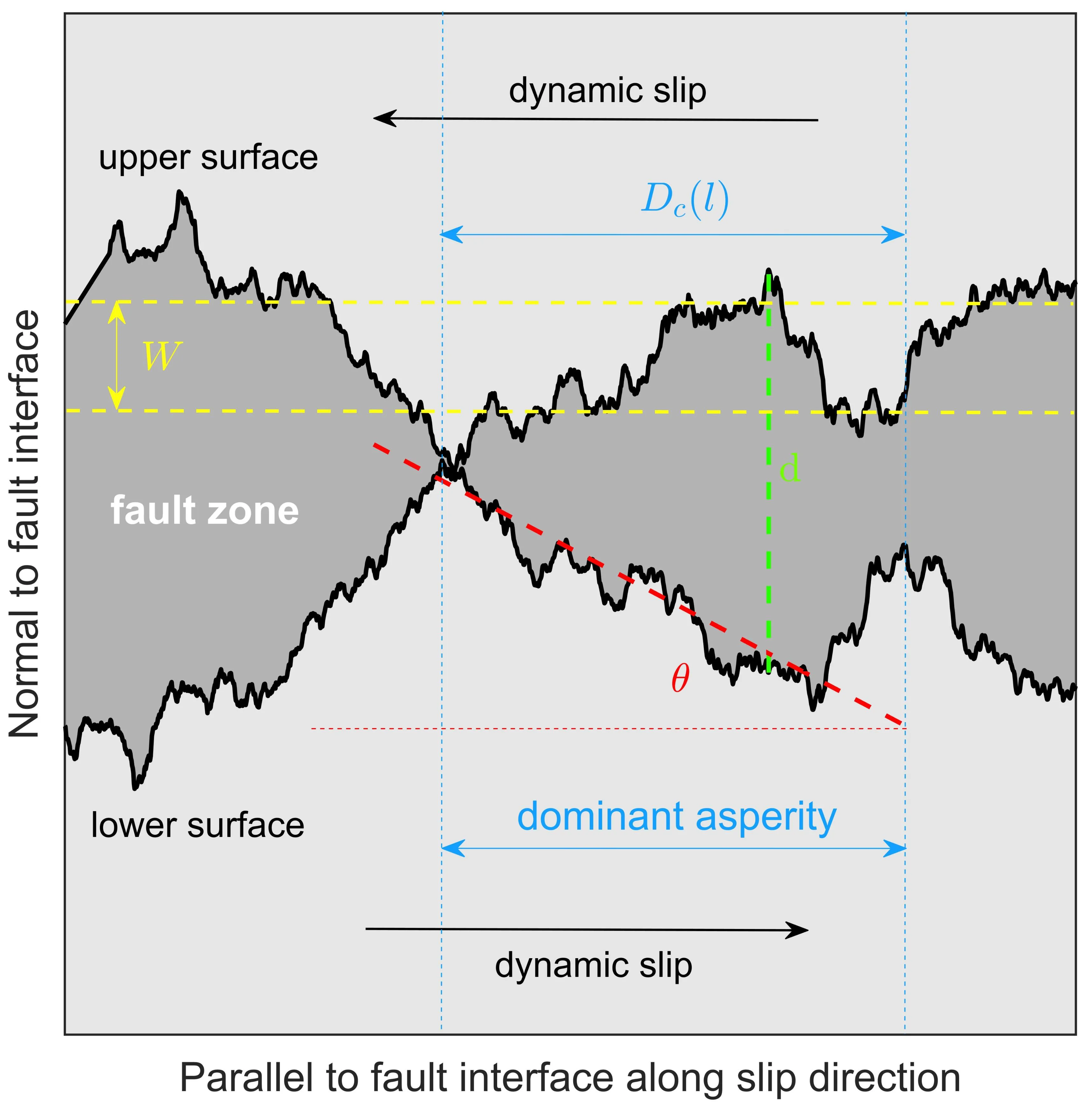
However, measurements were puzzling. In the lab, on small samples, this distance is thousandths of a millimeter. On real faults stretching for kilometers, it's meters. Simply changing the rock type couldn't explain such a spread. The authors of the new study proposed that it's not about the material at all, but about the geometry of the fault itself. Its surface isn't smooth; it's covered with bumps and hollows, like a miniature mountain range. And this roughness is cleverly arranged: if you look at it at different scales, it looks the same, like a coastline that's jagged both on a map and in a satellite image.
It turns out that critical slip is not a property of the rock but a characteristic of the fault's relief. When the edges slide, they must disengage from the major asperities that hold them like hooks. The larger these asperities, the more displacement is needed. And since asperity size grows with fault length, critical slip grows too. Thus, the lab chip and the giant tectonic rupture are no longer a mystery.
From this understanding, a new concept was born — the fault's 'holding capacity.' It's its ability to stop a crack that has started, preventing it from growing into a catastrophe. It all comes down to the hierarchy of bumps: many small irregularities dampen energy like a palisade, and the fault heals after weak tremors. But if large asperities are few, the crack slips past them and races onward. Such a fault can accumulate stress and deliver a powerful blow.
Original abstract
as written by the authors arXiv:2607.23736
The critical slip distance $$D_c$$ - the characteristic displacement over which a fault dynamically weakens from peak to residual strength - is a key parameter in earthquake rupture dynamics, controlling the nucleation process and slip evolution. Nevertheless, its physical origin and scaling remain debated: Dc is observed to span from micrometers in lab experiments to meters on natural faults, a scaling which cannot be explained within the standard friction framework, which interprets Dc as a material constant related to the contact population and provides no mechanism linking it to fault structure or event size. Here, we propose a first-principles derivation showing that Dc is a structural property of faults, governed by their self-affine roughness belonging to the Kardar-Parisi-Zhang universality class. We further demonstrate that rate-and-state friction emerges as the mean-field limit of the underlying fractal asperity dynamics and provide analytical formulas for its parameters: the state variable represents the population-averaged contact age, while the critical distance identifies the geometric unlocking of the dominant pinning bumps. Rate-and-state friction is therefore an emergent phenomenology whose mathematical form reflects the statistical mechanics of the underlying contact population, and its parameter values are strictly scale-dependent. This allows us to better characterize fault stability from a multiscale perspective; hence, we introduce a new concept named "fault retentivity'': the ability of a fault to arrest a nucleated rupture before it degenerates into run-away via the multiscale barrier population encoded in the fault structure. Retentivity determines whether a fault hosts only small earthquakes or can occasionally nucleate large ones. The key implication is that assessing fault stability requires to understand the hierarchical architecture of the fault system.
Fault roughness follows the same mathematical laws as tumor growth or cloud shape.
In Andreas Eschbach's novel 'Earthquake,' characters try to predict tremors by analyzing fault microrelief — much like in this work.