Why the Fault Decides Whether an Earthquake Happens express
Two pieces of sandpaper are pressed tightly together. As you start to slide them, they first catch on the rough spots, then suddenly slip. A fault in the Earth behaves much the same way during an earthquake. But there's a crucial detail: how far do you need to push the edges before the grip gives way? This distance is called the critical slip distance. Until now, it was considered something like a constant material property, like hardness or density.
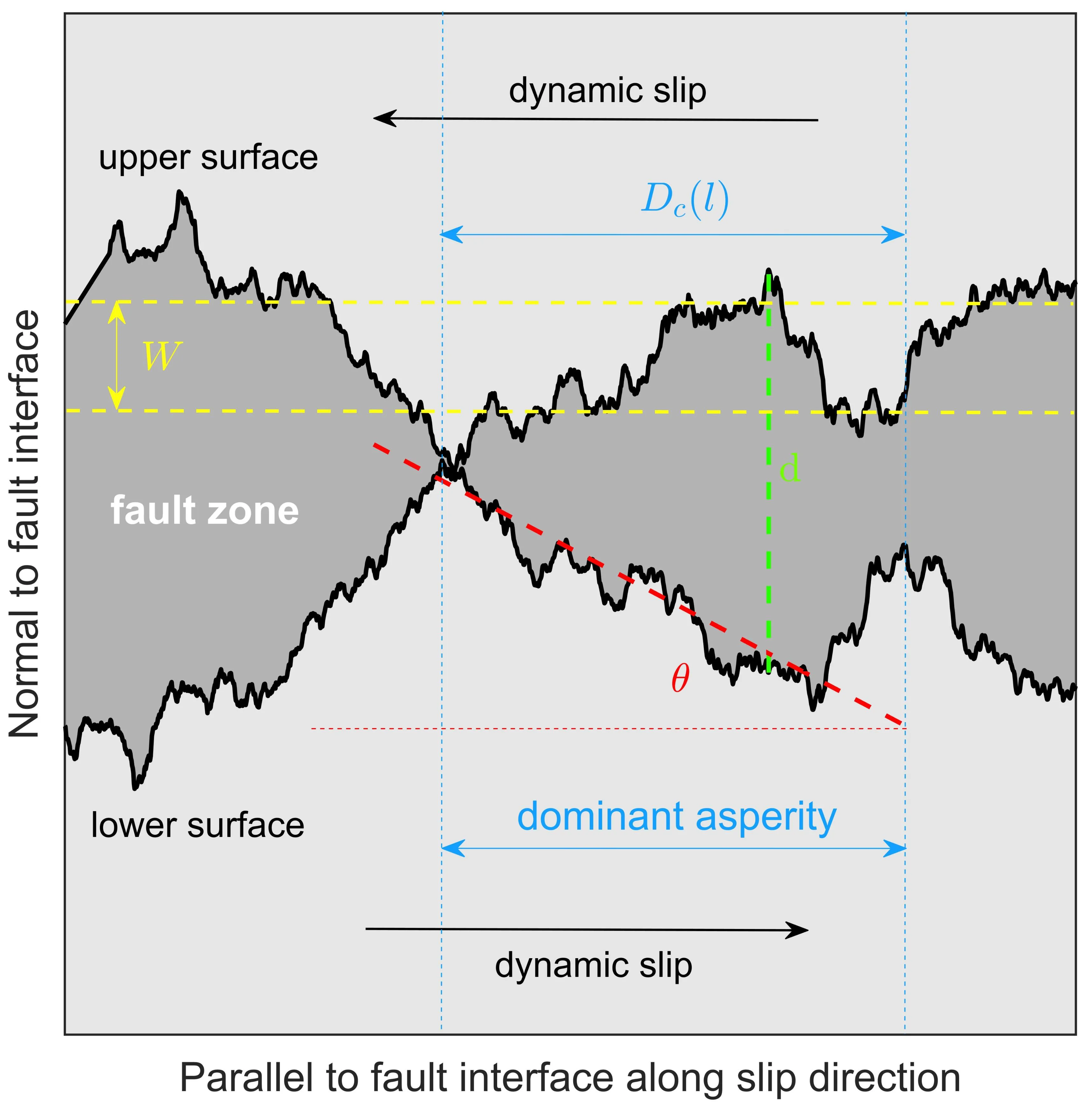
However, measurements were puzzling. In the lab, on small samples, this distance is thousandths of a millimeter. On real faults stretching for kilometers, it's meters. Simply changing the rock type couldn't explain such a spread. The authors of the new study proposed that it's not about the material at all, but about the geometry of the fault itself. Its surface isn't smooth; it's covered with bumps and hollows, like a miniature mountain range. And this roughness is cleverly arranged: if you look at it at different scales, it looks the same, like a coastline that's jagged both on a map and in a satellite image.
It turns out that critical slip is not a property of the rock but a characteristic of the fault's relief. When the edges slide, they must disengage from the major asperities that hold them like hooks. The larger these asperities, the more displacement is needed. And since asperity size grows with fault length, critical slip grows too. Thus, the lab chip and the giant tectonic rupture are no longer a mystery.
From this understanding, a new concept was born — the fault's 'holding capacity.' It's its ability to stop a crack that has started, preventing it from growing into a catastrophe. It all comes down to the hierarchy of bumps: many small irregularities dampen energy like a palisade, and the fault heals after weak tremors. But if large asperities are few, the crack slips past them and races onward. Such a fault can accumulate stress and deliver a powerful blow.
Fault roughness follows the same mathematical laws as tumor growth or cloud shape.
In Andreas Eschbach's novel 'Earthquake,' characters try to predict tremors by analyzing fault microrelief — much like in this work.