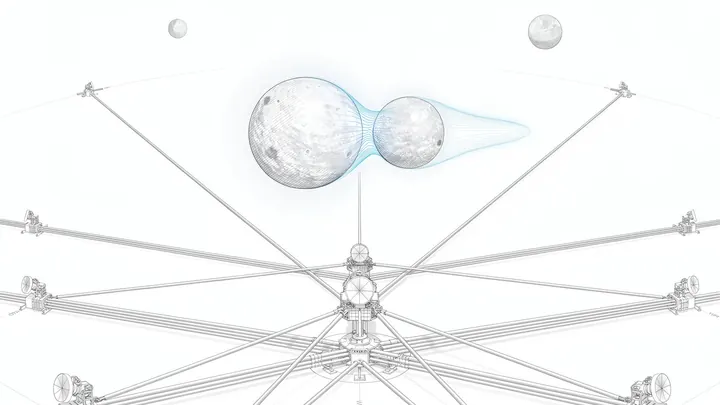
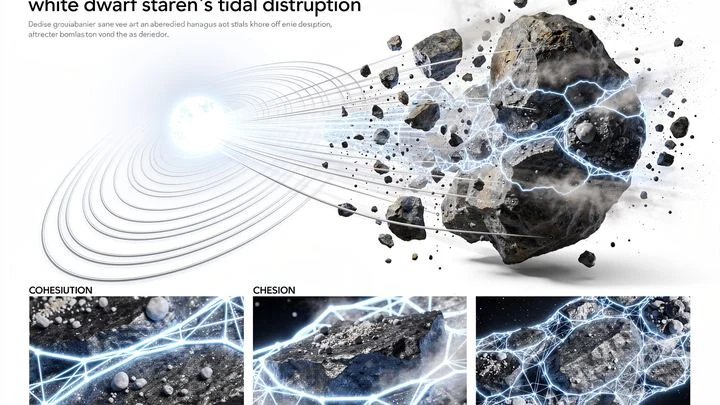
The Roche limit is the minimum distance at which a celestial body, held together by gravity, will disintegrate due to tidal forces from a more massive body.
French astronomer Édouard Roche first calculated this distance in 1848. The Roche limit is the radius at which tidal forces (the difference in gravitational attraction between the near and far sides of a moon) exceed the moon's own gravity holding it together. A simple analogy: a falling water droplet keeps its shape due to surface tension, but if you blow on it too hard, it tears apart — here, tidal forces play the role of the 'blow'.
History
Édouard Roche (1820–1883) first formulated the concept in 1848 while studying the shape of Saturn's moons and rings. Later, James Jeans (1877–1946) refined the theory of tidal stability by introducing the Jeans criterion for gravitational collapse.
How it works
The Roche limit is critically important in astrophysics: it explains the formation of planetary rings (e.g., around Saturn, Uranus, Neptune) and destructive tidal events. It is used in designing orbits of artificial satellites to prevent them from breaking up. It also helps analyze exoplanetary systems and predict possible cataclysmic events in close binary star systems.
In practice
It helps calculate safe orbits for moons and determines where rings can form around a planet.
Fun fact
Saturn's rings may consist not only of destroyed moons but also of material that could never coalesce into a moon because it lay inside the Roche limit.
A gas disk with a mass of four hundred thousand suns encircles the black hole at the center of the Milky Way. Its gravity works like a gravitational rudder: slowly but inexorably turning the orbits of binary stars, driving them into the region where tidal forces tear the pair apart.
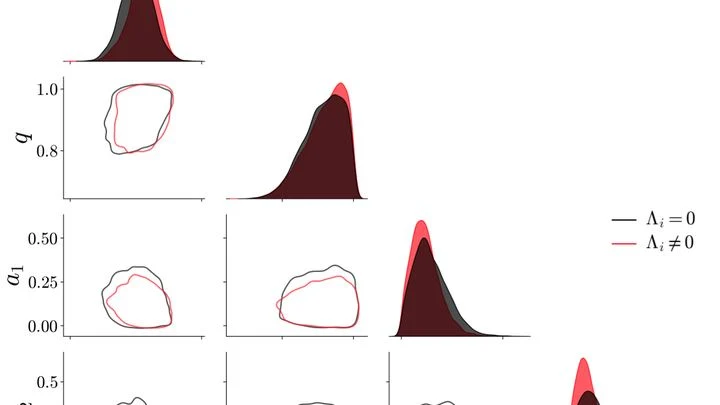
Two neutron stars whirl in a close dance, each feeling the tidal field of its partner. It's like the Moon raising oceans on Earth, but here it's spacetime itself and the star's matter that deform. Astrophysicists call this tidal deformation — a measure of how much an object 'bends' under the gravitational pull of its companion.
Two pieces of sandpaper are pressed tightly together. As you start to slide them, they first catch on the rough spots, then suddenly slip. A fault in the Earth behaves much the same way during an earthquake. But there's a crucial detail: how far do you need to push the edges before the grip gives way? This distance is called the critical slip distance.
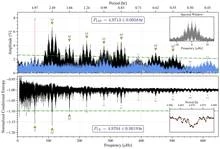
It takes the stellar pair J05+50 nearly two months to complete one orbit around their common center. From Earth, it appears as a faint point in the constellation Hercules — 4625 parsecs away. Photometry of the binary star only captures a steady flicker of brightness, like the pulse of a giant heart.
Two thousand years ago, a brilliant beacon shone in the constellation Eridanus, recorded in the registers of ancient astronomers. Hipparchus in 129 BCE noted it as a first-magnitude star, Ptolemy confirmed its brightness in the Almagest, and the Persian scholar Al-Sufi still saw it among the brightest in 964.
When a telescope catches the light of a distant white dwarf, the spectrograph sometimes fishes out heavy elements — calcium, iron, magnesium. These metals could not have stayed in the thin atmosphere of the stellar remnant; they are the traces of recently fallen planetary debris.
Our Solar System isn't an island in the void: it's a sensitive web stretched in a dark cosmic corner. Planets circle their orbits like dewdrops on threads, and we are the spider sensing the faintest tremor. That tremor betrays the approach of the catastrophe astronomers call the Big Rip.
In a vast dark hall, someone invisible plucks the strings. The cosmic gas, the tenuous hydrogen that filled the young universe, resembles stretched strings that can resonate at a radio wavelength of 21 centimeters. This is hydrogen whispering about its temperature.
Two astronomers look at the same universe but see it differently. One measures the expansion rate using ancient light that has been traveling toward us for nearly 14 billion years. The other uses recent stellar explosions in nearby galaxies. The first gets 67 kilometers per second per megaparsec, the second gets 73.
If two steel balls circle each other, their mutual attraction is powerless to change each other's shape. A water ball, on the contrary, would stretch out like a droplet.
Four hours and fifty-eight minutes. With a rhythm like a metronome, something passes in front of the white dwarf ZTF J1944+4557, dimming its light by a third, sometimes almost by half.