How to Weigh the Universe Without a Scale express
A fast radio burst is a short but powerful flash of radio waves from deep space. As it travels to us, the signal passes through clouds of tenuous gas, and the more gas it encounters, the more the signal is smeared across frequencies. Astronomers call this delay the dispersion measure — essentially, it's a "weighing" of all the matter along the line of sight.
But here's the catch: for most bursts, we don't know how far away they are. Without that, it's unclear where exactly the gas was encountered. The authors of the study propose a clever statistical trick to get around this. Instead of determining the distance for each burst individually, they cross-correlate two datasets: a list of bursts with their dispersion measures and a galaxy map with known distances. This cross-analysis, akin to finding matches between two long lists, captures common patterns — where there are more galaxies, the signal delay is on average larger.
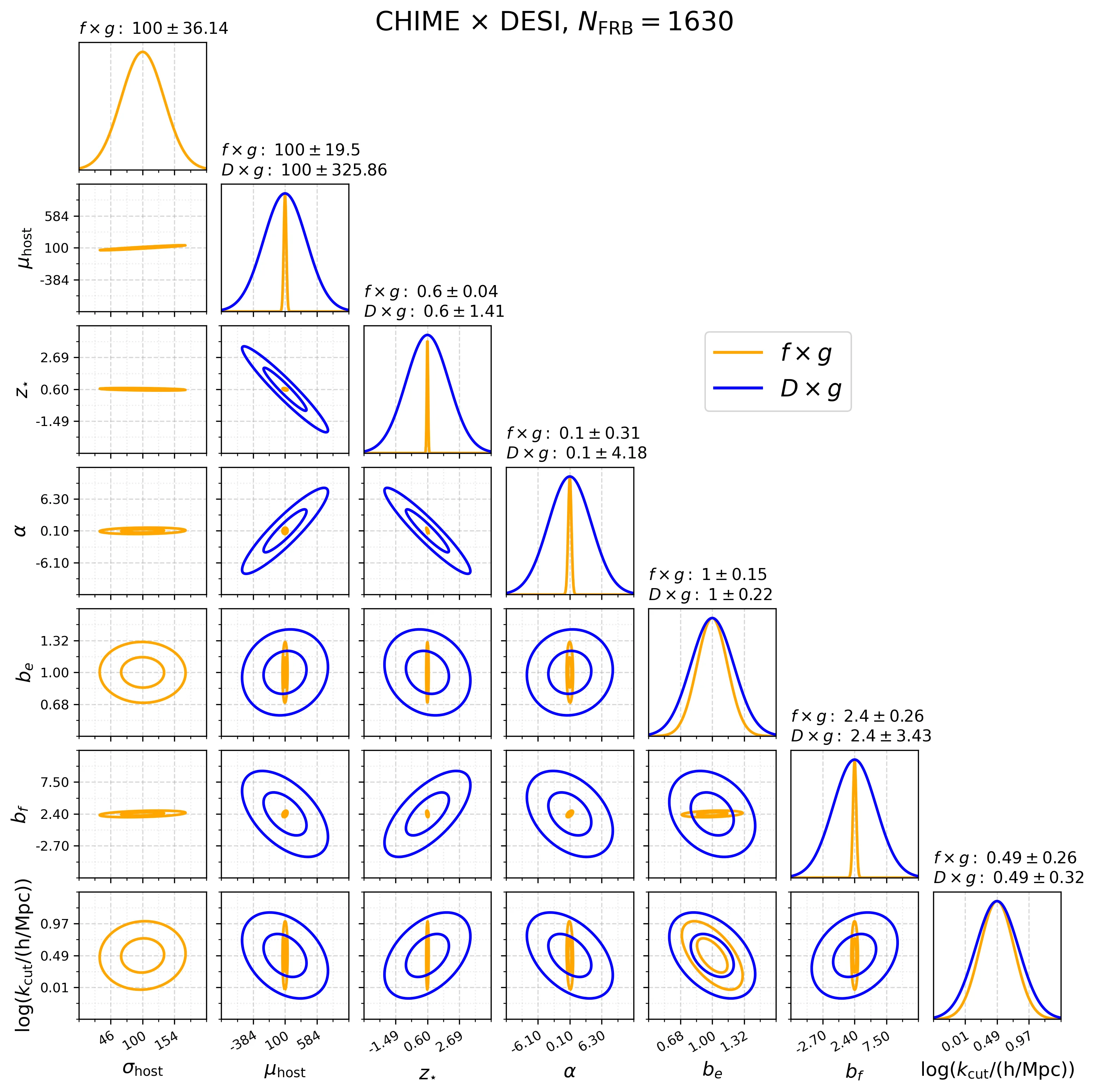
The researchers compared two versions of this cross-correlation. The old method worked directly with the dispersion measure, while the new one splits bursts into groups by delay magnitude and looks for a correlation with galaxies for each group. It turns out the second approach is far more sensitive. For a sample of 1600 bursts, roughly what the CHIME telescope has gathered, it yields a signal-to-noise ratio of about 12. And for future 20 000 bursts from the CHORD facility, it reaches 54. That means the signal stands out very clearly against random noise.
The main practical takeaway: the method promises to measure an important parameter — the scale at which feedback from stars and black holes "blows out" gas and prevents it from clumping. With current data, the precision will be 26%, and with future data, 14%. This is a window into the physics of how galaxies exchange matter with their surroundings. And all this without a single precise distance to the bursts themselves.
Original abstract
as written by the authors arXiv:2607.26135v1
Cross-correlating the dispersion of fast radio bursts (FRBs) with galaxies provides a means to study the distribution of the baryons in the Universe, even in the absence of FRB redshifts. To this end, two variants of angular cross-power spectrum statistics have been proposed: one between DM and galaxy density binned by redshift $$C^{Dg}_l(z_g)$$ (abbreviated $$D \times g$$), and one between FRB counts binned by dispersion measure (DM) and galaxy density binned by redshift $$C^{fg}_l(\textrm{DM}, z_g)$$ (abbreviated $$f \times g$$). Here we show the $$D \times g$$ statistic can be recovered as a DM-moment of $$f \times g$$, implying the latter is strictly more informative. By slicing in both DM space and galaxy redshift space, the $$f\times g$$ statistic separates contributions from the clustering of free electrons and from the clustering of FRB sources. We perform Fisher forecasts for FRB samples consistent with CHIME (1,600 FRBs) and the upcoming CHORD (20,000 FRBs) survey cross-correlated against the DESI Legacy Survey BGS sample and Euclid galaxy surveys, respectively. We show that, compared to the $$D \times g$$ statistic, the $$f \times g$$ statistic results in $$S/N\approx 12$$ for CHIME$$\times$$DESI(LS) and SNR $$\approx 54$$ for CHORD$$\times$$Euclid. The $$f \times g$$ statistics is more sensitive to the redshift distribution of FRBs with forecasted errors on a simple parameterization of order $$10 \%$$. It measures the logarithmic cutoff scale for clustering of baryons due to feedback $$k_{cut}$$ to 26\% precision with CHIME and 14\% precision with CHORD. Since most FRBs currently lack host identifications, and scaling optical followup to large samples will remain challenging even with precise localizations, reliable redshifts will be unavailable for most FRBs for the foreseeable future. The $$f \times g$$ statistic provides a means to extract maximum cosmological information in their absence.
Fast radio bursts last only milliseconds, but in that time they release as much energy as the Sun does in several days.