Dispersion measure (DM) is a quantity in astrophysics that measures the total number of free electrons along a line of sight, integrated from the observer to a distant source. It is defined as the integral of the electron number density over the path length. Because free electrons slow down radiowaves, a higher DM causes a frequency-dependent delay in the arrival time of a signal, with lower frequencies arriving later than higher ones.
History
The concept of dispersion measure was introduced in the mid-20th century with the discovery of pulsars in 1967. Astronomers quickly realized that the observedfrequency-dependent delays in pulsar signals could be used to infer the electron content of the interstellar medium.
How it works
When a radio pulse travels throughionized gas, the group velocity of the wave depends on frequency: lower frequencies are delayed more. By measuring the arrival times of a pulse at multiple frequencies, astronomers can calculate the DM. This delay is proportional to the DM divided by the square of the frequency, allowing a direct estimate of the electron column density along the line of sight.
In practice
Dispersion measure is used to study the interstellar and intergalactic medium, to estimate distances to pulsars and fast radio bursts, and to probe the electron density distribution in the Milky Way and beyond.
Fun fact
The dispersion measure of a fast radio burst can be used to estimate the distance to the source, with a typical value of a few hundred pc/cm³ indicating a source at cosmological distances.
A hunter sets snares in the woods. They know the animal's habits but not whether it will ever show up. In much the same way, physicists set up detectors in hopes of catching particles of dark matter — the invisible substance thought to make up most of the Universe's mass.
A new study offers hunters an unusual tool: not a trap, but a measuring tape.
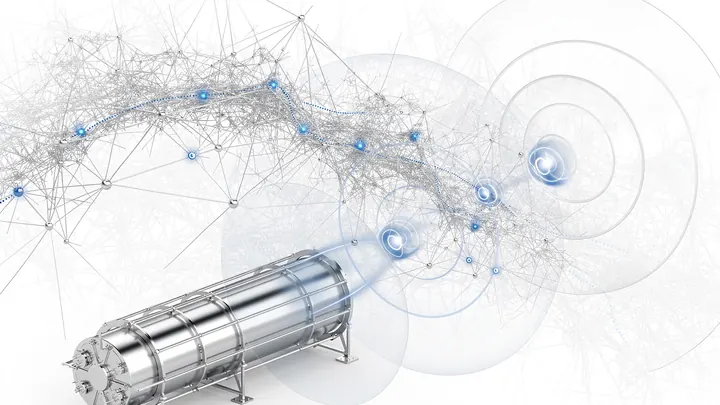
A flashlight beam cuts through fog. The denser the fog, the more the light scatters and the later it reaches your eye. A similar principle works with fast radio bursts — mysterious, super-powerful pulses from distant galaxies. As their radio waves travel through space, they interact with free electrons — particles stripped from atoms.
When a radio wave encounters a building in its path, it doesn't just reflect or get absorbed: it bends around it, much like ocean waves flowing around a rock, leaving calm water behind. In radiophysics, this phenomenon creates a radio shadow — a complex pattern of zones where the signal is amplified or attenuated, which scientists call a radio portrait.
A laser is like a tuning fork that rings at a single note. But even in complete silence, its sound trembles slightly. Previously, it was thought that this tremor, random kicks from spontaneous emission of light by atoms inside the laser, was the main limit to precision.
Dark matter leaves no trace in ordinary detectors: it passes through them like wind through gauze. To spot it, you need instruments that can feel a mosquito's punch in a storm. Quantum sensors with a threshold of a fraction of an electronvolt (a thousand times less than the energy of visible light) are just that.
In the 1930s, Fritz Zwicky first noticed that galaxies in clusters were moving too fast — something invisible was holding them. Later, Vera Rubin measured the rotation of spiral galaxies, confirming that space is permeated by dark matter.
Drop two pebbles into a pond at the same time — the ripples will spread evenly and in sync. The same happens in a quantum interferometer: a particle is split into two waves that travel along different paths and then meet. Ideally, their crests align.
The Universe is expanding, but at what speed? Astronomers have been arguing for decades about the precise value of the Hubble constant. Two classic methods give slightly different results. Now there's a third — using mysterious radio bursts.
Fast radio bursts are instantaneous radio flashes from deep space. In a thousandth of a second they release as much energy as the Sun emits in a month. One such burst, repeating, allowed scientists to peer into the epicenter of a recent stellar explosion.
The nucleus of deuterium, or the deuteron, can be pictured as a microscopic spinning top. If its charge distribution is not perfectly symmetric, then in an external electric field this top experiences a minuscule tilt of its spin axis.
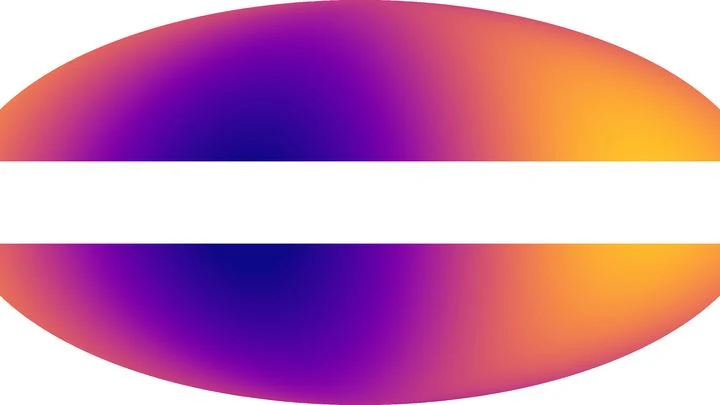
A distant radio signal travels toward us through gas, and the more gas it encounters, the more the signal is 'slowed down.' Astronomers use this to weigh the invisible envelope of our Galaxy: its halo. But if the halo is uneven, like a thick scarf draped over the shoulders, measurements in different directions will differ.
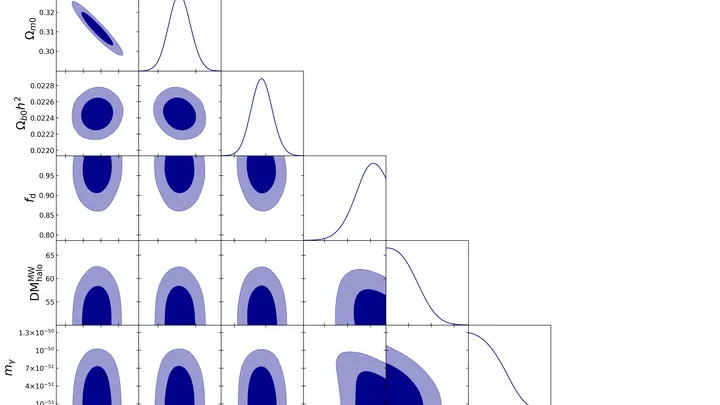
Fast radio bursts are brilliant cosmic flashes that, like a starting signal, set off a race of radio waves across the universe. Astronomers used them as a natural laboratory to test whether the photon, the quantum of light and the carrier particle of the electromagnetic interaction, has mass.