The diffusion coefficient quantifies how quickly particles or energy spread through a medium due to random motion. In the context of cosmic rays, it measures how fast charged particles like protons and electrons scatter off magnetic field irregularities in space and thereby diffuse through the interstellar or intergalactic medium. A higher coefficient means faster spreading, while a lower one means the particles remain more localized.
History
The concept of diffusion was formalized by Adolf Fick in 1855, and its application to cosmic-ray propagation was developed in the mid-20th century by physicists like Ginzburg and Syrovatskii.
How it works
Diffusion is described by Fick's law, where the particle flux is proportional to the gradient of density, with the diffusion coefficient as the proportionality constant. In cosmic-ray transport, the coefficient often depends on particle energy and the properties of the magnetic turbulence. It is typically derived from the mean free path of scattering: the longer the mean free path, the larger the diffusion coefficient. The resulting random walk leads to a Gaussian spread of particles over time, with the variance growing linearly with time.
In practice
It is essential for modeling how cosmic rays propagate through the galaxy, predicting their arrival times and spectra at Earth, and interpreting data from observatories like Fermi and IceCube.
Fun fact
In the interstellar medium, the diffusion coefficient for cosmic rays is typically about 10²⁸ cm²/s — roughly a million times larger than that of heat in copper, reflecting the vast distances between scattering events.
Units by system: SI: m2s · CGS: cm2s · Planck: l p2t p
If you push water in a narrow channel too fast, a steep wave forms and breaks into foam. In the world of ultracold atoms, cooled to near absolute zero, quantum laws prevent such a wave from breaking. Physicists took a cloud of rubidium atoms stretched into a thin thread and sharply compressed it from one end with a movable wall of light.
A fast radio burst is a short but powerful flash of radio waves from deep space. As it travels to us, the signal passes through clouds of tenuous gas, and the more gas it encounters, the more the signal is smeared across frequencies. Astronomers call this delay the dispersion measure — essentially, it's a "weighing" of all the matter along the line of sight.
A disease outbreak is like a wildfire: the fire runs through dry grass, and its speed depends on wind and humidity. But an infection has its own 'wind'—how often people infect each other. When this rate changes along with the fraction of already infected, the epidemic wave can behave differently.
Cosmic rays do not travel in straight lines. Charged particles accelerated to enormous speeds loop through the Galaxy's magnetic field like dust motes in a gust of wind. It's usually assumed that they simply scatter along and across field lines.
Interstellar space is not empty: it is filled with tenuous gas, which is warm in some places and cold in others. The boundaries between such regions resemble the walls between soap bubbles.
The Universe is expanding, but at what speed? Astronomers have been arguing for decades about the precise value of the Hubble constant. Two classic methods give slightly different results. Now there's a third — using mysterious radio bursts.
A neutron star the size of a city spins faster than a kitchen blender, flinging particles around itself. A glowing cloud forms around it — called a pulsar halo. The shape of this cloud depends on invisible magnetic fields that, like ocean currents, steer the particles.
Dust grains in the disk around a young star stick together, grow, and will eventually become planets. But to know how much planet-building material each disk holds, you need to measure its mass and size. You can't weigh a distant cloud directly: you have to infer it from the dust's radiation.
Fluid flows in the narrow gaps between brain cells. It doesn't stay still: each heartbeat pushes it forward, and breathing adds its own waves. This was seen in images ten years ago, but only now have researchers calculated how this pulsing accelerates molecules.
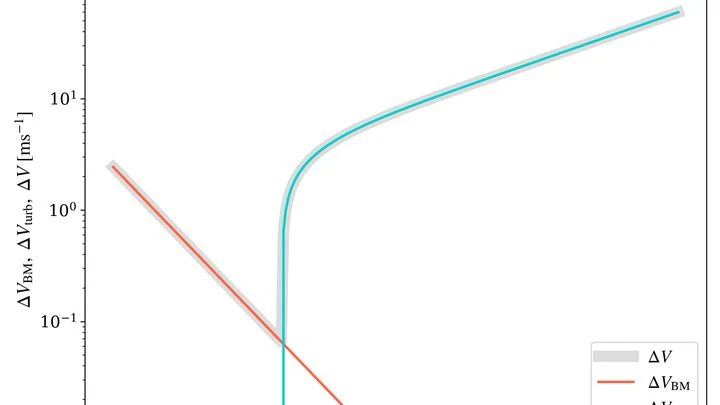
If you drop ink into a stream, it drifts with the current. But if the stream speeds up and slows down, the ink spreads wider.
Two laser beams cross at a tiny angle, and an invisible lattice appears in a cloud of rubidium atoms: some atoms are excited, others are not. Then this lattice begins to melt, like a pattern in the sand under the wind. Atoms collide with surrounding gas molecules and drift apart.
The speed of this blurring depends directly on the surrounding gas.
In the cold clouds of gas and dust where stars will one day ignite, some atoms have lost electrons and become charged. Charged particles feel the magnetic field, while neutral ones do not, so the charged ones slip through the neutral ones like water through a sieve. Astronomers have measured this drift speed: about a hundred meters per second.
The diffusion equation, a mathematical tool describing how particles spread out in space, has long painted a paradoxical picture: a disturbance, like ripples on Water, instantly engulfs the entire universe. This challenged the theory of relativity, which holds that nothing can move faster than light.
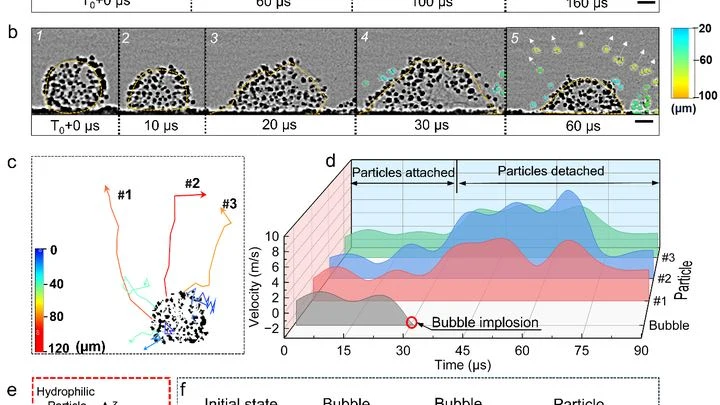
In a glass of water, ultrasound creates tiny bubbles. They grow and shrink, and sometimes they collapse sharply, like a popping soap bubble, but thousands of times faster. Near these bubbles float small particles — for example, nickel spheres the size of dust motes.
Two particles cling to each other like climbers on the same rope and fly toward a wall. When they hit, will they bounce off together, or will the rope snap? What does it depend on? Physicists considered the simplest case: everything happens on a single line, the particles attract only when they occupy the same point, and the wall is perfectly rigid.
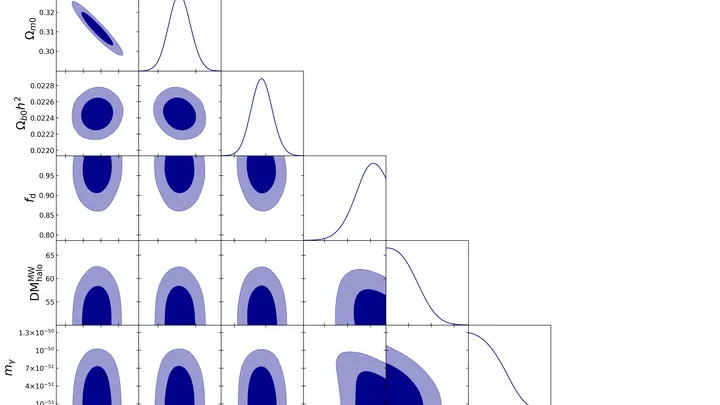
Fast radio bursts are brilliant cosmic flashes that, like a starting signal, set off a race of radio waves across the universe. Astronomers used them as a natural laboratory to test whether the photon, the quantum of light and the carrier particle of the electromagnetic interaction, has mass.