Black hole light: why its 'picture' doesn't change during eclipses ✛
Black hole in the Cygnus X-1 system is not alone: orbiting it is a blue supergiant that blows a powerful stellar wind. Sometimes this wind brings dense clumps that, like curtains, block the inner regions — and astronomers see sharp brightness dips. However, the black hole also has a corona — a tenuous but extremely hot halo extending far beyond the infalling disk. It is logical to assume that clouds can block the accretion disk, but cannot significantly affect such a huge corona. That is exactly what they decided to test using polarization.
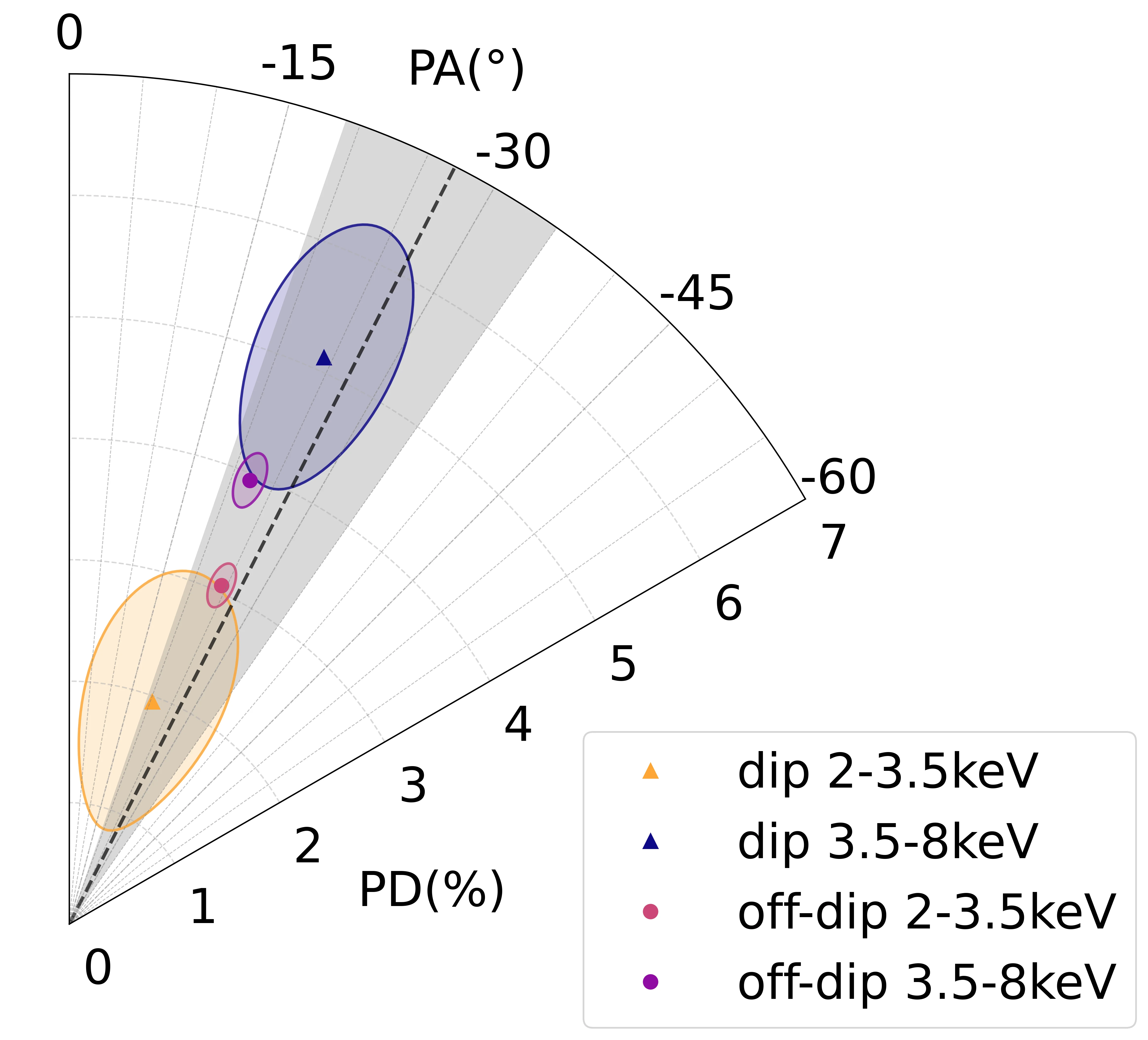
Polarization is the selection of light oscillating in one plane. Like picking out waves that go strictly up and down from a chaotically splashing sea. The space observatory IXPE measured the fraction of such 'combed' radiation and the angle at which the waves oscillate. It turned out that in the dips, both parameters are the same as in the quiet state.
Since the disk was blocked by clouds and the polarization did not disappear, it means it is born not in the disk but in the corona.
The stability of the polarization angle was the key. If the corona were like a lamp hanging over the pole, the angle would change — but it is constant. The only shape that explains the data is a flat 'slab' lying parallel to the disk. This slab is so extensive and stable that local influxes of clouds cannot shake it. Thus, the black hole in Cygnus X-1 truly wears an imperturbable corona.
The black hole in Cygnus X-1 spins at a speed exceeding 99.85% of the maximum allowed by general relativity. And its companion, a blue supergiant, is so massive that its stellar wind 'blows off' material, creating the very clouds we see as dips.