X-ray polarization refers to the tendency of X-ray waves to oscillate in a preferred direction, rather than randomly in all directions perpendicular to their travel. While the human eye cannot see this property, it carries crucial information about the physical conditions of the source that emitted the X-rays. In astrophysics, measuring X-ray polarization allows scientists to probe the geometry of magnetic fields, the structure of accretion disks, and the extreme physics near neutron stars and black holes.
History
The first detection of X-ray polarization from a cosmic source was achieved in the 1970s with the OSO-8 satellite, but the field remained dormant for decades due to the difficulty of making such measurements. The launch of the Imaging X-ray Polarimetry Explorer (IXPE) in 2021 revived the field, leading to breakthroughs such as the detection of polarization from magnetars and active galactic nuclei.
How it works
X-rays are produced by high-energy processes such as synchrotron radiation (from electrons spiraling in magnetic fields), Compton scattering, or thermal emission from hot gas. Each mechanism imprints a characteristic polarization pattern on the emitted radiation. By measuring the degree and angle of polarization with specialized detectors, astronomers can infer the orientation and strength of magnetic fields, the shape of emitting regions, and the geometry of the source. For example, if X-rays from a magnetar are polarized, it indicates that the emission is influenced by the star's intense magnetic field, possibly through quantum electrodynamic effects like vacuum birefringence.
In practice
Beyond astrophysics, X-ray polarization is used in medical imaging and materials science to enhance contrast and reveal structural details of biological tissues and crystalline materials.
Fun fact
In 2022, IXPE measured X-ray polarization from a magnetar at up to 47%, the highest ever observed, confirming that the vacuum around the neutron star behaves like a birefringent crystal due to quantum effects.
The interpreter in the meeting room hears the shift in tone before it is spoken aloud. They catch subtle changes in breathing, pauses, and intonations, and already know that in a few minutes the conversation will turn heated.
A globe sits on a table, and a ruler lies beside it: one is curved, the other straight. X-ray telescopes have lived with this mismatch for years. Their mirrors gather light onto a curved surface, like the globe, while the detectors that catch that light have been flat, like the ruler.
A sculptor shapes mountains from magnetic fields and heat, but the stone resists. A neutron star, the ultra-dense remnant of a supernova explosion, in a binary system pulls matter from its companion star. This infalling matter heats the star's crust unevenly, while the magnetic field tugs from within.
May 2022. The space polarimeter IXPE, the spectroscope NuSTAR, and the monitor NICER simultaneously stared at one spot in the sky — at the black hole in the Cygnus X-1 system, where it orbits a blue supergiant in a close binary system with a period of 5.6 days.
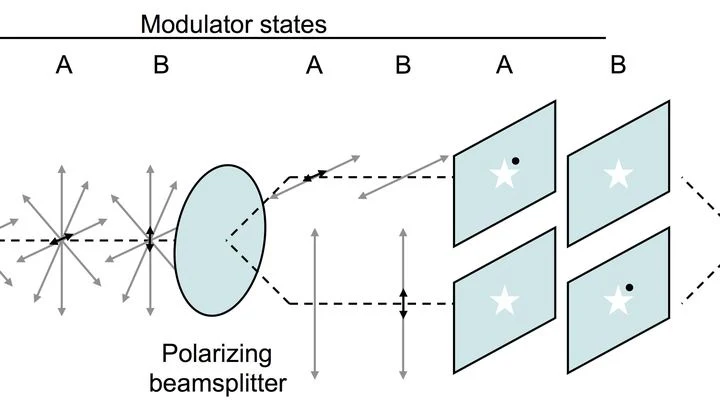
An ordinary flashlight emits light whose waves oscillate in all directions at once. But pass that light through a special filter, and you get a beam that oscillates strictly in one plane: that's polarized light. When such a beam travels through biological tissue, the tissue's internal structure slightly alters the orientation of the oscillations.
Night on La Palma. The 4.2-meter William Herschel Telescope is aimed at Venus. At the focus is the experimental polarimeter ExPo, designed to catch the ghostly light of exoplanets.
A waterfall that doesn't heat up from the fall but freezes — that's roughly how gas behaves as it flows onto a neutron star in an X-ray pulsar when the star shines dimly. Usually, infalling matter is heated to a white-hot glow, but new work shows the opposite.
In a close binary system, the hot star, like a searchlight, illuminates its cooler companion. Some of the light scatters off free electrons in its atmosphere — this is Thomson scattering — and acquires linear polarization. As the stars orbit each other, this polarization rotates, like the hand of a peculiar cosmic metronome.
Two sensitive microphones are listening to the Universe. One hears a low hum, the other hears almost nothing. It's not a malfunction: it's about how they are oriented.
Gravitational-wave observatories like LIGO don't just catch loud bursts from black hole mergers.
An ordinary microscope is powerless when you need to examine a single virus in detail. It's too small. But there's a tool that fires flashes billions of times brighter than sunlight — an X-ray free-electron laser. It's designed to 'photograph' a particle before the beam vaporizes it.
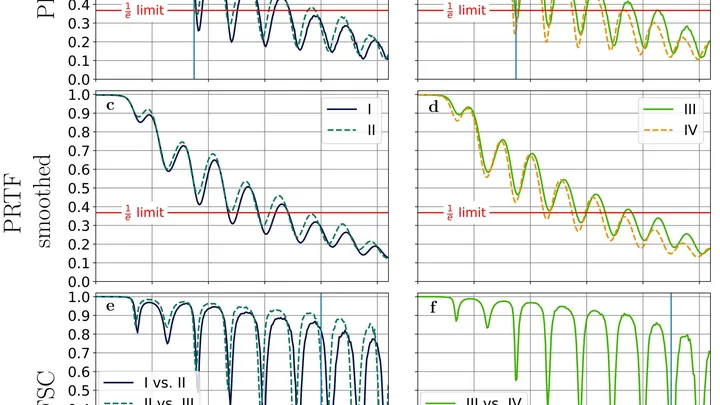
X-ray detectors work like honeycombs: particles flash here and there in hexagonal cells. Conventional algorithms stretch these combs onto a square grid, creating ghostly polarization artifacts. Scientists used a neural network that lives by the rules of the hive — it processes the hexagonal structure directly, preserving the natural pattern.
A pebble drops into a pond, and ripples spread across the water. But one wave suddenly doesn't spread out: it clings to an invisible fold on the surface and runs only along it.
A spinning top whirling so fast that it forces light around it into spirals: that's a fitting image for what happens near a black hole's horizon. Hot plasma falls in and emits radio waves. Their polarization (the plane in which the wave oscillates) becomes an arrow pointing in the direction of energy flow.
Red giants are swollen, aging stars. Deep inside, an ocean of plasma churns: heat forces its way from the core to the surface, generating waves like a mighty surf. The star's magnetic field acts like an invisible seabed – it steers these waves, changing their height and speed.
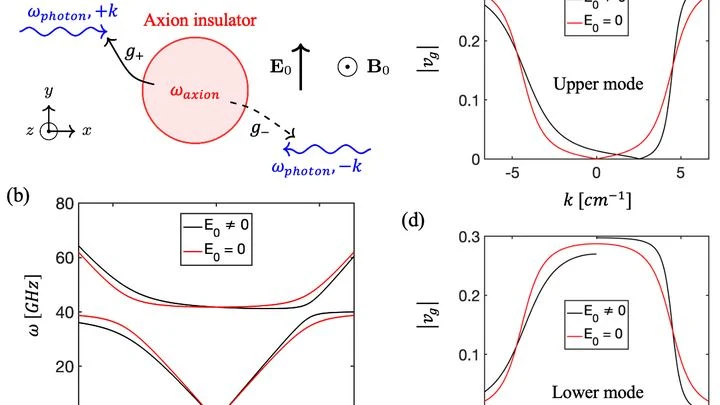
A regular flashlight shines equally forward and backward. But in magnetic crystals, a axion appears — a ghostly excitation, like a wave going around a stadium: atoms pass a magnetic impulse to each other. When light meets an axion, a hybrid forms, whose fate depends on electric and magnetic fields.
Gravitational waves are the trembling of spacetime itself. Usually we only catch their overall hum, but each wave also has a direction of oscillation – polarization. Old maps were built only from signal loudness, which led to errors. It's like trying to see the bottom of a pond through sun glare.
Tiny invisible bullets pass straight through the Sun, barely noticing its matter. These are axions — hypothetical particles so light and elusive that they are often compared to ghosts.
Around an invisible fire, glowing gas swirls. The fire itself is hidden, but its outline can be guessed from the way the flames dance. That's roughly how astronomers 'see' black holes — not the object itself, but the superheated matter that, before plunging into the abyss, accelerates to enormous speeds and shines.
Radio waves from a gamma-ray burst — the cataclysmic death of a massive star whose flash briefly outshines an entire galaxy — reach Earth polarized. This means their electric field oscillates predominantly in a single plane, like a compass needle frozen in a magnetic field.
A pair of figure skaters spins while holding hands. If their path is a perfect circle, each push from a partner is predictable. But stretch that path into an oval, and the effort becomes uneven: a jerk as they come together, a lull as they pull apart. Something similar happens with two black holes in the final minutes before they merge.
When matter is heated to millions of degrees, it turns into plasma — a mix of free electrons and ions, like a boiling soup of charged particles. You can't measure the temperature of such a 'soup' with an ordinary thermometer, but you can shine X-rays through it.
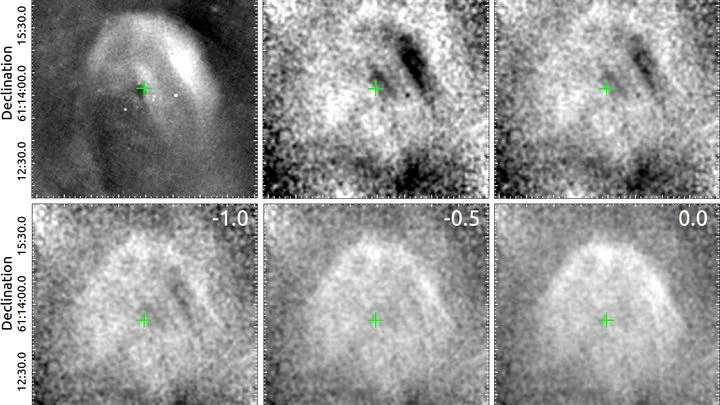
Deep in space, a rapidly spinning neutron star, a pulsar nicknamed the Lighthouse, speeds through tenuous gas. Like a motorboat cutting through water, it leaves a glowing trail of charged particles behind. In X-rays, this trail appears as a bright tail and a thin filament stretching over many light-years.
A galaxy is like a glowing pancake studded with stars. If you look at it face-on, you see everything at once — both the bright spiral arms and the dark dust lanes. But tilt the pancake, and the picture changes: layers overlap, light blends together. This very effect, it turns out, creates the illusion of a tight link between radio and gamma-ray emission in distant star systems.
The neutron star 4U 1735-44 is gobbling up matter from a companion star. The matter spirals into a flat disk, like water going down a bathtub drain. But this disk shines in X-rays, and astronomers have for the first time measured how "combed" those rays are: that is, how polarized.
Neutron stars are the compressed cores of dead stars — city-sized objects with staggering density. Some of these stars become pulsars, cosmic lighthouses emitting strictly periodic radiation pulses.
A pot of boiling water sits on the stove: the higher the heat, the hotter the water and the more steam escapes. Hot gas in galaxy clusters behaves much the same way. But in small galaxy groups, this "steam" leaks out faster than you'd expect from the temperature alone.
Fibers in composites, paper, or biological tissues are often hidden from view, but their orientation determines the strength and properties of the material. Previously, to see fiber directions, you had to take many images at different angles and assemble a three-dimensional picture, like slicing a loaf of bread into thin pieces. For thin samples, this approach doesn't work: you can't slice what isn't thick enough.
Laser light is like a perfectly aligned row of soldiers on parade: all waves oscillate in the same plane. Such light is called polarized. In a new study, physicists have for the first time produced polarized gamma rays by colliding electrons with a powerful laser pulse.
A giant cosmic funnel sucks in gas from its surroundings. But not all of that gas falls in — some is spat back out, like splashes from boiling water. That's exactly what the ultraluminous X-ray source NGC 5204 X-1 does: a compact object (likely a black hole) feeds so voraciously that the excess escapes in powerful jets.
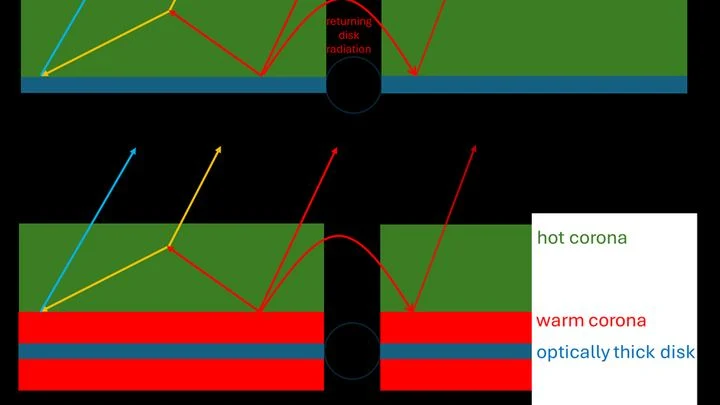
The black hole Cygnus X-1 is one of the most studied in our galaxy. It pairs with a normal star, pulling matter from it. The gas spirals into a glowing disk, like water down a drain, and above the disk hangs a scorching corona — a cloud of electrons at temperatures of hundreds of millions of degrees.
A neutron star the size of a city spins thirty times per second. Its magnetic field is trillions of times stronger than Earth's. Such conditions could spawn a cloud of axions around the star — light particles that no detector has caught yet, but which neatly explain the hidden mass of the Universe.
A neutron star is a city the size of a metropolis squeezed into a small asteroid. Around it, plasma, a gas of charged particles, seethes, and waves ripple through it like ripples on a pond. There are three kinds of waves: Alfvén (A), ordinary (O), and extraordinary (X).
If you hold an iron nail near a magnet, it will be attracted. Inside the magnet, tiny atomic magnetic arrows point in the same direction, like soldiers in formation. But in some crystals, the formation is different: neighboring arrows point in opposite directions. This order is called altermagnetism, and it is hard to see directly.
The Sun is not a calm sphere. Waves constantly ripple through its interior, like a bell after being struck. These oscillations reach the surface and reveal what's happening on the far, invisible side. Astronomers have long been able to 'listen' to this ringing and find large sunspot groups there.
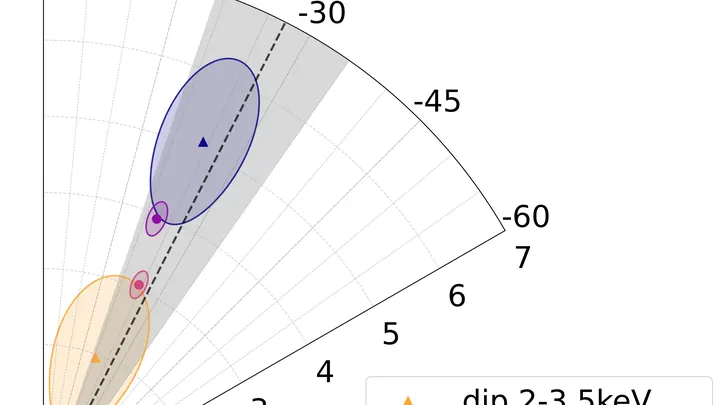
The X-ray pulsar Centaurus X-3 is a neutron star that spins rapidly and emits pulses of X-ray light like a lighthouse. Scientists pointed three space telescopes at it and studied the polarization of its emission — how the electric field of the light wave oscillates.
The black hole GS 1354-64 in the constellation Musca woke up in 2025 and began greedily pulling matter from its companion star. The orbiting X-ray telescope IXPE caught it at a rare moment: the outburst had already subsided, but the system had not yet settled down.
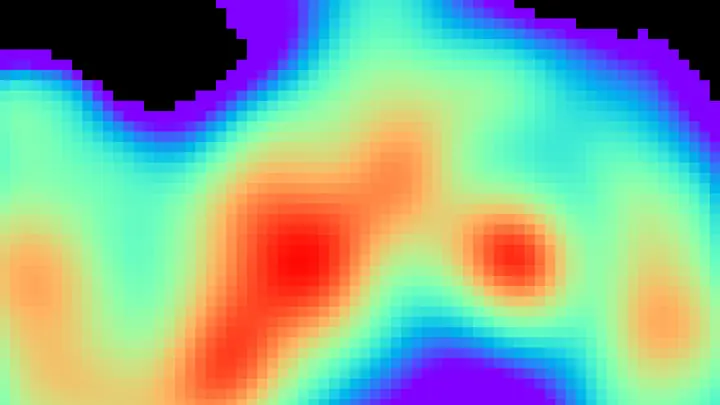
The VLA radio telescope peered into the Boomerang Nebula — a cloud inflated by the wind from a rapidly spinning neutron star. The new images reveal details as small as a lunar disk on the sky: an elongated core around the pulsar and a long arc curving around it from the north.
In the dark cloud L43, where stars are born, dust grains twirl like tiny compasses. Light from a young star pushes them, while the magnetic field lines them up in a specific direction. When a grain is turned sideways to us, its heat reaches us polarized, like light passing through a narrow slit.
Light from the star HD 163296 passes through the surrounding gas-and-dust disk like a flashlight beam through murky water. The disk's particles scatter the light, giving it a special property — polarization: the waves begin to oscillate in a single plane, like a rope shaken strictly up and down.