Imperturbable Corona: How Polarization Revealed the Black Hole's Stable Geometry ✛
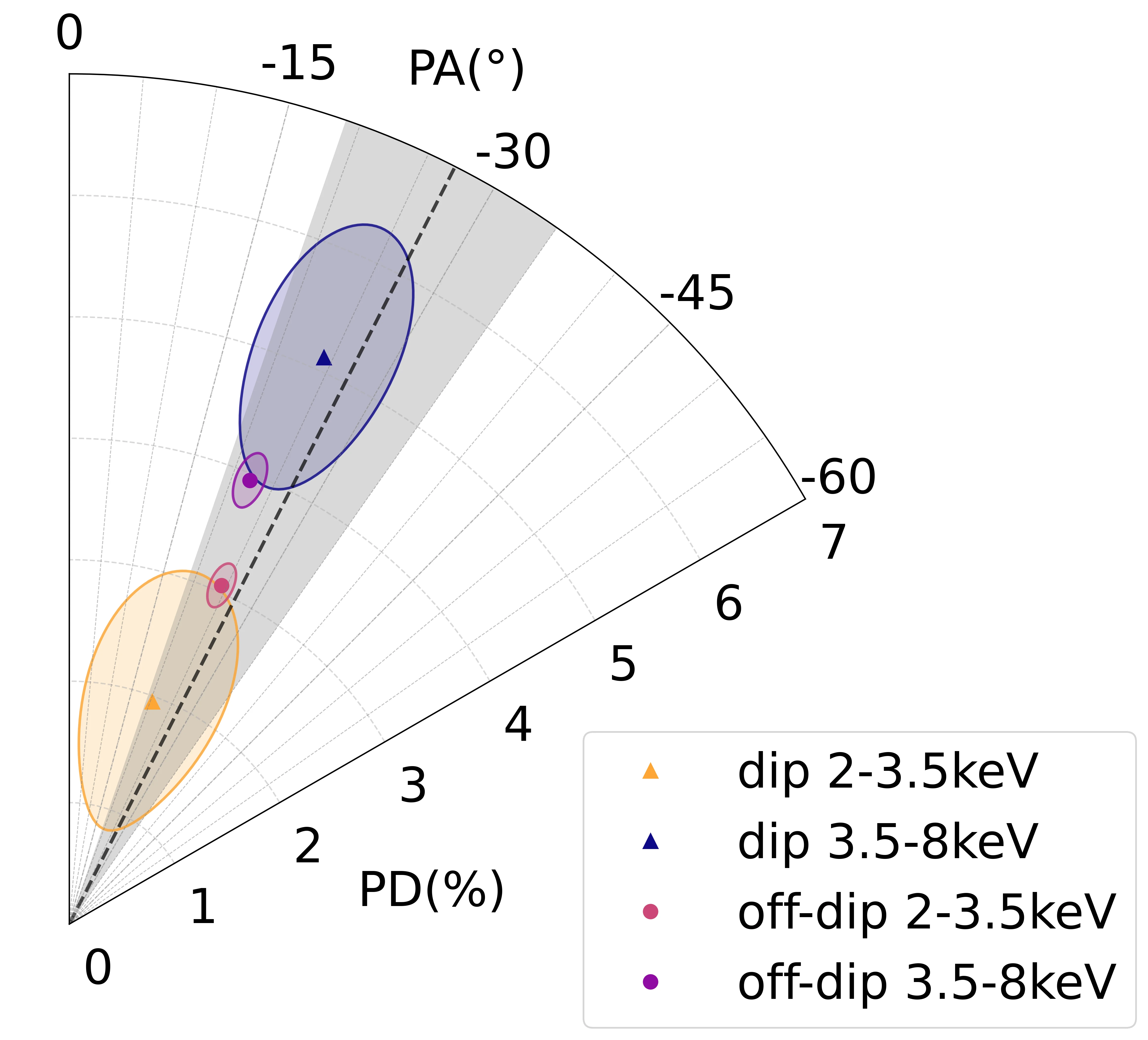
May 2022. The space polarimeter IXPE, the spectroscope NuSTAR, and the monitor NICER simultaneously stared at one spot in the sky — at the black hole in the Cygnus X-1 system, where it orbits a blue supergiant in a close binary system with a period of 5.6 days. Hours passed, photons accumulated, but every now and then the flux would drop sharply. As if someone were blocking the light with a shutter. In reality, these were dips — brief eclipses by stellar wind clouds. Yet the corona itself, spread around the black hole, remained unscathed.
A dip is like a cloud on a sunny day: the landscape dims, but the Sun itself shines unchanged. In the X-ray spectra, hard rays remained at the same level, while soft ones, born in the accretion disk, disappeared. The model showed: cold clumps with a high covering fraction obscure the disk itself. The corona, whose temperature is tens of times higher, is no obstacle for them — too hot and vast. It extends for hundreds of thousands of kilometers, like an invisible halo.
Polarimetry added the key clue. The degree of polarization (the fraction of photons 'combed' in one direction) outside dips was 3.8%±0.3%, and during dips about 5%, within errors. The polarization angle (direction of oscillations) was frozen at about –26°. It coincided with the direction of the radio jet — a relativistic jet emerging from the system's poles. The clouds, it turned out, cannot shift this pattern.
Joint fitting of spectra and polarization unambiguously pointed to the corona's geometry. If the polarized emission came from the disk, the pattern would change during dips. But the data required only one reasonable scenario: light is polarized in a compact but extended corona shaped like a flattened 'slab' (the Sunyaev and Shakura model). The scenario of a lamp-post corona elongated along the jet was ruled out — it would give a different angle. The stability of the angle during eclipses means that the global structure of the corona is not distorted by infalling clumps.
This discovery connects the corona and the jet. If the magnetic field at the base of the jet is anchored in the same slab, then any local perturbations cannot shake it. Essentially, we see evidence of remarkable magnetic stability that fuels relativistic outflows.
Those very May and June nights of 2022 provided the key. When three observatories simultaneously watched the flickering of Cygnus X-1, they captured not just dips in brightness — they witnessed the immutability of the corona. The stellar wind clouds proved powerless before this giant luminous slab. The imperturbable corona continues to shine, whatever phase the system goes through.
The black hole in Cygnus X-1 spins at a speed exceeding 99.85% of the maximum allowed by general relativity. And its companion, a blue supergiant, is so massive that its stellar wind 'blows off' material, creating the very clouds we see as dips.