The Unflappable Corona: Stable Polarization During Brightness Dips in Cygnus X-1 ✛
Context
Cygnus X-1 is a black hole of 21 solar masses, orbiting a stellar evolution in a binary star with a period of 5.6 days. Since its discovery, it has served as a benchmark for studying Accretion disk onto compact objects. However, classical spectroscopy and timing analysis could not unambiguously determine the geometry of the X-ray radiation corona—the tenuous hot cloud where low-energy photons are boosted to hard radiation. Models boiled down to two extremes: a lightweight 'lamp' above the poles or a massive 'slab' lying parallel to the disk. With the launch of the IXPE polarimeter, an instrument capable of distinguishing these scenarios arrived: polarization degree and its angle are tightly linked to the shape of the emitting region. But how to disentangle the corona's contribution? Dips provided the clue—sudden brightness drops when dense clouds of material cross the line of sight.
Methods
For the analysis, two observing campaigns of Cygnus X-1 in May and June 2022 were selected, when all three observatories were simultaneously active. From the total X-ray photon flux, time intervals of dips (hardness increased, count rate dropped) and outside dips were extracted. Broadband spectra (0.5–79 keV) were jointly fitted with a model that included thermal emission from a standard Sunyaev–Shakura disk, Comptonization in the corona, relativistic and non-relativistic reflection, as well as absorption in the interstellar medium and additional partial covering by cold clumps. For polarization, the pcube algorithm was used in the 2–8 keV band; then a joint spectro-polarimetric fit was performed with fixed spectral parameters.
Results
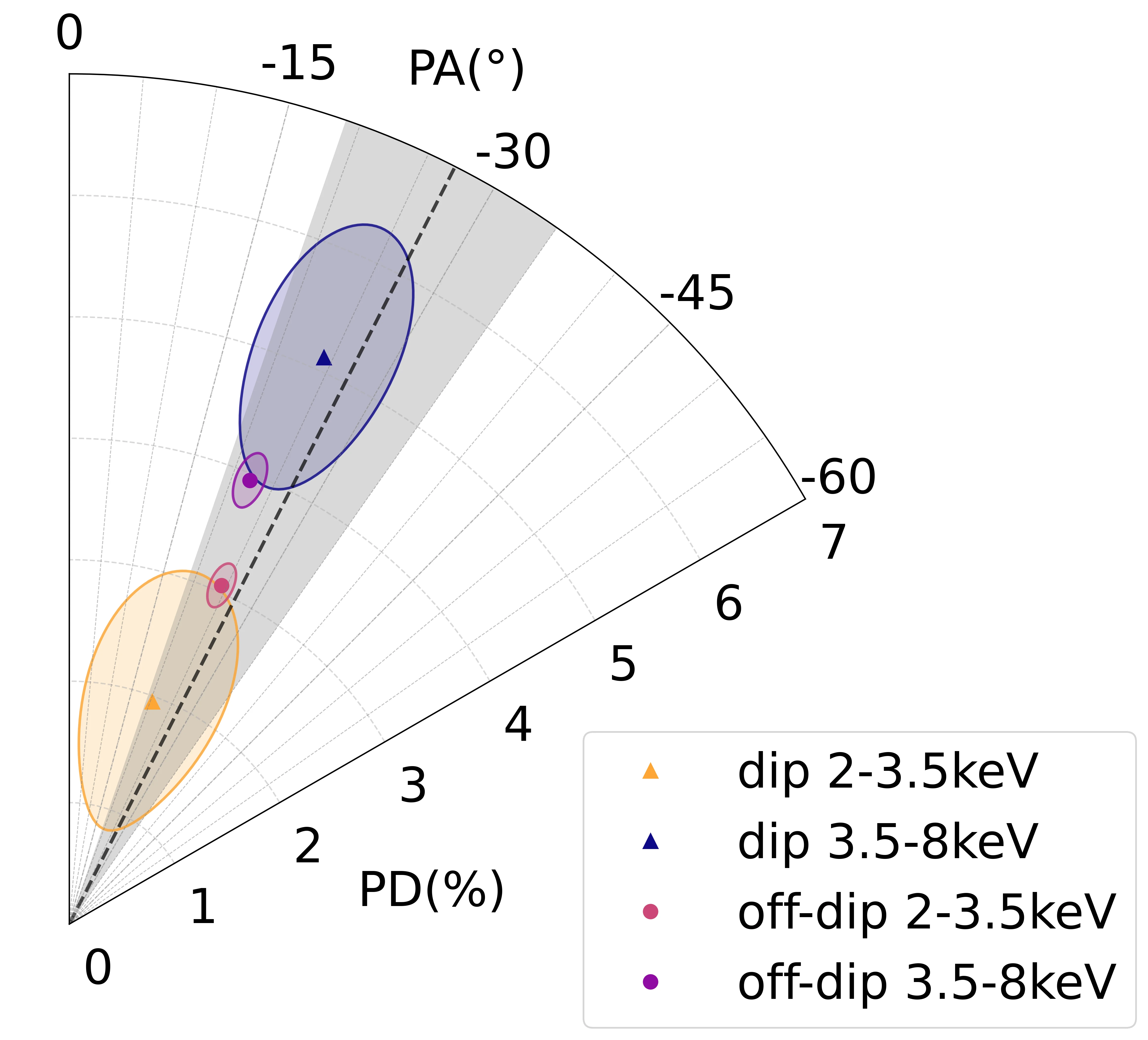
The spectral model confirmed that soft X-ray absorption is enhanced during dips: a high covering fraction (~0.7) column of material almost entirely removes the accretion disk's contribution below 3 keV, while the hard component remains unchanged. This matches the picture where cold clouds block direct rays but do not touch the extended corona. Polarization measurements showed astonishing stability. Outside dips, the polarization degree in the 2–8 keV band was 3.8%±0.3%; during dips, it was 5%±4%—both values agree within errors. The polarization angle remained around −26° and aligned with the direction of the jet, known from independent observations. Even when splitting into energy sub-bands, no significant difference between dip and non-dip emerged. Detailed spectro-polarimetric decomposition into components showed that attributing noticeable polarization to the disk leads to unphysical values. The only reasonable scenario: polarization arises in a compact yet very extended corona, and local clouds do not distort its global geometry.
Implications
This result strengthens the model in which, during the hard state of black holes, polarized emission comes not from the accretion disk itself but from its corona, which has the shape of a flattened 'slab.' The constancy of the polarization angle during eclipses rules out lamp-post corona scenarios stretched along the jet axis. This imposes important constraints on the physics of accretion and launching of relativistic jets: if the corona and jet are tightly linked, then polarization stability points to a steady magnetic structure at the jet base, unperturbed by infalling clumps.
Future development
The next generation of X-ray polarimeters, such as the planned eXTP, will be able to study short dips (under an hour) and other accreting systems with much greater sensitivity. Long-term monitoring of Cygnus X-1 at different orbital phases will allow building a three-dimensional map of polarization distribution and finally solving the mystery of the corona's shape.
Impact
The result directly impacts models of accretion and jet generation in X-ray binaries and may be extended to active galactic nuclei, where supermassive black holes exhibit similar spectral and polarization behavior.
Next steps
Expand the sample of dip events from other black holes, such as the source IGR J17091-3624, and conduct high-precision polarimetric observations over a broader energy range to test the universality of the discovered pattern.
Key open problems
This work directly connects to unsolved questions: What is the true geometry of the accretion flow near the event horizon? Why does the polarization angle remain constant when transitioning between spectral states? And how exactly do magnetic fields shape jets? The discovered insensitivity of the corona to local eclipses provides a key clue to understanding the stability of these structures.
The knowledge machine's view
This section is addressed to the author of the paper and their colleagues. Neighbouring works were found by meaning-based search across our archive, not by word overlap. We do not review: we show the field around the work.
What the work does
The study examines the polarization of X-ray emission from Cygnus X-1 during dips and outside them, using data from IXPE, NICER, and NuSTAR. Joint spectro-polarimetric fitting showed that the degree and angle of polarization remain stable, and the main source of polarized emission is an extended corona whose geometry is not perturbed by local clouds.
Where its strength is
The polarization characteristics are shown to be independent of variable absorption, allowing a reliable separation of the coronal contribution from the disk and enabling polarization to serve as a direct indicator of the geometry of the hard X-ray source in accreting systems.
Where it could go next
- It may be interesting to compare the stable polarization of the Cygnus X-1 corona with the polarization properties of coronae in other states or objects—our archive contains a discussion of disagreements over corona geometry based on IXPE data for different X-ray binaries.based on: A Clash Over the Corona arXiv:2606.15406
- Nearby lies a study analyzing how a black hole separates light by polarization depending on energy; this could help interpret the energy dependence of polarization in Cygnus X-1 over a broader range.based on: How a Black Hole Splits Light by Polarization arXiv:2511.22276
- Since the polarization direction aligns with the jet axis, it is worth exploring the connection with wind and jet variability—the archive includes a paper on wind gusts around a black hole, discussing the interaction between the accretion flow and outflows.based on: Gusts of Wind Around a Black Hole arXiv:2605.22918
Worth trying
- Test whether polarization stability persists in other phases of the orbital period and at different hardness levels.
- Apply the spectro-polarimetric decomposition method to other X-ray binaries with dips to determine how universal the extended corona model is.
- Combine polarization data with radio jet maps to refine the three-dimensional orientation of the system.
Why this may matter
The stability of polarization during dips provides a new observational benchmark for accretion models: the corona appears to be a large-scale structure not tied to the inner parts of the disk, which is important for understanding the formation of hard radiation and the launching of jets in stellar-mass black holes.
Nearby works in our archive
- A Neutron Star Dances on the Edgesimilarity 0.65
- Gusts of Wind Around a Black Holesimilarity 0.62
- Echoes from a Black Hole's Dinnersimilarity 0.62
- A Hidden Black Hole Lurks After a Cosmic Mealsimilarity 0.61
- Cosmic Hot Tap: How Primordial Black Holes Rewrite the Speed of the Universesimilarity 0.61
- A Clash Over the Coronasimilarity 0.60
- How a Black Hole Splits Light by Polarizationsimilarity 0.59
The closest work in the archive sits at 0.65 by meaning — the usual level for our corpus.
Original abstract
as written by the authors arXiv:2607.26144v1
Cygnus X-1 serves as a foundational benchmark for studying accretion mechanisms in stellar-mass black hole X-ray binaries. While traditional X-ray timing and spectroscopy have mapped its bimodal state transitions, constraining the exact geometric configuration of its accreting plasma requires additional tools. In this letter, we present a joint spectro-polarimetric analysis of Cygnus X-1 during flux-decrease events, or ``dips'', observed in its low hard state using simultaneous data from IXPE, NICER, and NuSTAR. The broadband spectral model reveals that the energy-dependent flux reduction during these dips is best described by a partial-covering absorption model, heavily impacting the softer energy bands. This absorption is consistent with obscuration by dense, cold clumps originating from the companion's stellar wind or the outer accretion disk during superior conjunction. Notably, our polarimetric analysis demonstrates that despite significant flux drops, the polarization degree and polarization angle in the 2-8 keV band remain largely consistent between dip and off-dip intervals. The stability of the polarization signature during these highly absorbed periods indicates that the obscured thermal disk emission does not significantly contribute to the total polarization. Ultimately, these results strongly support a scenario where the X-ray polarization originates from an extended, likely oblate, accretion-disk corona whose large scale renders its overall geometry unaffected by localized clumping.
The black hole in Cygnus X-1 spins at a speed exceeding 99.85% of the maximum allowed by general relativity. And its companion, a blue supergiant, is so massive that its stellar wind 'blows off' material, creating the very clouds we see as dips.
Key numbers
- X-ray flux drop during dip: up to 40%
- Polarization degree (outside dips): 3.8%
- Polarization angle: –26°
- Black hole mass: 21 M⊙
- Distance: 2.2 kpc