The Cosmic Web on a Neural Leash express
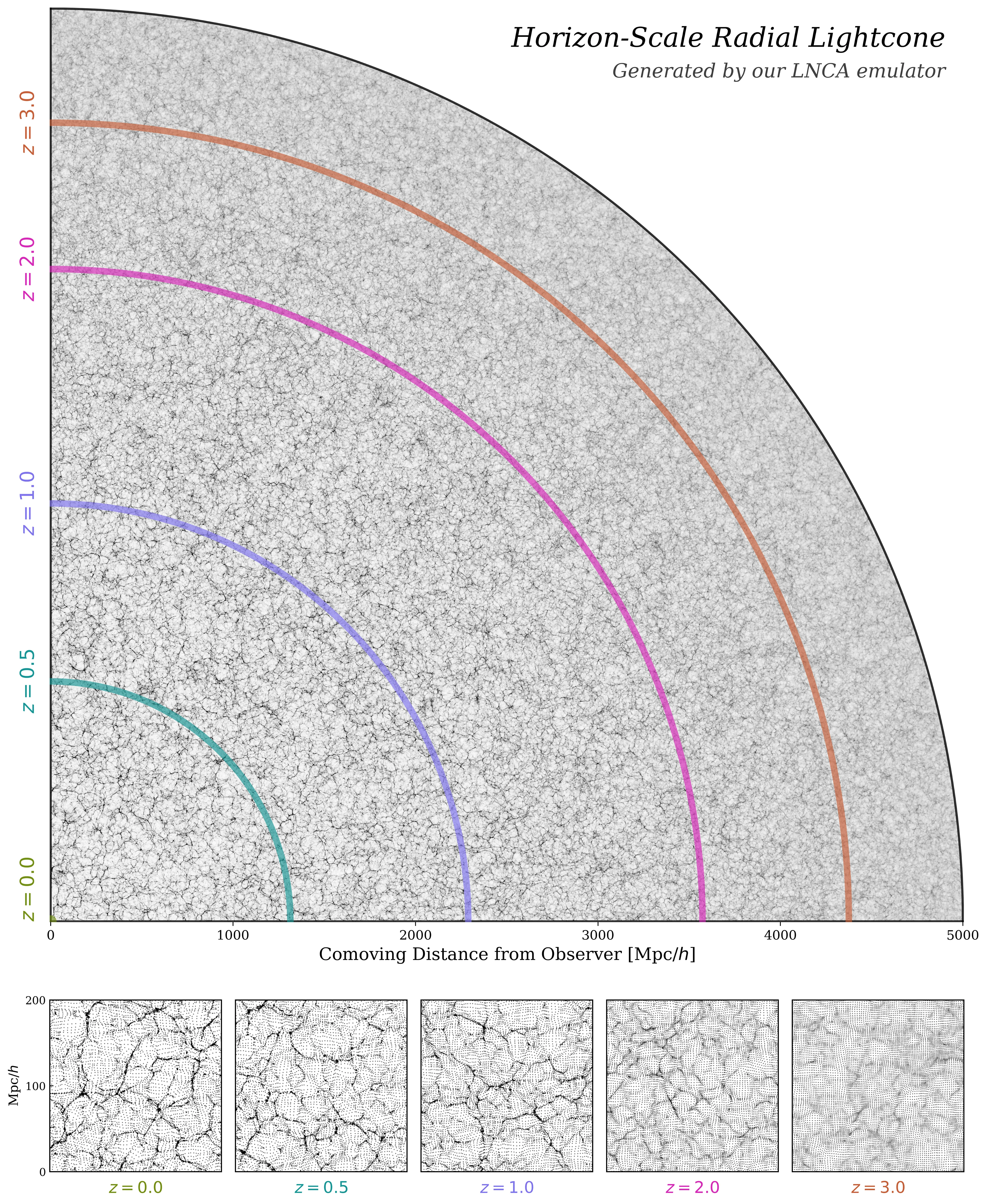
In a dark room, music plays. Powder is scattered on the floor — fine, almost invisible. Low frequencies make it gather into intricate patterns: filaments, clumps, voids. In much the same way, gravity over billions of years weaves galaxies into the cosmic web — except here, attraction does the work instead of sound waves. To figure out what 'melody' it all started with, you need to rewind time: from the finished pattern back to the initial handful of powder. That is the task of reconstructing the initial conditions of the Universe.
Ordinary computer simulations are too heavy for such a journey backward. They honestly compute every gravitational nudge, but a single iteration can take hours. Approximate methods are faster, yet they cut corners — losing the very lace-like dynamics where halos are born. The authors propose a compromise: a cellular automaton with a neural network brain. The model LNCA (Lagrangian Neural Cellular Automaton) tracks not a fixed density grid but the matter particles themselves, moving along with them. It learns only to correct a rough but physically meaningful guess — the Zel'dovich approximation. On top of this foundation, the model adds careful residual displacements. This preserves accuracy on large scales, while training fills in the fine details.
The secret to this economy lies in locality. Each automaton cell updates its state by looking only at its nearest neighbors, and it does so step by step. The result is not just a final snapshot but the entire history of motion, like a frame-by-frame recording of a dance of dust particles. The rules of this dance rotate and shift with the matter: the architecture is rotationally and translationally equivariant. The final accuracy is impressive. Up to scales of about 12 megaparsecs (roughly 40 million light-years), the model errs by no more than a few percent. This provides a reliable pendulum for reversing time — from the modern web back to the nearly uniform beginning.
The Zel'dovich approximation, which the model takes as its foundation, was devised in 1970 to describe the growth of perturbations in an expanding universe. It has proven so successful that it still serves as the 'zeroth-order approximation' in many cosmological calculations.
In the novel 'The End of Eternity,' Isaac Asimov describes an organization that corrects history by calculating the consequences of the slightest changes. LNCA is a step toward such a 'reality computer,' capable of reconstructing initial conditions from the current pattern of galaxies.