process

cosmic structure formation

Process by which gravitational collapse of matter forms galaxies and larger structures.
30 related articles

Description

Cosmic structure formation is the process by which the initially nearly uniform matter in the early universe evolved into the rich hierarchy of structures we observe today: stars, galaxies, galaxy clusters, and the vast cosmic web of filaments and voids. It begins with tiny density fluctuations imprinted in the primordial plasma, which are amplified by gravity over billions of years. Dark matter plays a crucial role, providing the gravitational scaffolding that attracts ordinary matter, which then cools and collapses to form luminous objects.

History

The modern theory was developed in the 1960s and 1970s, with key contributions from Yakov Zeldovich, Jim Peebles, and others, building on earlier ideas from the 1940s by George Gamow and collaborators.

How it works

The mechanism is gravitational instability. Regions with slightly higher density exert a stronger gravitational pull, attracting surrounding matter and becoming even denser. This runaway growth continues until pressure, radiation, or angular momentum halts collapse at various scales. Dark matter, which interacts only gravitationally, collapses into halos first; ordinary gas then falls into these halos, shocks, cools, and forms stars and galaxies. On large scales, the distribution of matter is shaped by the expansion of the universe, producing a web-like pattern of filaments and nodes.

In practice

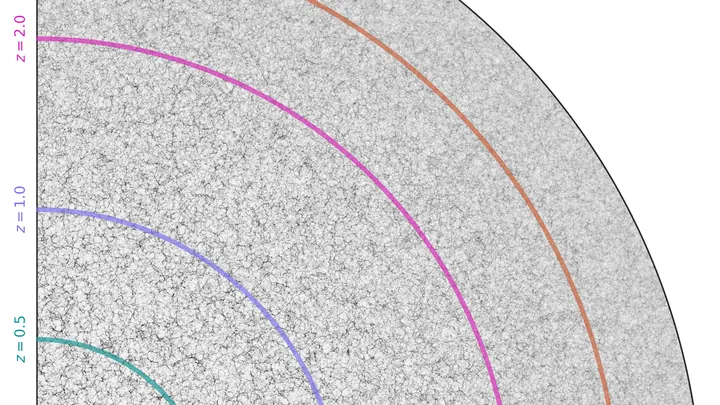
Cosmological simulations of structure formation are used to interpret galaxy surveys and cosmic microwave background observations, constraining the nature of dark matter and dark energy.

Fun fact

The largest structures in the universe, such as galaxy filaments, are so massive that they are still collapsing today, even though the universe's overall expansion is accelerating.

Concept graph →

Related articles · 30

HEP Phenomenology2026-08-062 minarXiv:2608.05538express
Dark Matter from Thermal Noise
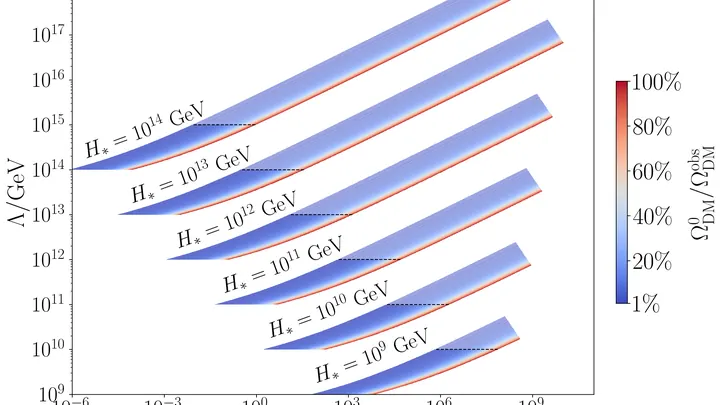
In the first moments after the Big Bang, the universe resembled a boiling cauldron. According to one hypothesis, dark matter, the invisible substance that holds galaxies together, could have been born there.
Cosmology2026-08-051 minarXiv:2608.04694express
The Cosmic Web: Fractals in the Architecture of the Universe
The night sky looks like a random scattering of stars. But zoom out to enormous distances, and the chaos disappears. Galaxies gather into long filaments and flat walls, with colossal voids gaping between them — cosmic voids. This structure is called the cosmic web.
Cosmology2026-07-302 minarXiv:2607.28326express
Three Faces of the Cosmos: Geometry, Growth, and the Beginning
The standard cosmological model ΛCDM (which includes dark energy and cold dark matter) is the score of a cosmic symphony. It describes how space expanded after the big bang. How dark matter clumped together. How galaxies ignited. For a long time, everything played flawlessly.
Instrumentation2026-07-292 minarXiv:2607.27320express
The Cosmic Web on a Neural Leash
In a dark room, music plays. Powder is scattered on the floor — fine, almost invisible. Low frequencies make it gather into intricate patterns: filaments, clumps, voids. In much the same way, gravity over billions of years weaves galaxies into the cosmic web — except here, attraction does the work instead of sound waves.
Cosmology2026-07-292 minarXiv:2607.27515
Dark-Sector Seesaw: How a Scalar Spring Solves Cosmological Puzzles
In 1929, Edwin Hubble pointed his telescope at distant galaxies and discovered they were receding. Ninety years later, two measurements of this recession rate, from ancient light and from nearby stars, stubbornly disagree. A 9% discrepancy cannot be chalked up to error. It is as if the Universe in its youth and in its maturity runs on different clocks.
Cosmology2026-07-203 minarXiv:2607.18025
Triple Thread: How Vector Dark Matter Gives Birth to Invisible Stars
Three invisible strings oscillate in the intergalactic void. This is not poetry, but a hypothesis about the nature of dark matter — an ultralight quantum field with spin 1, carrying three polarizations.
Cosmology2026-07-123 minarXiv:2607.10607
General Relativity2026-07-031 minarXiv:2607.03272express
How Friction Gives Birth to Dark Energy
In the first moments of the universe's life, there was not even a hint of dark energy — the very force that today pushes galaxies apart ever faster. But if you look deeper, down to the Planck scale (billions upon billions of times smaller than an atomic nucleus), spacetime ceases to be smooth.
Cosmic Molasses: How Viscosity Changes the Rules of Primordial Black Hole Birth
In the search for the nature of dark matter, one of the most intriguing hypotheses traces back to the first moments after the Big Bang. Back then, quantum fluctuations of the inflation field gave rise to clumps of matter that could collapse into primordial black holes.
Cosmology2026-06-254 minarXiv:2606.27290
Universal Amber: How Petrified Darkness Accelerates the Cosmos
The story began with a missing mass. In the 1930s, Fritz Zwicky, measuring velocities in galaxy clusters, first suspected the presence of invisible matter. Later, Vera Rubin showed that the outskirts of spiral galaxies rotate too fast for the visible matter.
General Relativity2026-06-222 minarXiv:2606.23418express
Dark Matter from Twisted Space
The early universe was a restless place. Space trembled with gravitational waves — ripples in the very fabric of reality. In this churning cauldron, dark matter is thought to have been born. But the newborn particles had no mass: it had to come from somewhere. Usually, the Higgs field is responsible for mass.
General Relativity2026-06-221 minarXiv:2606.23447express
Gravitational Waves Sculpt Dark Matter
Spacetime is not empty: it shivers. After the Big Bang, the universe was filled with a hum of gravitational waves, like the low rumble of a giant bell. In this ripple, as it turns out, particles of dark matter, the invisible substance that holds galaxies together, can be born. But the previous idea had a snag.
General Relativity2026-06-222 minarXiv:2606.23846express
Black Holes from the Universe's Infancy
It all began not with emptiness, but with a boiling ocean of plasma. In that primordial broth, sound waves raced through the fiery matter, colliding and compressing it. Sometimes a clump grew so dense that light could no longer escape, and right out of the scorching gas, a primordial black hole was born.
Galaxies2026-06-112 minarXiv:2606.12909express
Dark Matter Clumps into Dense Cores
A giant cloud of invisible matter acts like a funhouse mirror — distorting the light from a distant galaxy. From these distortions, astronomers can weigh the cloud and peer into its depths.
Cosmology2026-05-302 minarXiv:2606.00803express
How to See the Invisible Web of the Cosmos
Through the ripples on the water, pebbles at the bottom of a pool look shifted and warped. In a similar way, the gravity of invisible dark matter bends the light of distant galaxies — a phenomenon known as weak lensing.
Cosmology2026-05-273 minarXiv:2605.28797express
Cosmic Friction: How Disorder Fixes the Universe
A blacksmith forges a sword. With each hammer blow, the red-hot metal flattens, but the hammer, the anvil, and the surrounding air all warm up slightly. Part of the impact energy is irreversibly lost as heat — a trade-off familiar to anyone who has ever driven a nail, and it turns out to be the key to the biggest mysteries of the cosmos.
Mesoscale2026-05-102 minarXiv:2605.09488express
Dark Excitons: A Quantum Trickle in a Chip
In a thin sandwich of semiconductors, light creates pairs, an electron and a positive hole, that stick together like a ball on a rubber band. Normally, such pairs, called excitons, quickly emit light and vanish. But there are others, dark ones, that live hundreds of times longer because their internal structure forbids them from easily giving off energy.
Cosmology2026-04-231 minarXiv:2604.21520express
The Rhythm of Black Holes from the Early Universe
Drops from a leaky faucet beat a clear rhythm. A similar rhythm, only on the scale of the universe, has been found by astrophysicists: the formation of primordial black holes — tiny objects born in the first moments after the Big Bang — also proceeds not chaotically, but in a strictly measured way.
Optics2026-04-222 minarXiv:2604.20207express
Light Whirlwinds That Can't Be Broken
A candle flame flickers in a draft but doesn't go out — the tongue of fire briefly changes shape and then returns. Optical skyrmions behave much the same way — tiny vortices in a light beam, reminiscent of swirling eddies. Until recently, they were created only in the perfect, smooth light of a laser.
Cosmology2026-04-162 minarXiv:2604.14653express
Cosmic Whirlpools, Painted by a Neural Network
Toss a handful of glitter into a river, and some flakes will drift straight while others spin in tiny eddies. Galaxies in the universe do something similar: they don't just recede due to cosmic expansion: they also swirl in giant currents, like wood chips caught in invisible whirlpools.
Cosmology2026-04-162 minarXiv:2604.15006express
The Dark Sector with a Spring Inside
No one has ever seen dark matter, but every galaxy feels its pull. Usually, it's pictured as a sea of identical, silent particles. The new work paints a livelier picture: two kinds of particles, heavy and light, constantly exchanging between them.
General Relativity2026-04-011 minarXiv:2604.01283express
Quantum Brushstrokes on the Canvas of the Cosmos
It all started with tiny quantum flickers on the primal canvas. Inflation — an avalanche-like expansion proposed by Alan Guth — stretched those brushstrokes to the scale of galaxies.
HEP Phenomenology2026-03-061 minarXiv:2603.08749express
Dark Matter: The Annihilation Fireworks
In the mid-20th century, astronomer Vera Rubin discovered that stars on the outskirts of galaxies were moving too fast — held by an invisible mass. Thus the mystery of dark matter was born. It doesn’t emit light but reveals itself through gravity. The big question: why is there exactly as much as we see?
Cosmology2026-02-251 minarXiv:2602.21890express
Where Stars Are Born: The Threads of the Universe
The Universe looks like a giant spiderweb: galaxies aren't scattered randomly but are gathered into knots and along filaments. Inside the filaments, there's plenty of gas, and that's where new stars most often flare up. But how has this changed over time? Scientists compared data from a computer model with real observations of thousands of galaxies.
Cosmology2026-02-091 minarXiv:2602.08338express
Dark matter from eternal inflation
The universe began with the Big Bang and subsequent inflation — a rapid expansion. Alan Guth suggested that in some regions this growth never stopped. They remained ‘underbaked’ pockets of eternal expansion forever.
HEP Phenomenology2026-02-061 minarXiv:2602.06922express
Cosmic Seesaw: How the Young Universe's Pulsations Boosted Dark Matter
In its infancy, the universe was a hot, plasma-like mixture of particles. Microseconds after the Big Bang, as it cooled, the temperature fluctuated slightly.
Cosmology2026-01-131 minarXiv:2601.08936express
Primordial Black Holes Build Early Galaxies
The early Universe was like a construction site where, instead of slowly building floors, they used prefabricated blocks. These blocks were primordial black holes, born in the first fraction of a second after the Big Bang.
Cosmology2026-01-121 minarXiv:2601.07670express
Dark Matter from the Bends of Space
Back in the last century, Vera Rubin discovered that stars on the outskirts of galaxies rotate too fast, as if held by some invisible substance. Since then, dark matter has remained a puzzle. Usually, its origin is linked to new particles or forces. But a new study points to a simpler source — the geometry of space itself.
Popular Physics2026-01-101 minarXiv:2601.06592express
The Invisible Threads of the Cosmos
The night sky is full of stars, but they are only a small part of everything that exists in the universe. Astronomers have long noticed a strange thing: galaxies rotate so fast that they should fly apart, yet they don't. Something invisible holds them together, like invisible threads linking beads on a spinning wheel. This "something" was named dark matter.
Cosmology2025-08-202 minarXiv:2508.15864
Quantum Fog in Space: Bose-Einstein Condensates from Neutron Stars to Galaxies
In laboratories on Earth, Bose-Einstein condensates are created by cooling a cloud of atoms to billionths of a kelvin. The atoms lose their individuality and merge into a single quantum wave that behaves as one entity. But in space, such conditions are not needed: gravity itself creates deep wells where matter compresses and cools into a state of quantum fog.