Why the Universe Expands at Different Rates: A Seesaw Mystery Solved ✛
The seesaw moves on its own — someone invisible is shifting the weight. That's roughly how our Universe works. Its expansion is measured in two ways: by ancient light (the cosmic microwave background) and by nearby stars. The numbers don't match. The difference is 9%. Why?
It all comes down to dark matter (the invisible substance that makes up most of the mass of galaxies). Usually, it's considered constant, but the mass of its particles can change. A single field controls this, like a spring on a seesaw. When the Universe was 50,000 years old, the densities of radiation and matter equalized. The field gave a tug, creating a peak of energy. This compressed the sound horizon, and the inferred expansion rate increased.
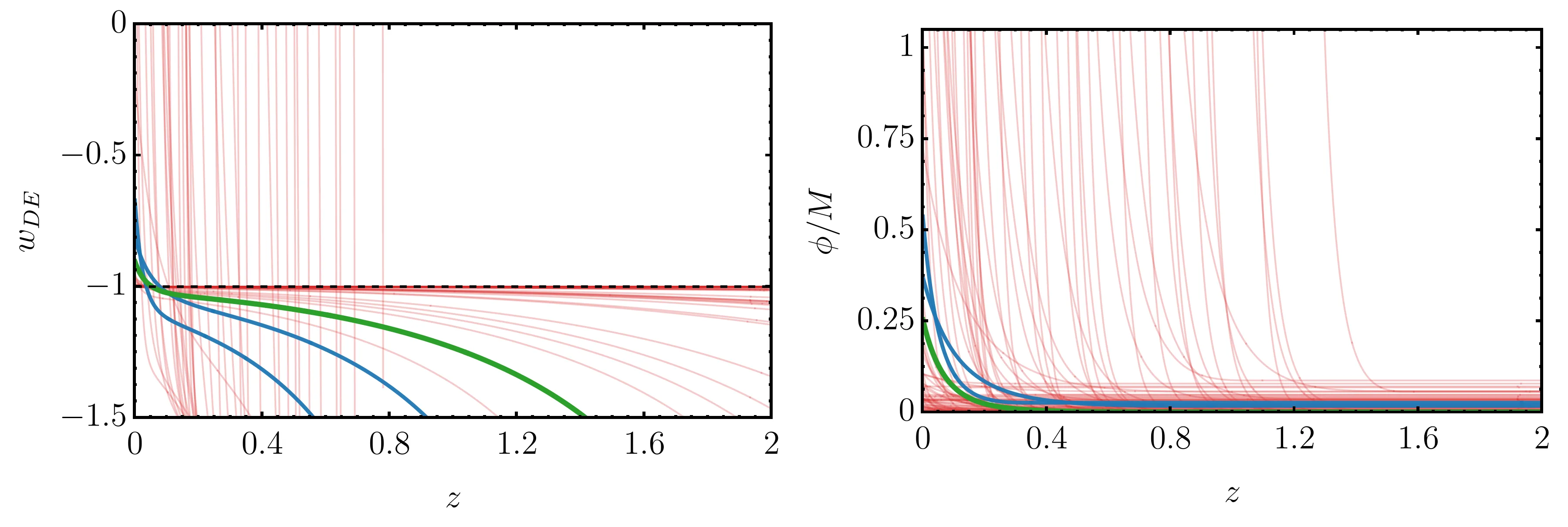
Later, near our time, the field moved again. The mass of dark matter particles changed, and an astronomer, unaware of this, would see a "phantom mirage"—as if dark energy (the mysterious force pushing the Universe apart) were breaking the laws. In reality, everything is fine. Also, in the past, the mass was smaller, which slowed the growth of galaxies and resolved the S8 problem (the discrepancy in matter clumpiness).
So one spring explains three puzzles at once. It triggers at the right moments on its own, without fine-tuning.
If the dark matter particle mass in the early universe were twice its current value, the peak of effective dark energy could reach 10% of the total density — roughly the energy stored in a teaspoon of matter via E=mc², but smeared over a cubic kilometer of space.
The idea of variable dark matter mass echoes the concept of the 'morphogenetic resonance field' from Greg Bear's novels, where fundamental constants evolve, as well as Liu Cixin's 'Dark Forest', where the laws of physics can be locally altered by interactions of hidden sectors.