The Dark Sector on a Seesaw: How a Single Scalar Spring Solves Cosmological Puzzles ✛
Context
Cosmology is going through a curious phase: the ΛCDM model describes most data beautifully, but two stubborn discrepancies won't go away. The first is the Hubble tension: the value of Hubble's constant derived from the cosmic microwave background (67.4 km/s/Mpc) flatly disagrees with local measurements using Cepheid variables and supernovae (73.0 km/s/Mpc). The second is that baryon acoustic oscillation (BAO) data from the Dark Energy Spectroscopic Instrument (DESI) suggest that dark energy may not have been constant but evolved, possibly crossing the 'phantom divide' (equation of state w < –1). Standard phantom models suffer from theoretical pathologies like violations of the null energy condition. The way out is to stop treating dark matter as inert and allow it to interact with a chameleon field that changes its mass. Then an observer who mistakenly assumes the mass is constant will see a phantom mirage, while the underlying physics remains healthy.
Methods
The authors build an analytic framework for mass-varying dark matter models, where a single scalar field φ controls both the dark matter particle mass m(φ) and the potential V(φ) responsible for late-time acceleration. Instead of numerical simulations, they derive conditions under which the field naturally activates at two key epochs: at matter-radiation equality (z ~ 3400) and near matter-dark energy equality (z ~ 0.5). The equations of motion are rewritten in terms of the number of e-folds N = ln a, making the dependence on the cosmic background explicit. For the early epoch, they use the approximation that the coupling dominates over the bare potential; for the late epoch, they analyze the system in variables (w_φ, Ω_φ), similar to classical quintessence. Two mechanisms for the late-time start of the field are separately analyzed: the 'sign-flip', where the potential and coupling compensate each other until a certain moment, and the 'slow-roll exit', characteristic of exponential potentials. The tuning check is performed with conservative estimates that deliberately underestimate the field evolution to show the inevitability of fine-tuning in the first case.
Results
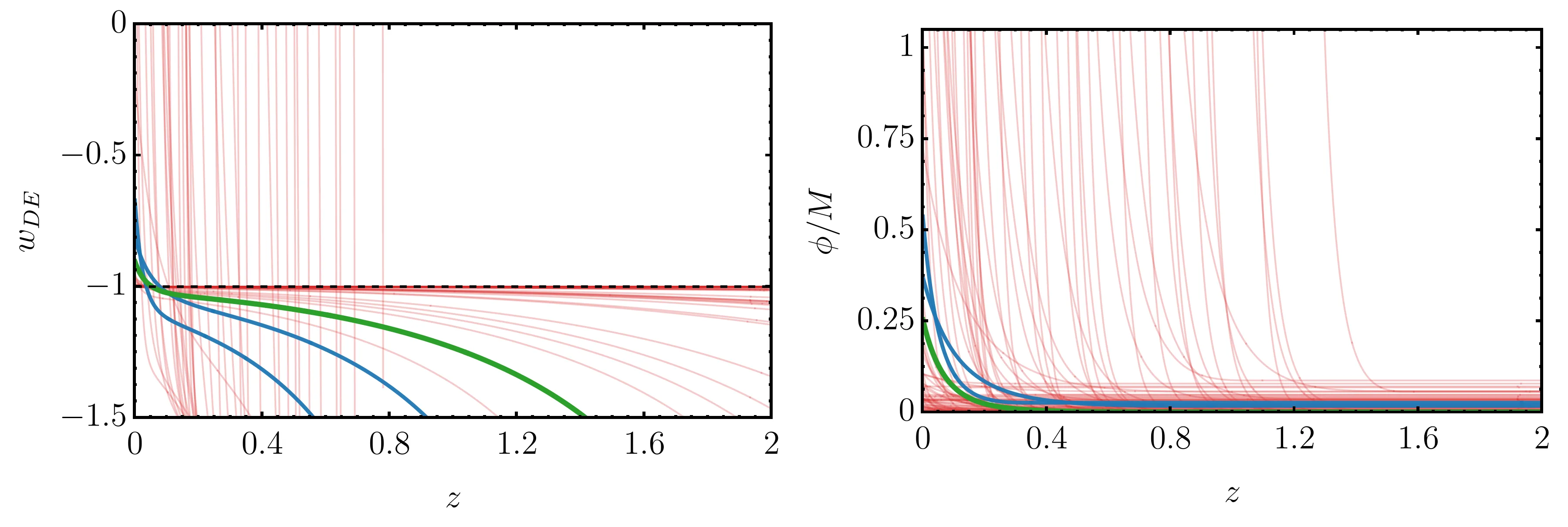
The model can produce two effects without introducing independent scales. First, around matter-radiation equality, the coupling to dark matter drives the field out of freezing, creating a peak in effective dark energy with amplitude up to ~10% of the critical density. The peak time is set by the local curvature of the function m(φ), and the height by the ratio of dark matter masses then and now. This energy injection reduces the sound horizon and raises the inferred value of H0, alleviating the Hubble tension. Second, at late times, the same scalar, driven by the potential V(φ), changes the particle mass, and an observer interpreting the data within ΛCDM sees an apparent crossing of the phantom divide w < –1 — the 'phantom mirage'. Along the way, during the dark ages, the particle mass was smaller than today, which lowers the physical dark matter density and suppresses structure growth, shifting the S8 parameter toward observed values. The analysis reveals that the 'sign-flip' mechanism requires fine-tuning of the initial field displacement and its mass, whereas the 'slow-roll exit' with an exponential (or near-exponential) potential is much more robust: the field starts moving naturally when its fraction in the universe's budget becomes noticeable. For a realistic phantom crossing, it suffices that the interaction scale M is of order the Planck mass, and both the early peak and the late mirage emerge naturally.
Implications
The work offers an elegant unifying language for describing several cosmological anomalies at once. Instead of inventing separate patches for the Hubble tension, the S8 problem, and hints of evolving dark energy, the physics of an interacting dark sector shows that all could be symptoms of the same scalar field changing the dark matter mass. The key lesson — that the timing of effects is tied to epochs of density equality (radiation-matter, matter-dark energy) — reduces the need for fine-tuning and makes the model more theoretically appealing. Moreover, analytic criteria (slow variation of the parameter λ = –$M_{pl}$ V'/V) provide a practical recipe for constructing new potentials without resorting to full-scale simulations.
Future development
A natural next step is to confront the model directly with the full set of cosmological data: cosmic microwave background (Planck, Simons Observatory), baryon acoustic oscillations (DESI, Euclid), supernovae (LSST), and weak lensing. This will require careful treatment of scalar field perturbations and modified dark matter equations to obtain robust constraints on the forms of m(φ) and V(φ). Of particular interest is the microphysical justification: can the required mass dependence be realized within specific particle physics models (e.g., with light sterile neutrinos or axion-like particles)? Finally, the analysis can be extended to the case where only a fraction of dark matter interacts with the field, which would weaken constraints and possibly open new observational windows.
Impact
The proposed mechanism will influence the interpretation of data from major surveys (DESI, Euclid, Rubin Observatory) and may change the strategy for searching for deviations from ΛCDM. In particle physics, it stimulates the construction of models with variable dark matter mass and relaxes theoretical prohibitions on phantom behavior.
Next steps
Numerical simulation of the full system (background + linear perturbations) for realistic potentials and coupling functions, as well as Bayesian analysis on combined Planck, DESI, and Pantheon+ data to quantitatively assess the model's success in relieving tensions.
Key open problems
The paper directly addresses the nature of dark energy and dark matter, proposing a unified description. It also touches on the question of why the densities of dark matter and dark energy are comparable today (the coincidence problem) and shows how interactions in the dark sector can mitigate this puzzle by tying the field dynamics to epochs of density equality.
The knowledge machine's view
This section is addressed to the author of the paper and their colleagues. Neighbouring works were found by meaning-based search across our archive, not by word overlap. We do not review: we show the field around the work.
What the work does
This work develops an analytical framework for models with varying dark matter mass, where a single scalar field controls both the particle mass and late-time acceleration. It shows how the field naturally activates at matter–radiation equality and near the present epoch, giving rise to early dark energy effects and an apparent phantom crossing without introducing independent scales.
Where its strength is
The strength of the approach lies in tying two key cosmological effects to the background evolution through a single scalar field, which reduces fine-tuning and simultaneously alleviates the S8 problem by suppressing structure growth.
Where it could go next
- It might be interesting to compare the field's thawing mechanism with the idea of kinetic quintessence, where dynamics are also driven by the cosmic background but through a non-canonical kinetic term. In our archive, there is a review of a model where transitions between epochs are realized via the shape of the kinetic term rather than coupling to dark matter.based on: Dancing Shadow: How Kinetic Quintessence Reconciles the Universe's Epochs arXiv:2607.03569
- The phantom mirage discussed in the paper, without violating the null energy condition, resonates with models where dark energy and dark matter act together through direct interaction in the dark sector. Nearby, there is a quick review of such a model, where joint field dynamics lead to an effective w<−1 at late times.based on: Dark Dancers: When Dark Matter and Dark Energy Dance Together arXiv:2601.19662
Worth trying
- Investigate whether the 'sign flip' in the potential can be realized not through fine-tuned compensation but via a spontaneous symmetry-breaking mechanism, analogous to that used in axion models.
- Test the method of conservative fine-tuning estimates on BAO and supernova data to quantitatively compare the two mechanisms for late field onset.
- Explore how the suppression of structure growth in this model relates to predictions of 'warm void' models and whether it can provide an additional constraint on the coupling function.
Nearby works in our archive
- Bubble in a Sea of Dark Energysimilarity 0.71
- Why Has Cosmology Cracked?similarity 0.70
- Dancing Shadow: How Kinetic Quintessence Reconciles the Universe's Epochssimilarity 0.70
- A Dark Deal: How the Universe Reconciles Its Clockssimilarity 0.69
- Warm Emptiness Instead of Dark Energysimilarity 0.68
- Dark Energy as a Falling Pencilsimilarity 0.67
- Dark Dancers: When Dark Matter and Dark Energy Dance Togethersimilarity 0.67
The archive is crowded around this work: 9 reviews nearby, closest at 0.71. This ground is well walked — and there is plenty to compare against.
Original abstract
as written by the authors arXiv:2607.27515v1
We present an analytical study of minimal mass-varying dark matter models, in which a single scalar field controls the dark matter mass, focusing on their utility in simultaneously addressing multiple cosmological tensions. We show that such minimal models can naturally become relevant at two critical epochs in the history of the Universe; matter-radiation equality and the present day, generating an early dark energy-like energy injection, as motivated by the Hubble tension, and an apparent phantom crossing, as suggested by baryon acoustic oscillation data from the DESI project. Crucially, the characteristic timing of these effects is tied to the cosmological background evolution itself, rather than specific energy scales. In addition, the intermediate evolution reduces the clustering matter density and can therefore lower $$S_8$$, in the direction preferred by data, while avoiding new long-range interactions. We derive analytic arguments to understand the conditions for these effects to arise in the same model and assess whether they can occur without introducing additional fine-tuning. This provides a simple framework for identifying which potentials and couplings to dark matter can simultaneously affect early- and late-time cosmological tensions.
If the dark matter particle mass in the early universe were twice its current value, the peak of effective dark energy could reach 10% of the total density — roughly the energy stored in a teaspoon of matter via E=mc², but smeared over a cubic kilometer of space.
The idea of variable dark matter mass echoes the concept of the 'morphogenetic resonance field' from Greg Bear's novels, where fundamental constants evolve, as well as Liu Cixin's 'Dark Forest', where the laws of physics can be locally altered by interactions of hidden sectors.
Key numbers
- peak of effective dark energy at z~3400: up to 10% of critical density
- Hubble constant from Planck (ΛCDM): 67.4 ± 0.5 km/s/Mpc
- Hubble constant from SH0ES (local): 73.04 ± 1.04 km/s/Mpc
- characteristic interaction scale M: ~1–100 Planck masses
- field displacement for phantom mirage: Δϕ ~ 0.5 M_Pl