Dark-Sector Seesaw: How a Scalar Spring Solves Cosmological Puzzles ✛
In 1929, Edwin Hubble pointed his telescope at distant galaxies and discovered they were receding. Ninety years later, two measurements of this recession rate, from ancient light and from nearby stars, stubbornly disagree. A 9% discrepancy cannot be chalked up to error. It is as if the Universe in its youth and in its maturity runs on different clocks.
Imagine a children's seesaw. A child sits still, but the board suddenly goes up — someone invisible has shifted the load. So here: dark matter is not inert; its mass changes over time. This variability is set by dark energy — not a cosmological constant, but a living field that sometimes freezes, sometimes awakens. In the early Universe, when radiation and matter were in equal proportions, the field yanks the rope, and the seesaw gets a sharp push. An energy peak arises that compresses the sound horizon (the maximum distance sound could travel in the hot plasma) and alters the inferred expansion rate.
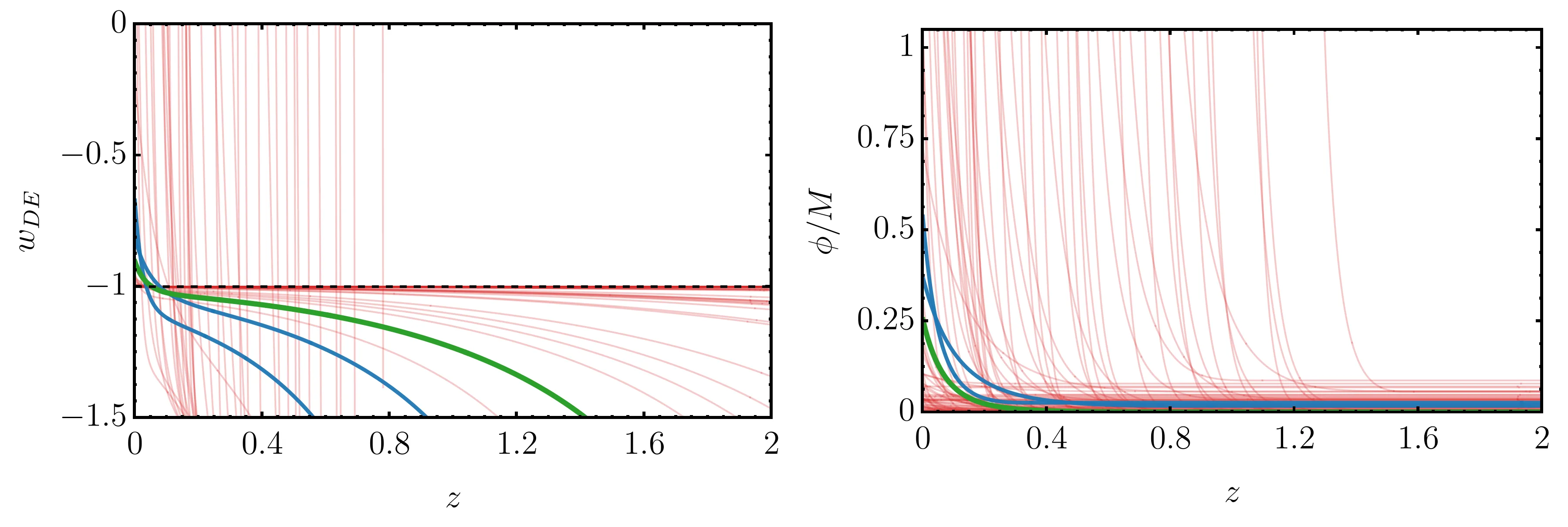
Billions of years pass. The seesaw is in motion again, but now smoothly. The field changes the mass of dark matter particles, and an astronomer assuming the mass is constant sees a phantom mirage: the equation of state of dark energy drops below –1. The actual physics remains healthy, without pathologies. And during the dark ages, the mass was lower than today, which dampened galaxy growth and shifted the S8 parameter toward observations.
The key is temporal anchoring. The field activates exactly when densities of different components become comparable: radiation and matter at dawn, dark energy and matter near us. No artificial scales. Thus, one scalar spring connects two epochs, and the seesaw, starting with a sharp push, ends with a gentle rocking, in which the observer sees a phantom mirage.
If the dark matter particle mass in the early universe were twice its current value, the peak of effective dark energy could reach 10% of the total density — roughly the energy stored in a teaspoon of matter via E=mc², but smeared over a cubic kilometer of space.
The idea of variable dark matter mass echoes the concept of the 'morphogenetic resonance field' from Greg Bear's novels, where fundamental constants evolve, as well as Liu Cixin's 'Dark Forest', where the laws of physics can be locally altered by interactions of hidden sectors.