The Universe's Memory of Gravitational Waves express
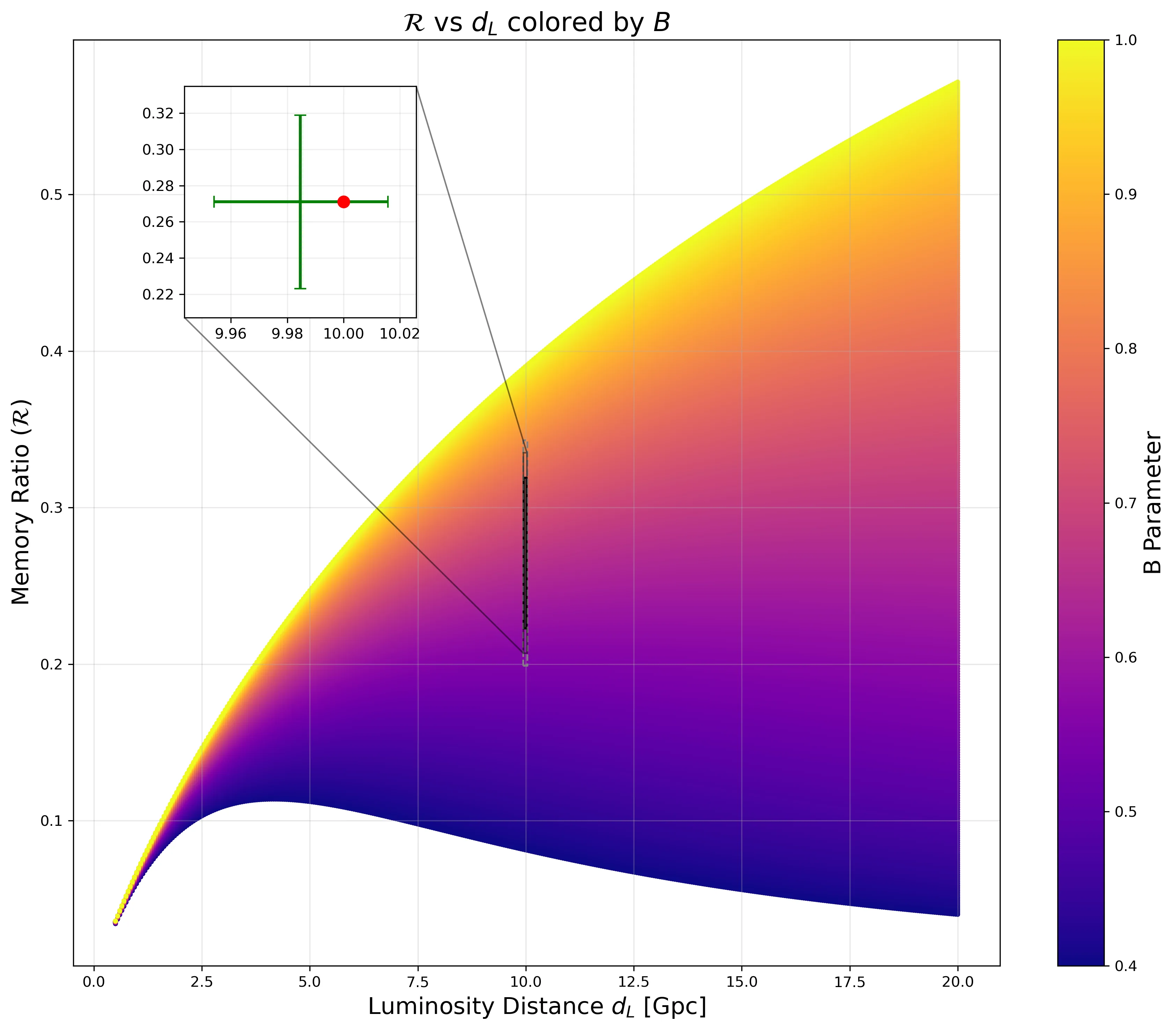
A gravitational wave from a black hole merger is like a bell tolling in the night. The loudness tells you how far away the source is. But to learn how fast the night itself, the cosmos, is expanding, you usually need a second signal: a flash of light or a catalog of galaxies. Both are rare to catch.
The authors propose listening not only to the toll itself but also to how it changes the shape of the bell. This accumulated trace is called integrated cosmological memory. It builds up from all past mergers and depends on how fast the universe expanded at different stages. From a single event, you can now extract two quantities at once: the distance to the source and the contribution of expansion to the memory. This breaks the vicious circle where one couldn't be calculated without the other.
So a single bell strike tells you not only about itself but also about all the silence that preceded it. For third-generation detectors, this opens the door to purely gravitational cosmology: no telescopes, no galaxies, just listening to the trembling of space.
Original abstract
as written by the authors arXiv:2608.03739v1
Gravitational-wave (GW) cosmology is currently bottlenecked by the scarcity of electromagnetic counterparts for bright sirens and the systematic uncertainties of galaxy catalogs for dark sirens. We propose a purely gravitational resolution using the Integrated Cosmological Memory (ICM)-the cumulative GW strain encoded in the spacetime geometry of an expanding Universe. While the GW transient emitted by the source provides the luminosity distance, the ICM accumulates a mathematically distinct integral of the cosmic expansion history. We demonstrate that extracting both observables from a single binary merger completely breaks the distance-redshift degeneracy within the gravitational sector. This establishes a novel, catalog-free dark siren framework for third-generation GW detector networks. Crucially, the resulting constraints on late-time dark energy are only weakly sensitive to the local expansion rate, providing a robust cosmological probe that can potentially mitigate the impact of the H0 tension.
Gravitational memory is like residual deformation: after a wave passes, two freely floating mirrors will never return exactly to their original positions, the distance between them changes forever.
In Carl Sagan's novel "Contact," an alien signal contains blueprints for a machine that uses gravitational waves, as if the very fabric of space became a carrier of a message.