Gravitational wave cosmology uses ripples in spacetime to probe the universe on the largest scales. Gravitational waves carry information about cosmic expansion, the distribution of black hole mergers, and even the symmetries of the universe. By detecting waves from distant mergers, scientists can test whether the universe is isotropic and homogeneous, measure the Hubble constant, and study the evolution of black hole populations over cosmic time.
History
The first direct detection of gravitational waves was made by LIGO in 2015, confirming a prediction of general relativity from 1916. Since then, gravitational wave astronomy has rapidly developed, with dozens of events cataloged and new cosmological applications emerging.
How it works
Gravitational waves are generated by accelerating massive objects, such as merging black holes. As they travel across the universe, they are influenced by the expansion of space, which stretches their wavelength. By measuring the waveform and its redshift, astronomers can infer the distance to the source and the expansion rate. Additionally, the gravitational wave background — a stochastic signal from many unresolved sources — can reveal information about early universe processes and cosmic structure formation.
In practice
Gravitational wave observations are used to measure the Hubble constant independently of other methods, test general relativity in strong-field regimes, and probe the dark universe through the gravitational wave background.
Fun fact
Gravitational waves can carry 'memory' — a permanent displacement of spacetime after a wave passes, which could encode information about the source's history.
A gravitational wave from a black hole merger is like a bell tolling in the night. The loudness tells you how far away the source is. But to learn how fast the night itself, the cosmos, is expanding, you usually need a second signal: a flash of light or a catalog of galaxies. Both are rare to catch.
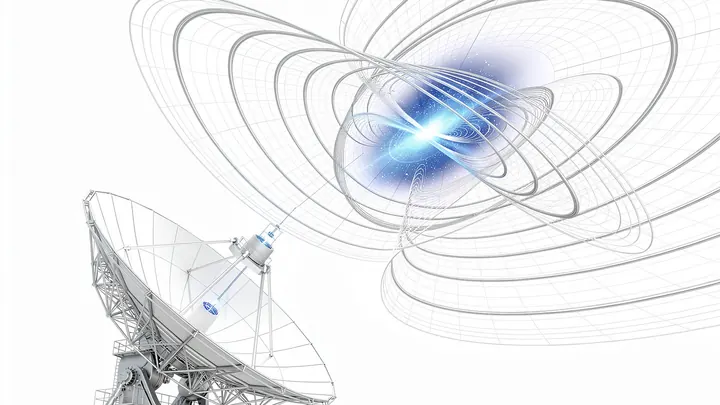
You could send a short radio pulse toward a black hole and wait for the reflected echo. Intuitively, the shorter the signal, the better it would probe the finest details of spacetime right at the horizon: that region from which even light cannot return.
2.1 × 10⁻⁹ — that's the temperature variation across the sky, about the same as measuring ripples a fraction of a millimeter high on the ocean surface. This microscopic non-uniformity is imprinted in the cosmic microwave background and tells the story of the very beginning of time.
The merger of two black holes is the most powerful explosion in the Universe, yet we cannot see it. We only catch the shudder in spacetime — gravitational waves that carry information from the heart of the cataclysm. In December 2025, the LIGO detectors registered event GW250114.
Detectors pick up the “ripples” of gravitational waves from mergers of black holes or neutron stars — like an echo from the kitchen where a cosmic dish was being prepared. Astronomers are trying to reconstruct the recipe: how two massive stars turned into an exotic pair and collided.
It was Edwin Hubble who discovered that galaxies are rushing apart, and Georges Lemaître linked this to the expansion of space. Today, the ΛCDM model, relying on dark energy and dark matter, asserts that the Universe is flat as a perfectly stretched canvas.
Two black holes smash head-on at full speed — while a third one circles nearby. In ordinary life, such a crash would produce a burst of gravitational waves (ripples in space, like the ripples from a stone thrown into a pond). But here, part of the ripple passes by the massive neighbor, and changes, like light in a funhouse mirror.
When two dead stars collide in a distant galaxy, two messengers bring us the news: a shiver in space, a gravitational wave, and a flash of light. Both messengers race toward us across the entire Universe, but their paths can differ slightly. Light sometimes gets delayed by cosmic dust, while gravitational waves pass through everything almost without noticing obstacles.
The mystery of the missing antimatter has haunted physics since the mid-20th century. The Big Bang should have created equal amounts of matter and antimatter, yet today's world is almost entirely matter. The Standard Model is powerless to explain this baryon asymmetry — we need new particles and mechanisms beyond it.
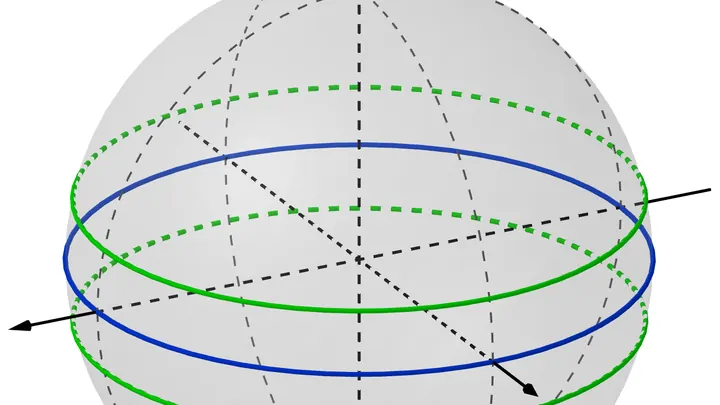
The night sky looks as smooth as the surface of a calm lake. But if you look at gamma-ray bursts (brief, blinding explosions visible across the entire universe) you'll find ripples in that smoothness.
Scientists took a catalog of such bursts and divided the sky into two hemispheres. In the southern one, they found a tiny group: 4–5 bursts huddled together.
Take two heavy balls and place them a meter apart: they attract each other with a force that weakens by a factor of four when you double the distance. Newton discovered this law, and it works in a room, in the solar system, in a galaxy. But does it still hold when we're talking about hundreds of millions of light-years?
Astronomers found a way to test this directly.
Two black holes spiral faster and faster until they merge into one. This dance shakes space itself: waves ripple outward from the collision site, like ripples from a stone thrown into a pond. Sometimes the merger also produces a flash of light.
If you look at a map of distant galaxies, it is not perfectly uniform: on one side of the sky there are slightly more, on the other — slightly fewer. This lopsidedness has been noticed in several sky surveys, and it does not look like a random fluke. Usually, it is explained by the fact that our Galaxy itself is flying somewhere, making distant objects appear shifted.
The universe is expanding, and scientists want to know how fast and what it's made of. To do that, they compare data from distant stellar explosions, sound waves in the early universe, and the faint glow left over from the Big Bang. Each dataset is like a piece of a mosaic, and the goal is to assemble them into a full picture.
A black hole merger gives birth to a gravitational wave. Sometimes the wave’s path is blocked by a galaxy or a clump of dark matter, predicted by Zwicky and discovered by Rubin.
Dark matter makes up 85% of the matter in the Universe, yet remains invisible. It only reveals itself through gravity. We can catch it by its cosmic 'hum' — a faint vibration that permeates space. A single detector is powerless here: the signal is too quiet.
Physicists turn many sensors into a quantum ensemble.
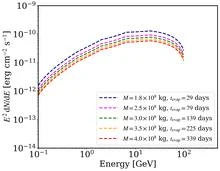
In 2017, the LIGO and Virgo gravitational detectors caught ripples in spacetime from the merger of two black holes 540 megaparsecs away. The event was named GW170814. But what remained after this cosmic collision? Besides distorted space, tiny black holes, or 'crumbs', might have been born.
Setting up an orchestra without a conductor: the algorithm itself decides which instruments (basis functions) and at what volume (weights) should play to reproduce Earth's gravitational symphony.