TianQin is a proposed space-based gravitational wave observatory, designed to detect low-frequency ripples in spacetime that are inaccessible to ground-based detectors. It is one of several planned missions, alongside LISA, that aim to open a new window on the universe by sensing signals from massive black hole mergers, galactic binaries, and possibly exotic sources like cosmic strings. The mission's name, meaning 'harp of the heavens,' reflects its role in 'listening' to the cosmic symphony of gravitational waves.
History
TianQin was proposed in 2015 by a team led by Jun Luo at Sun Yat-sen University in China. The project is in the development phase, with a planned launch in the 2030s.
How it works
TianQin would consist of three spacecraft arranged in an equilateral triangle, with sides of about 100,000 kilometers. The spacecraft would exchange laser beams, and passing gravitational waves would cause tiny changes in the distance between them, measured via laser interferometry. To achieve the required sensitivity, the spacecraft must be in a highly stable orbit, and the entire system would be placed in geocentric orbit, using the Earth's gravitational field to maintain the formation. The mission would operate in the millihertz frequency band, complementing ground-based detectors that sense higher frequencies.
In practice
TianQin would enable the study of massive black hole mergers, test general relativity in strong fields, and potentially detect gravitational waves from the early universe.
Fun fact
TianQin's orbit is designed so that the spacecraft formation rotates as a whole, maintaining a fixed orientation relative to the Sun, which simplifies thermal and power management.
Imagine an interpreter distracted by every rustle in the hall, turning a one-hour meeting into two. That's roughly how gravitational wave detectors behaved when analyzing long signals: each turn of the Earth added noise to the calculations, and processing a day-long neutron star merger threatened to stretch into weeks.
Somewhere in the depths of the Milky Way, radio pulses flare up from time to time — rare, steady, like the ticks of a distant metronome. These long-period radio transients were discovered only recently, and they immediately puzzled astronomers.
A gravitational wave from a black hole merger is like a bell tolling in the night. The loudness tells you how far away the source is. But to learn how fast the night itself, the cosmos, is expanding, you usually need a second signal: a flash of light or a catalog of galaxies. Both are rare to catch.
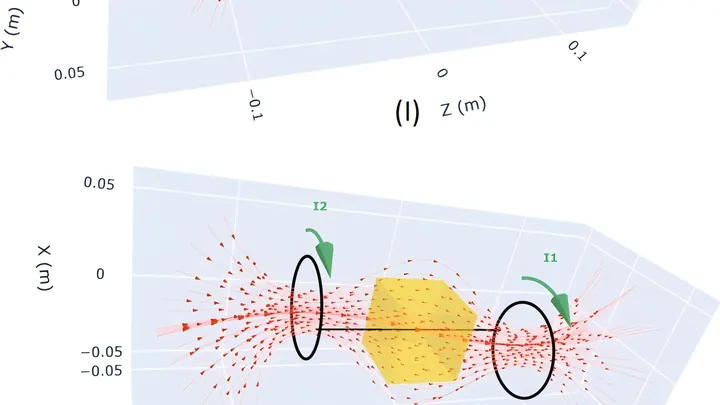
In a dark room, a whisper is barely audible. To make out the words, you need to get close, or set up many sensitive microphones. That's roughly the reasoning behind the new work: the authors place quantum "ears" right inside a resonator, where a high-frequency gravitational wave turns into an electromagnetic echo.
A spinning top that makes a hundred turns per second suddenly starts losing speed dramatically — much faster than any known top. That's exactly what pulsar J0435+3233 is doing. It's a dead star, crushed to the size of a city, but whirling at a furious rate.
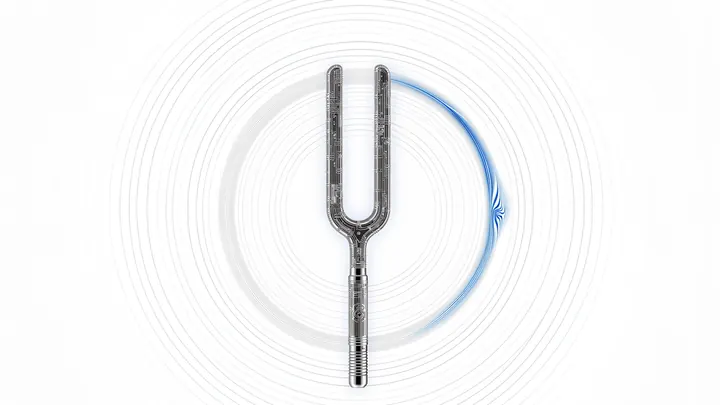
In 2034, a rocket leaves a spaceport with an unusual payload: two spheres the size of a large globe, each weighing nearly a ton. No engines, no electronics. Just a mirrored surface of hundreds of corner-cube reflectors — tiny prisms that return light exactly to where it came from. This is the future space tuning fork.
In the silent ocean of the Galaxy, mature civilizations have likely long chosen an unexpected strategy: instead of loud beacons, they scatter quiet fireflies — autonomous interstellar laser beacons, drifting in the void and dropping microsecond flashes. These 'seeds of contact' are not tied to their home stars and do not drown in their glow.
Gravitational waves from merging black holes sound like bass chords, pulsars tap out a rhythm, and the cosmic microwave background carries echoes of the Big Bang. But there is a silent player — dark matter, whose presence is betrayed only by gravitational effects.
The LIGO detectors caught the signal GW250114—a gravitational wave from the merger of two black holes. After the main burst, a decaying 'tail' remained — direct waves from the newborn hole's horizon. It was expected that their damping would reveal the gravitational strength at the horizon's surface. But the measured value came out smaller.
The space antennas LISA and Taiji each consist of three satellites flying around the Sun behind Earth, forming a triangle with sides millions of kilometers long. They measure how the distance between them changes when a gravitational wave passes, like ripples on a pond from a thrown stone.
In 2015, detectors caught a gravitational wave for the first time — a ripple in space that traveled from merging black holes. Since then, such signals have become a new window into the universe for astrophysics. But gravitational waves can do more: they carry the imprint of the very theory of gravity.
A tiny coin circles a heavy bowling ball. The coin is a small black hole or a neutron star, and the ball is a supermassive black hole at the center of a galaxy.
Pulsars are dead stars spinning with flawless rhythm. Their radio blips are more precise than atomic clocks. However, gravitational waves — ripples in the fabric of spacetime, predicted by Einstein — disrupt that rhythm.
When two neutron stars, compressed to the size of a city, approach in their final dance, the spacetime around them comes alive, emitting gravitational waves.
It was Edwin Hubble who discovered that galaxies are rushing apart, and Georges Lemaître linked this to the expansion of space. Today, the ΛCDM model, relying on dark energy and dark matter, asserts that the Universe is flat as a perfectly stretched canvas.
The universe sometimes resembles a pot of boiling water. With enough heat, liquid turns to vapor: that's a phase transition. Something similar could have happened in the early universe: a field filling space suddenly changed its state, like water becoming gas.
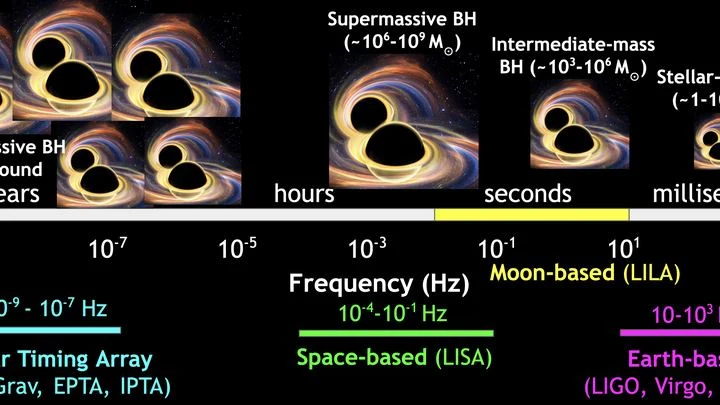
Gravitational waves are ripples in the fabric of space, like circles on water from a thrown stone. On Earth, they are drowned out by traffic, tides, and earthquakes, like a storm beating on a lake, making it impossible to notice faint splashes. The LILA project moves the detector to the Moon, where windless silence reigns.
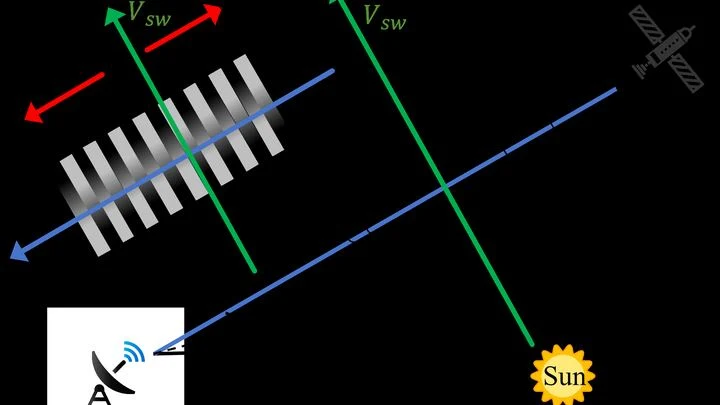
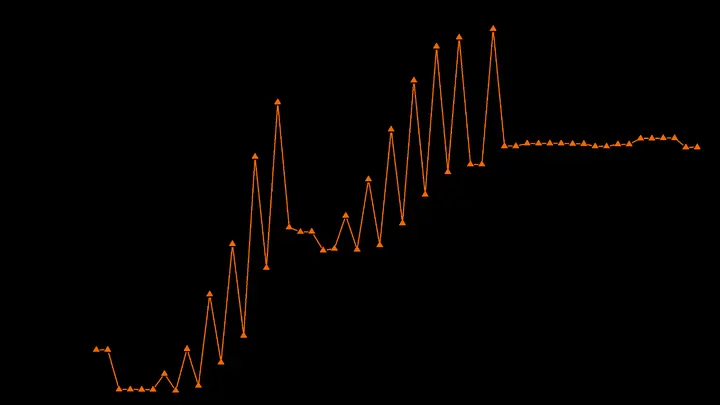
A radio signal travels from Mars to Earth, but on the way it has to push through the invisible "wind" of charged particles blowing from the Sun. This wind, like ripples on water, slightly distorts radio waves.
In 2015, two giant facilities in the United States caught the shiver of space — a gravitational wave from the collision of black holes. Since then, such signals have been caught regularly, but the detectors themselves are enormous: their arms stretch for kilometers.
The Big Bang was like a cosmic thunderclap that set the fabric of space vibrating. These vibrations — gravitational waves — still echo through the Universe like a fading rumble from that ancient event. The louder the initial 'bang,' the more primordial black holes should have formed.
Pluck a guitar string, and it vibrates — the air around it carries the tremor to your ear. Spacetime vibrates differently: when a gravitational wave passes through, it stretches and squeezes slightly. Spotting such a tremor at frequencies from 10 kilohertz to 100 megahertz is the challenge that new detectors are being built for.
Two giant black holes spiral together and collide — a ripple of spacetime spreads across the Universe. Detectors of gravitational waves catch this ripple. But the signal may hide more than just mass and distance: if the laws of physics differ ever so slightly in different directions, the wave will be distorted.
The Moon is not just a satellite; it is a potential gravitational bell. When massive bodies collide, spacetime shudders, and that shudder, gravitational waves, makes everything in their path vibrate.
Setting up an orchestra without a conductor: the algorithm itself decides which instruments (basis functions) and at what volume (weights) should play to reproduce Earth's gravitational symphony.