Multi-messenger astronomy combines electromagnetic radiation, gravitational waves, neutrinos, and potentially cosmic rays. Gravitational-wave detectors LIGO and Virgo register mergers of compact objects through oscillations of test masses with precision down to a thousandth of the proton diameter. Neutrino telescopes like IceCube scan a cubic kilometer of Antarctic ice for Cherenkov radiation from high-energy neutrinos. Coordinated observations have made it possible to measure the speed of gravity — it matches the speed of light to within 10^−15 — and to determine that neutron star collisions do indeed produce heavy elements.
History
The idea of detecting cosmic neutrinos was discussed as early as the mid-20th century, but the first real event was the arrival of neutrinos from supernova SN1987A in 1987, recorded by the Kamiokande-II, IMB, and the Baksan Neutrino Observatory. Gravitational waves were predicted by Einstein in 1916, but direct detection occurred only in 2015 by the LIGO collaboration (Rainer Weiss, Kip Thorne, Barry Barish — Nobel Prize 2017). The breakthrough of multi-messenger astronomy came on August 17, 2017, with the observation of the neutron star merger GW170817: the gravitational signal was registered by LIGO and Virgo, 1.7 seconds later a gamma-ray burst by the Fermi and INTEGRAL telescopes, and then hundreds of instruments worldwide tracked the optical, infrared, and radio emission from the kilonova. This event confirmed the link between kilonovae and the production of heavy elements (r-process).
How it works
Each messenger obeys its own physical laws. Gravitational waves are described by Einstein's equations and propagate at the speed of light, interacting extremely weakly with matter, which allows them to carry information about the most energetic processes, such as mergers of black holes and neutron stars. Neutrinos, having tiny mass and weak interaction, escape from practically any astrophysical crucible, for example, from the collapsing cores of supernovae, where densities are so high that photons are trapped. Electromagnetic waves provide a detailed picture of thermal and non-thermal processes, allowing us to reconstruct chemical composition, temperature, and magnetic fields. Joint analysis uses the arrival time, direction, and spectra of signals to build a complete model of the source. For instance, the gravitational-wave signal gives the distance and mass of the system, and optical identification gives the redshift, providing an independent measure of the Hubble constant.
In practice
Early warning of neutron star collisions and understanding the processes that create gold and platinum.
Fun fact
On July 4, 2012, a supermassive black hole tore apart a star, and the IceCube detector recorded a neutrino with an energy of 200 TeV — 30 times higher than particles in the Large Hadron Collider; astronomers still debate whether it was connected to that event.
Imagine a simultaneous interpreter in a room where two people are speaking: they must keep up with both meaning and intonation, but if the speech is too fast, only a paraphrase remains. That's roughly how scientists feel as the stream of gravitational waves from black hole and neutron star mergers grows, while precise signal calculations lag behind.
Light in an optical fiber is like a stream: it flows inside a glass thread and doesn't spill out. A thick thread carries many streams at once, a thin one only one. Astronomers often need to pour light from a thick fiber into several thin ones to split it into colors.
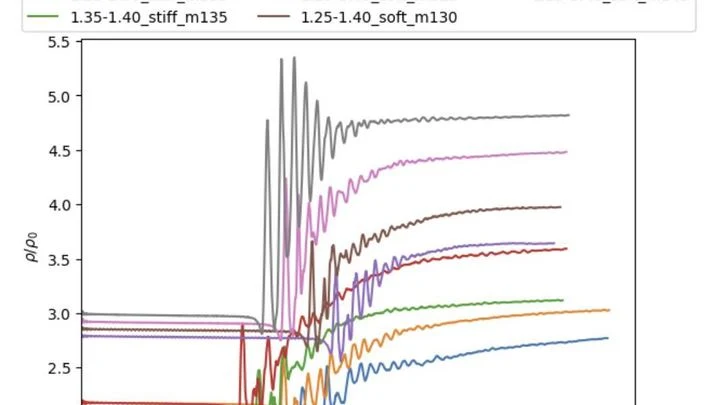
The merger of two neutron stars is not just a collision. Even before they touch, they deform each other through tidal forces, and this deformation depends on how 'soft' or 'stiff' the matter inside is. Stiff matter resists more; soft matter changes shape more easily.
Somewhere in the depths of the Milky Way, radio pulses flare up from time to time — rare, steady, like the ticks of a distant metronome. These long-period radio transients were discovered only recently, and they immediately puzzled astronomers.
Buried in Antarctic ice, there's a detector the size of a cubic kilometer. It doesn't catch light but ghostly particles — neutrinos. Yet sometimes, a different beast might flash through: a pair of muons born together and flying apart in a wide fan. No known particle of ordinary matter can paint that pattern.
Light escaping a massive body loses steam. Its frequency dips slightly, and its color shifts toward red. Physicists call this gravitational redshift. In classical theory, it's all clear, but the moment you bring quanta into the picture, trouble starts.
Previously, this shift was modeled as a kind of mode mixer — a device that entangles different states of light.
A gravitational wave from a black hole merger is like a bell tolling in the night. The loudness tells you how far away the source is. But to learn how fast the night itself, the cosmos, is expanding, you usually need a second signal: a flash of light or a catalog of galaxies. Both are rare to catch.
At the end of a massive star's life, its core collapses in a fraction of a second, giving birth to a supernova flash. This cataclysm shakes spacetime itself, emitting gravitational waves — ripples that race across the Universe.
When an orchestra of thousands of musicians plays in harmony, the credit goes not only to each player's talent but also to the invisible work of the conductor.
A noisy café. You're trying to make out two quiet conversations: one from the table by the window (black hole mergers), the other a barely audible whisper from the far corner (echoes of the universe's birth). But the hiss of the espresso machine and street noise (detector jitter) drown everything out. New work teaches a computer to separate these sounds.
Deep beneath the ice of the South Pole, nearly two and a half kilometers down, an unusual telescope is at work. It is not pointed at the sky but through the Earth. Its quarry: neutrinos, nearly elusive particles that pass through planets and stars without interacting with anything.
Five thousand robotic fingers of the DESI spectroscopy reach toward the telescope's focus. In a single night, they record one hundred thousand light signatures. Hidden among these records are binary star systems with white dwarfs — cataclysmic variables.
Two galaxies (our Milky Way and its satellite, the Large Magellanic Cloud) slowly circle each other. Their gravitational pull stirs the distant outskirts of the Milky Way, like a pebble thrown into a pond makes the water ripple.
Seventeen minutes: that’s the heartbeat frequency of AM Canum Venaticorum, setting the rhythm for the entire class of ultracompact binaries. In these systems, two white dwarfs whirl in a death dance, tightening their orbit to the still-inaudible whisper of gravitational waves.
In the silent ocean of the Galaxy, mature civilizations have likely long chosen an unexpected strategy: instead of loud beacons, they scatter quiet fireflies — autonomous interstellar laser beacons, drifting in the void and dropping microsecond flashes. These 'seeds of contact' are not tied to their home stars and do not drown in their glow.
Two neutron stars spiral closer and collide. The result: a gravitational wave, a ripple in spacetime, a short gamma-ray burst, and a faint glow astronomers call a kilonova. But sometimes the signal passes by a massive galaxy.
The early universe expanded at a breakneck pace: this phase is called inflation. But how exactly did it do it? Some models describe the expansion as a steep exponential surge, others as a more gentle power-law motion.
Ever since Einstein predicted gravitational lensing, and gravitational waves were first heard by LIGO detectors, physicists have dreamed of catching the lensed echo — a repeating signal from one merger, multiplied by the gravity of a massive body.
For almost a century, seismology has been the planet’s chief X-ray, probing the interior through elastic waves. But neutrinos, ghost particles predicted by Wolfgang Pauli, offer a different perspective.
A pair of neutron stars, locked in a gravitational embrace, traces invisible circles in the void. A century ago, Albert Einstein described this dance as waves of curved geometry, but for a long time we could only catch glimpses — through the feverish flicker of radio pulses.
Two sensitive microphones are listening to the Universe. One hears a low hum, the other hears almost nothing. It's not a malfunction: it's about how they are oriented.
Gravitational-wave observatories like LIGO don't just catch loud bursts from black hole mergers.
A gravitational wave observatory is like a set of microphones scattered across the Earth. When a signal arrives from space (say, from a black hole merger or a supernova explosion) each microphone hears something slightly different.
An ultra-sensitive microphone listens not to sound, but to the trembling of space itself. That's how gravitational wave detectors work — LIGO, Virgo, KAGRA.
Neutrinos are often compared to a radio broadcast picked up by different receivers. One station sends a signal, but antennas in Japan, Antarctica, and at the bottom of the Mediterranean Sea hear it differently — due to distance, interference, and antenna orientation.
Gravitational waves are ripples in the very fabric of spacetime, akin to vibrations of a giant cosmic string. Conventional detectors like LIGO and Virgo pick up low-frequency "notes"—disturbances from mergers of massive black holes of stellar masses.
Two stones fall into a pond. Ripples spread from each, but when they collide, there's a splash and a short, sharp clap. That's roughly what the merger of two neutron stars sounds like: those ultra-dense remnants of exploded stars.
A chamber the size of a small truck is filled with liquid argon at minus 186 degrees Celsius. When a particle flies in, it knocks electrons off argon atoms, and those electrons drift toward the walls, tracing a three-dimensional picture of the event.
Two neutron stars whirl in their final dance. If their spin aligns with their orbital motion, the partners merge neatly, launching a narrow jet of superheated matter. If they spin in opposite directions, the dance breaks apart, scattering a thick shroud of debris.
Two black holes smash head-on at full speed — while a third one circles nearby. In ordinary life, such a crash would produce a burst of gravitational waves (ripples in space, like the ripples from a stone thrown into a pond). But here, part of the ripple passes by the massive neighbor, and changes, like light in a funhouse mirror.
We know about neutron stars thanks to the work of Fritz Zwicky, Subrahmanyan Chandrasekhar, and Jocelyn Bell Burnell. They are former cores, squeezed to city size: a teaspoon of their matter weighs as much as Mount Everest.
Back in the 1960s, physicist Joseph Weber tried to catch gravitational waves using aluminum cylinders: they were supposed to tremble like tuning forks from the ripples of spacetime.
When two dead stars collide in a distant galaxy, two messengers bring us the news: a shiver in space, a gravitational wave, and a flash of light. Both messengers race toward us across the entire Universe, but their paths can differ slightly. Light sometimes gets delayed by cosmic dust, while gravitational waves pass through everything almost without noticing obstacles.
The fabric of space bends under weight, like a stretched trampoline. Gravitational waves — ripples spreading from cosmic cataclysms, such as merging black holes. If such a ripple encounters a massive galaxy or invisible dark matter, they act like a magnifying glass: bending and amplifying the signal.
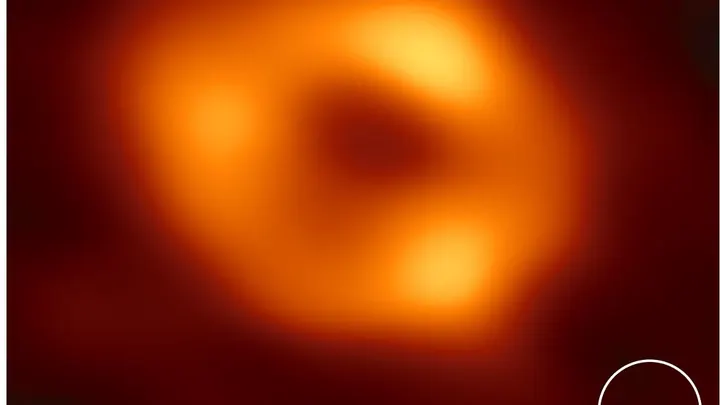
Einstein's theory of gravity explains how mass warps space and time. Its predictions have been tested near Earth, but the most grueling tests lie around black holes, where distortions reach their breaking point. Until now, astronomers saw them as blurry smudges on an underexposed photo.
When black holes or neutron stars merge, they disturb the very fabric of spacetime, producing gravitational waves — ripples predicted by Einstein in his general theory of relativity.
A huge pond, with ripples spreading from two heavy stones circling each other. The stones draw closer, the ripples become more frequent and stronger, and soon the stones will collide. Gravitational waves are like those ripples, but not on water — in the very fabric of spacetime.
A translator gets distracted by every rustle in the hall, and a one-hour meeting stretches into two. Gluons, the particles that carry the strong force inside protons, behave much the same way. Usually, they dart back and forth, holding quarks together.
Imagine a tiny coin hidden inside a perfect safe, but the walls are so thin that the coin sometimes slips right through, leaving a barely audible sound. Axions are like those coins — except instead of metal, they're particles, and instead of a safe, they're ordinary matter. They barely notice obstacles, making them incredibly hard to catch directly.
An album with hundreds of family photos holds countless stories. If you look at each picture on its own, you might easily decide that Uncle is a real giant: that day he happened to stand a step higher than everyone else. But flip through the whole album, and it becomes clear — his height is perfectly ordinary; it's just that a step showed up in a couple of frames.