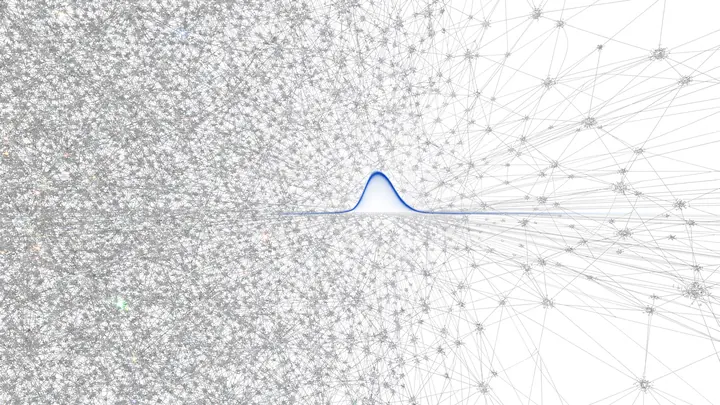
Dark Matter from Thermal Noise
In the first moments after the Big Bang, the universe resembled a boiling cauldron. According to one hypothesis, dark matter, the invisible substance that holds galaxies together, could have been born there.
The time over which a wave's phase remains predictable, limiting interference visibility.Coherence time also plays a role in astrophysics and cosmology. For example, in the search for dark matter, certain proposed particles like axions are expected to produce coherent signals over long timescales. The article 'Солнечная гравитационная ловушка для ультралёгкой тёмной материи' (Solar gravitational trap for ultralight dark matter) discusses how the Sun's gravity could concentrate dark matter, potentially enhancing its coherence and making it detectable. In gravitational wave astronomy, the coherence of the signal is essential for extracting faint signals from noise, as explored in 'Как услышать шёпот гравитации, не потеряв ни слова' (How to hear the whisper of gravity without losing a word).
The concept of coherence time emerged from classical optics in the 19th century, with Thomas Young's double-slit experiment demonstrating interference. The formal treatment of coherence was developed by Emil Wolf and others in the 1950s, leading to the modern theory of optical coherence. In quantum mechanics, the idea of decoherence was formalized in the 1970s and 1980s by physicists like H. Dieter Zeh and Wojciech Zurek.
Coherence time is fundamentally limited by interactions with the environment. For a photon, scattering off atoms or fluctuations in the medium can randomize its phase. For a quantum bit (qubit), interactions with stray magnetic fields or thermal vibrations cause decoherence. The longer the coherence time, the more isolated the system is from its surroundings. Techniques to extend coherence time include cooling to near absolute zero, using materials with low noise, and employing dynamical decoupling—a sequence of pulses that reverses the effects of environmental noise. In interferometry, coherence time is related to the bandwidth of the source: a narrow-band source (like a laser) has a long coherence time, while a broadband source (like sunlight) has a very short one.
Coherence time is a key parameter in quantum computing, where it determines how long qubits can retain information before errors occur. It is also critical in optical coherence tomography (OCT), a medical imaging technique that uses low-coherence light to produce high-resolution cross-sectional images of biological tissues.
The coherence time of a typical atomic clock's microwave signal is so long that if you started a wave at the Big Bang, it would still be coherent today, having oscillated about 10^30 times without losing phase.