S. Shankaranarayanan

6 articles · 11 co-authors · latest: 2026-08-07
10 citations · h-index 2 · 12 papersData: Semantic Scholar

We have retold 6 papers by this author. 1 of them with a full read. most often about: Hawking radiation, event horizon, black hole. 11 co-authors across our retellings.

Links in the knowledge graph
Statistical Mech2026-02-042 minarXiv:2602.04593express
Hawking Radiation on a Tabletop
A black hole is a place from which even light cannot escape. But quantum theory says it still glows faintly. This glow is called Hawking radiation. In space, it's impossible to spot: it's too faint. So physicists build models of black holes from ordinary materials.
Gravitational Radio Forest: How a Hydrogen Quantum Detector Reveals Dark Matter
Dark matter is the great cosmic invisible. It neither emits, absorbs, nor reflects light, yet its gravitational grip is felt in every motion of galaxies. Seventy years ago Vera Rubin showed that the outskirts of galaxies rotate too fast — as if spurred on by an unseen shepherd.
General Relativity2026-06-222 minarXiv:2606.23846express
Black Holes from the Universe's Infancy
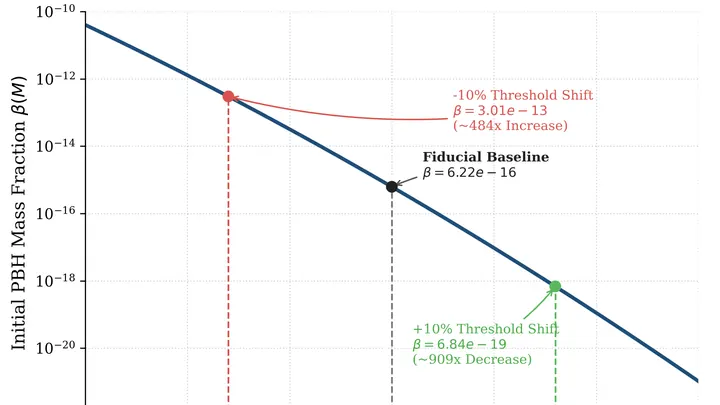
It all began not with emptiness, but with a boiling ocean of plasma. In that primordial broth, sound waves raced through the fiery matter, colliding and compressing it. Sometimes a clump grew so dense that light could no longer escape, and right out of the scorching gas, a primordial black hole was born.
General Relativity2026-07-312 minarXiv:2607.29427express
How geometry saves the quantum vacuum from infinity
The quantum vacuum is not empty: it is permeated by entanglement linking distant regions. But when physicists tried to compute this entanglement, it turned out to be infinite. The culprit: particles with very low energy that can smear out over arbitrarily large volumes. They are like waves with no shores to contain them.
Cosmology2026-08-041 minarXiv:2608.03739express
The Universe's Memory of Gravitational Waves
A gravitational wave from a black hole merger is like a bell tolling in the night. The loudness tells you how far away the source is. But to learn how fast the night itself, the cosmos, is expanding, you usually need a second signal: a flash of light or a catalog of galaxies. Both are rare to catch.
General Relativity2026-08-071 minarXiv:2608.07182express
Black Hole Cools Down and Freezes
A boiling kettle on the stove eventually boils dry — and so, according to the classical picture, a black hole should gradually vanish in a hiss of radiation. But what if you add a special ingredient to the kettle?