A gravitational wave catalog is a systematically compiled list of all confirmed detections, along with their inferred properties such as masses, spins, distances, and merger rates. These catalogs are the empirical foundation of gravitational wave astronomy, allowing scientists to study the population of black holes and neutron stars in the universe. The most comprehensive catalogs, like those from the LIGO-Virgo-KAGRA collaboration, contain dozens of events, revealing patterns in how these objects form and evolve.
History
The first gravitational wave catalog was released in 2018 by the LIGO and Virgo collaborations, containing the 11 events detected during the first two observing runs. Subsequent catalogs have grown with each observing run, with the third catalog (GWTC-3) containing around 90 events.
How it works
Each detection is analyzed using Bayesian inference to estimate the parameters of the source — the masses, spins, and distance. These individual results are then aggregated into a catalog with careful attention to selection effects: since more massive and closer mergers are easier to detect, the catalog must be corrected to infer the true underlying population. The catalog also includes information about the sensitivity of the detectors at the time of each observation.
In practice
Catalogs are used to test theories of stellar evolution, measure the expansion rate of the universe (via 'gravitational wave sirens'), and constrain the properties of dense matter in neutron stars.
Fun fact
The most recent catalogs include events from merging black holes with masses ranging from a few solar masses to over 100 solar masses, a range that challenges some models of stellar collapse.
A gravitational wave from a black hole merger is like a bell tolling in the night. The loudness tells you how far away the source is. But to learn how fast the night itself, the cosmos, is expanding, you usually need a second signal: a flash of light or a catalog of galaxies. Both are rare to catch.
Layer by layer, artifact by artifact — an archaeologist reconstructs the history of an ancient settlement. Similarly, astrophysicists sifting through 259 records from LIGO–Virgo–KAGRA saw a clear layered structure among merging black holes.
A huge bowl of water. Drop a stone into it — ripples spread across the surface. The fabric of spacetime works much the same way: when two massive stars merge, they create ripples — gravitational waves. These waves travel to Earth and are picked up by giant detectors like LIGO and Virgo.
The universe rewrites its history again and again. Where ordinary astronomy sees only a point, a black hole, gravitational waves peel back thin layers of the past, like an ancient palimpsest. The idea that black holes can grow by devouring each other, and their offspring can enter new unions, has been discussed by astrophysicists for half a century.
The cosmos sets its own lenses in the path of gravitational waves. When two black holes merge, the resulting ripple travels through the universe. If it encounters a massive galaxy cluster along the way, its gravity bends the path of the waves — much like glass focuses light.
In the first moments after the Big Bang, matter and antimatter were almost perfectly balanced. But something tipped the scales — otherwise everything would have annihilated into radiation, leaving the universe empty. One candidate for the role of "tipper" is the ultraheavy right-handed neutrino.
LIGO, Virgo, and KAGRA detectors act like giant microphones, listening in on gravitational waves — vibrations of space itself. The new GWTC-5.0 catalog recorded 161 black hole mergers, bringing the total count to 390 events.
Imagine a giant inflatable balloon with galaxies painted on it. As it inflates, the pattern stretches and neighboring dots move apart. The rate of that stretching is the Hubble constant. Astronomers usually catch light from distant stars and see how much it has reddened due to the stretching of space.
Usually, black holes inch closer gradually, circling in a tightening spiral. This dance births a long ripple of gravitational waves — a tremor in the very fabric of spacetime. Detectors LIGO and Virgo routinely catch such mergers.
But GW190521 is the exception.
Spacetime is not a passive void but a dynamic membrane capable of elastic deformation. When neutron stars (ultra-dense objects the size of a city, where matter is compressed to nuclear density or black holes) regions with gravity so strong that even light cannot escape their bounds collide, the membrane shudders, generating…
Two heavy spheres circle not in a neat circle but in a highly flattened oval — now approaching, now flying apart. That's roughly how pairs of black holes on elongated orbits behave. Unlike calm pairs that gradually spiral together and merge, these dancers retain a memory of their turbulent youth: of being kicked out of star clusters or made to whirl by close neighbors.
Twenty-first-century astrophysics is deafening with triumphs: we’ve caught the tremor of spacetime from the merger of invisible giants; glimpsed the 'shadow' of a supermassive monster in a distant galaxy; traced the orbits of stars dancing around a compact something at the heart of the Milky Way.
When black holes collide, the very fabric of spacetime trembles. That rumble, gravitational waves, gets picked up by detectors, but decoding the signal used to take hours of computer simulation.
An album with hundreds of family photos holds countless stories. If you look at each picture on its own, you might easily decide that Uncle is a real giant: that day he happened to stand a step higher than everyone else. But flip through the whole album, and it becomes clear — his height is perfectly ordinary; it's just that a step showed up in a couple of frames.
The merger of two black holes is like a dance that ends in a powerful burst — a gravitational wave. This wave carries the imprint of how spacetime is curved around the objects. If the geometry differed from what we're used to, as if a ball rolled not on a flat floor but on wavy linoleum, the signal would be different.
Previously, astronomers calculated galaxy mass as if they were perfect spheres. But a galaxy is a flat pancake. The new 'Lost and Found' model takes the actual shape into account: it sums up the gravitational pull from all parts of the disk, not just the central bulge. The result is stunning: many galaxies need a third less invisible dark matter than previously thought.
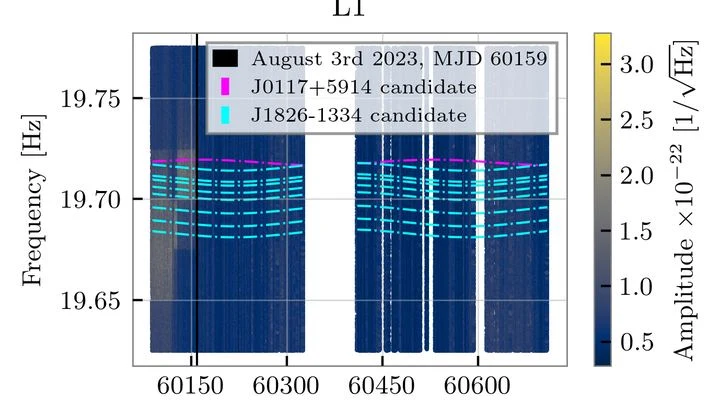
After a supernova explosion, a neutron star neutron star remains: a city-sized ball of unimaginably dense matter, spinning hundreds of times per second. Any tiny bump on its surface would make it wobble like an off-balance spinning top, humming faintly through the fabric of space.
The edge of a magnet works like a guitar fret: a string pressed near the edge sounds different, with a richer set of overtones. Magnetic waves in a thin strip of nickel and iron behave in much the same way.
In August 2017, gravitational wave detectors caught a signal from the merger of two neutron stars — the ultra-dense remnants of exploded stars. At that very moment, life on Earth was business as usual: planes were landing, cars were driving, and navigators were plotting routes.
Earth's magnetic field is like an invisible river that meanders beneath our feet. Navigators and geologists rely on maps of this river, but instruments only take readings at scattered points, leaving blank spots in between. Filling those gaps is like trying to sketch the river's course from a few pebbles found on the bank.
When two black holes merge, the newborn hole rings like a bell, emitting gravitational waves. In the past, only the fundamental tone of this ringing was captured. But analysis of the GW250114 merger showed that the signal hides extra faint vibrations — nonlinear overtones.