A Light Filter That Doesn't Lose the Details express
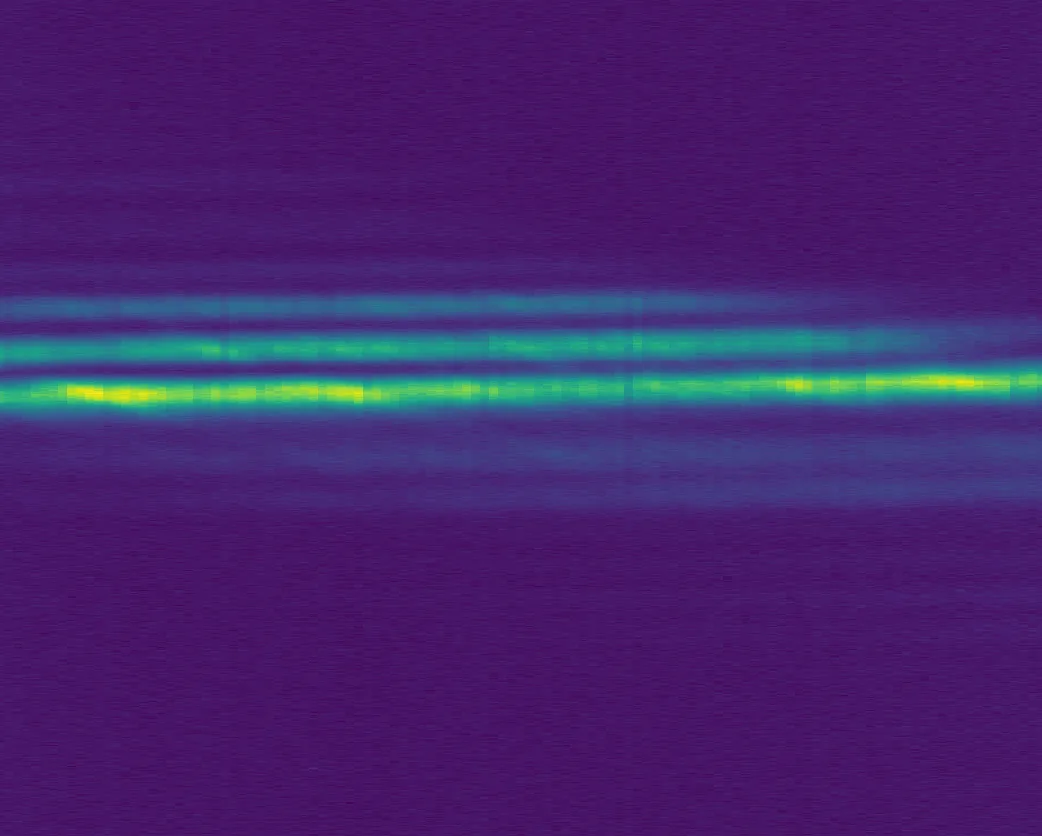
A short flash of light is like a musical phrase: you can distinguish individual notes if you listen very carefully. But in the quantum world, these 'notes'—temporal modes — are squeezed down to picoseconds, and ordinary optics can barely tell them apart. The scientists built a device that acts like a musical filter: it lets through only one selected note from a chord, not by muffling the others, but simply by not letting them pass.
This filter, a quantum pulse gate, is made from an ultra-thin film of lithium niobate, a material that changes the properties of light passing through it. Inside the gate, a weak signal beam and a stronger pump beam travel together. When they meet at just the right moment, a third beam is born at the sum frequency, but only for the 'note' that was selected. All of this happens in a tiny waveguide narrower than a human hair, where light is confined so tightly that the interaction is greatly enhanced.
The selection accuracy for temporal modes was about 97%—the light that passes through the gate contains almost no contamination from neighboring 'notes.' This is crucial for quantum networks, where each photon carries its own bit of information, and they must not be confused. Previously, similar gates required bulky lasers and worked only in narrow ranges. The new thin-film version promises to be compact and flexible, like a microchip.
Original abstract
as written by the authors arXiv:2608.09346v1
In this work, we demonstrate a quantum pulse gate (QPG) in thin-film lithium niobate. QPGs enable the selective manipulation and detection of temporal modes of quantum light and form the basis of numerous applications in photonic quantum technologies. To date, their widespread adaption is held back by two main limitations: restricted wavelength and polarization combinations of the involved fields and low normalized conversion efficiencies. We overcome these limitations through developing a QPG in thin-film lithium niobate. We design a waveguide geometry that provides the required dispersion properties for a highly efficient type-0 sum-frequency generation.We verify our design through mapping of the phase matching intensity, and demonstrate high-quality QPG operation by measuring a temporal-mode selectivity of (96.8$$\pm$$1.7)% on par with existing QPGs. Thanks to the strong confinement in thin-film lithium niobate, we succeed in demonstrating an internal conversion efficiency of (89.6$$\pm$$0.1)% for a pump power of only 20mW in front of our sample. This yields a lower-bound estimate for the normalized conversion efficiency of (1810$$\pm$$10)$$\mathrm{W}^{-1}\mathrm{cm}^{-2}$$, three orders of magnitude higher than in previous QPGs. Our results establish thin-film lithium niobate as ideal platform for high-performance QPGs and are a major step towards practical QPGs for photonic quantum technologies.
The thin film of lithium niobate used in the gate is about one-hundredth the thickness of a human hair, yet it can control light more precisely than the bulky crystals of the past.
In Hannu Rajaniemi's novel 'The Quantum Thief,' information is transmitted using quantum states, and such gates could become part of the 'spin-networks' that separate other people's memories.