A milliwatt (mW) is a unit of power equal to one-thousandth of a watt. It is a convenient scale for describing the power consumption or output of small electronic devices, such as microchips, sensors, and laser pointers. In physics and engineering, milliwatts are common when dealing with low-power systems where efficiency is critical, such as in portable electronics, optical communications, and biomedical implants. The unit helps quantify how much energy a device uses per second, directly impacting battery life and heat generation.
History
The watt is named after James Watt, the 18th-century engineer, and the milliwatt prefix follows the metric system's standard scaling. The unit has been in common use since the early 20th century as electronics became miniaturized.
How it works
Power in watts is the rate of energy transfer, defined as one joule per second. A milliwatt is simply a smaller subdivision, so 1 mW = 0.001 W. In practice, a device drawing 5 mW consumes 5 millijoules of energy every second. For context, a typical LED indicator might use tens of milliwatts, while a smartphone processor can draw several watts. The milliwatt scale is also used for optical power, such as in fiber-optic signals, where typical levels range from microwatts to a few milliwatts.
In practice
Milliwatts are used to specify the output of laser diodes in barcode scanners, the power consumption of microcontrollers in IoT devices, and the transmit power of Bluetooth and Wi-Fi radios (often around 1–100 mW).
Fun fact
A typical human brain runs on about 20 watts, which is 20,000 milliwatts—yet it outperforms supercomputers that draw millions of watts, highlighting the efficiency of biological computation.
Systems:SIOne milliwatt is one-thousandth of a watt, where a watt is one joule per second.
An assembly line spits out parts one by one per cycle. If the cycle is short and defects are few, the line runs fast. In quantum optics, a single-photon source plays the role of such a line: it must emit exactly one quantum of light per cycle, and the more cycles per second, the more photons go into the fiber.
The two states of a strontium atom are like twins running down the same track, but one is slightly higher than the other. Usually, the light used to manipulate atoms pushes one twin harder and the other more weakly. Here, they chose a wavelength of 813 nanometers—'magic'—where both get the same kick.
When designing smartphone antennas, engineers need a reference — something like a tuning fork for adjusting musical instruments. As Maxwell showed, radio waves and light are of the same nature, and the new antenna module uses 5G millimeter waves traveling at the speed of light.
In pursuit of gravitational waves, ripples in spacetime left by black holes and neutron stars, detectors like LIGO pump their arms with light of dazzling intensity.
A tiny ball weighing a fraction of a milligram, suspended in a magnetic field and cooled to near absolute zero, oscillates for 110 hours without stopping: this is record isolation. The energy loss is so small that the system's entropy barely increases, making any external influence noticeable.
A tuning fork grows quieter not because someone stops holding it, but because the very hand that strikes it creates an invisible haze around it that damps the vibrations. A superconducting resonator behaves much the same way — a tiny track along which a microwave signal runs with almost no loss.
A dust grain hangs in the air, held by an invisible beam of light. Around it is ordinary air, but sometimes a tiny spark jumps across the grain. For the first time, scientists have observed such discharges up close and found that they are triggered not by the grain itself, but by invisible visitors from space and from the ground.
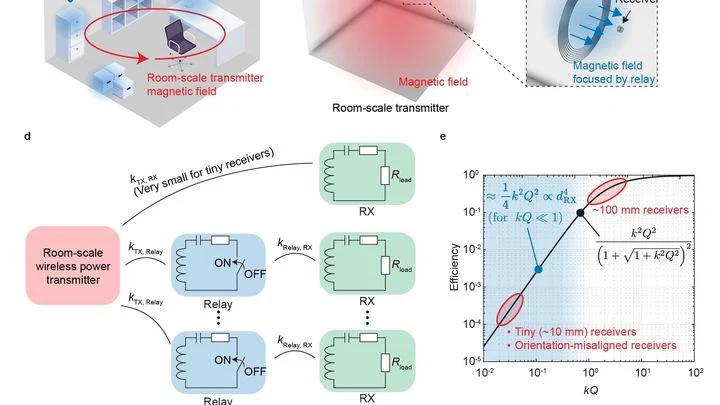
Think of wireless charging in a room as a pool where energy-water is everywhere, and tiny sensor-floats barely bob. Their induction coils are too small to efficiently scoop from this diffuse electromagnetic field. Unlike radio waves, the energy here doesn't travel at the speed of light: it lingers in the near field, waiting to be harvested.
A microwave signal that doesn't jitter from interference is needed in both radar and telecommunications. Until now, a clean signal was obtained on bulky setups where lasers and resonators sat on an optical table. Now engineers have packed everything into a box the size of a cup—166 milliliters.
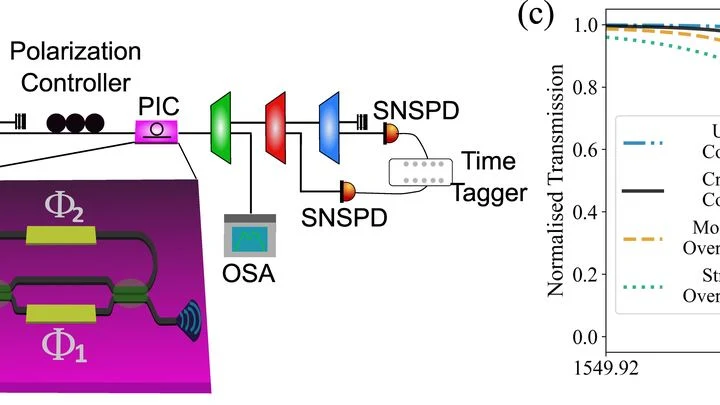
If light could be bottled, scientists would have the perfect assembly line: one bottle — exactly one photon, no stray drops. Such single particles of light are needed for quantum computers and secure communication: they carry information that cannot be eavesdropped on unnoticed.
A quantum computer is like an orchestra where each qubit is a musician, and a measurement is the conductor's attempt to hear who played what. But the hall is noisy: the signal fades like sound through a thick wall, and the conductor himself sometimes mixes up the notes.
A microwave oven heats food, but this circuit harvests energy from radio waves. Engineers have built a rectifier that converts 5.8 GHz microwaves into direct current. The big news: inside, there isn't a single capacitor: those little charge reservoirs that usually sit in every rectifier.
Short gamma-ray bursts — instantaneous, but most powerful explosions — are born from the mergers of neutron stars (the superdense remnants of dead stars).