Quantum Bridge Between Nodes express
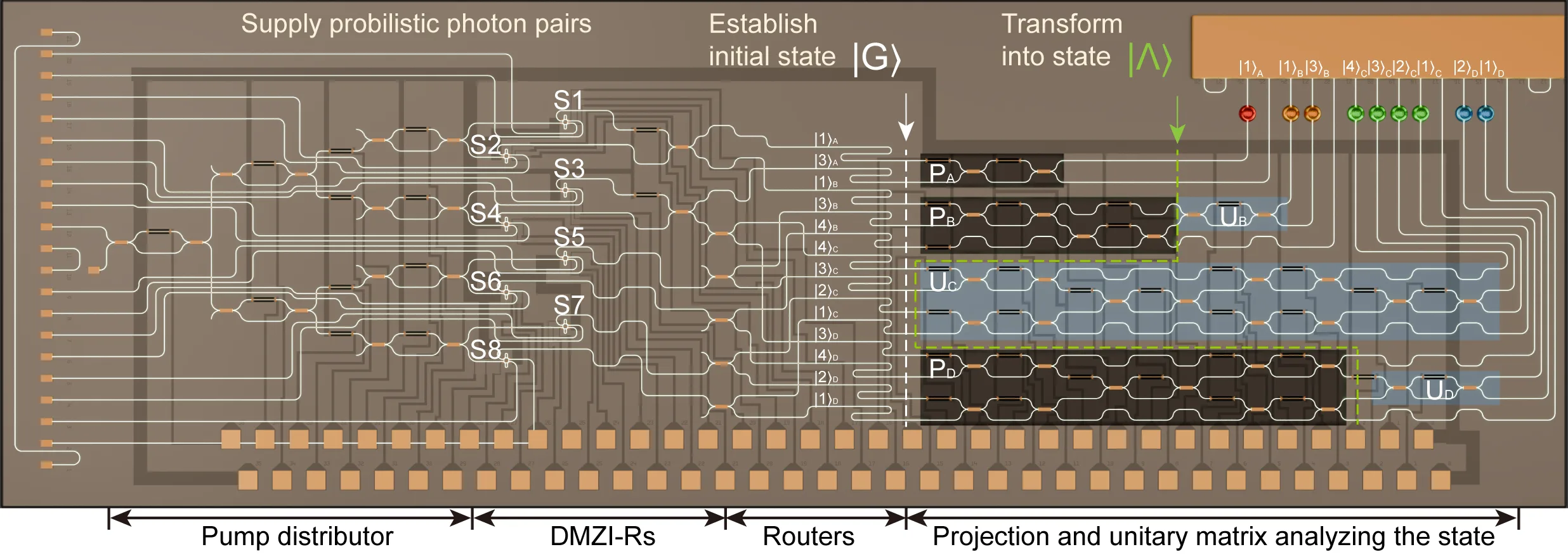
An ordinary random network is like a road map: to connect four cities with a complex interchange, you need to lay down many highways. In the quantum world, things are different. Physicists built a tiny network of four nodes on a silicon chip, where particles of light, photons, are linked not only by direct paths but also by invisible quantum entanglement. It's as if two cities were connected not just by asphalt but also by a teleporter that instantly transfers the state of one city to the other.
In the experiment, pairs of photons were generated on the chip, and the researchers steered their paths using light waves. They measured that a special connection emerged between the four nodes — high quantum entanglement that cannot be achieved in a classical network at the same connection density.
Such a quantum node is not just a curiosity. It shows that quantum networks can create complex structures with fewer resources than classical ones. This paves the way for more efficient quantum computers and secure communication, where intercepting a message is immediately noticeable.
Quantum entanglement is so strong that even if entangled particles are separated by kilometers, measuring one instantly determines the state of the other — faster than light could travel the distance.
In the series 'His Dark Materials', characters use entanglement to communicate across worlds without spending time on travel.