Photon entanglement is a quantum phenomenon where two or more photons share a single quantum state, such that measuring one instantly determines the properties of the other, regardless of the distance separating them. This non-local correlation is a cornerstone of quantum mechanics and underpins technologies like quantum cryptography, quantum teleportation, and quantum imaging. In practical terms, entangled photons act as carriers of quantum information, enabling secure communication channels that are fundamentally immune to eavesdropping.
History
The concept of entanglement was formalized by Einstein, Podolsky, and Rosen in 1935, but the first experimental verification of photon entanglement came in the 1970s with the work of John Clauser and Stuart Freedman, followed by Alain Aspect's experiments in the early 1980s.
How it works
Entangled photons are typically generated through processes like spontaneous parametric down-conversion, where a single high-energy photon splits into two lower-energy photons within a nonlinear crystal, preserving momentum and energy conservation. The two photons emerge with correlated polarizations, phases, or orbital angular momenta. When one photon is measured, the quantum state of the other collapses instantaneously, a feature that can be exploited to encode and transmit information. In scattering media, entanglement can be used to filter out noise and recover images that would otherwise be obscured.
In practice
Entangled photons are used in quantum key distribution (QKD) systems for secure communications, in quantum imaging to see through turbid media, and in quantum repeaters for future quantum internet architectures.
Fun fact
Entangled photons have been used to create images of objects that the photons never directly interacted with, a technique called ghost imaging.
On the table lies a layered cake of hexagonal boron nitride flakes, a material similar to graphite but made of boron and nitrogen atoms. One flake is carefully transferred onto another, and at the spot where they overlap, after heating in oxygen, bright single light sources are born.
A librarian in a rare-book archive takes a volume from the shelf and puts it back without waking the cat dozing nearby. That is roughly how the new quantum memory works: it catches a photon, tucks it into the mechanical vibration of a tiny silicon bridge, and returns it on request.
An ordinary random network is like a road map: to connect four cities with a complex interchange, you need to lay down many highways. In the quantum world, things are different.
The quantum networks of the future resemble the Tower of Babel: each node speaks its own dialect. Some store information in the polarization of a photon — the direction of oscillation of the light wave. Others use time bins: that is, when exactly the pulse arrives.
Each positron annihilation is like the birth of a pair of dancers, connected by an invisible thread of polarization. Two gamma quanta fly apart, but their states remain entangled: measuring one instantly determines the other — as if one partner senses every movement of the other, no matter the distance.
A living cell constantly emits faint magnetic signals, as if whispering. Scientists eavesdrop on this whisper with two microscopic 'microphones'—magnetic field sensors.
Quantum entanglement often behaves like a synchronized dance visible from only one angle. Change the way you observe it, and the particles appear disconnected. This limits secure communications. Now physicists have created a pair of photons whose 'dance' is flawless from all perspectives.
Quantum computers of the future will likely communicate via light. An atom stores information, and a photon carries it across the network. But an atom doesn't hang still: it jitters and oscillates, and this motion can corrupt the signal.
Previously, engineers could only calculate for a stationary atom.
A surfer glides across the ocean surface until a big wave comes, and then they're flying forward. Similarly, a free electron interacts with light: usually the energy exchange is barely noticeable, but if the surrounding medium begins to oscillate rhythmically, each wave crest pushes the particle harder and harder.
Toss a handful of phosphorus into silicon, and at a certain impurity concentration the material suddenly starts conducting electricity. This is a metal-insulator phase transition, and it happens abruptly. But what exactly changes in the electron wave functions when an insulator becomes a metal?
Spacetime can be imagined as a tightly stretched fabric. A massive body dents it, guiding light. Rotation twists the fabric into a spiral. Such a gravitational funnel can entangle a passing photon with the very source of rotation — say, a tiny mirror. Quantum entanglement springs up: an invisible thread binding their fates.
A single camera shot stores both a normal picture and a hidden map of how light rippled through the scene. Quantum entanglement makes this possible. Pairs of linked photons are generated: one visits the object, its twin takes a detour. Later, measuring the twin one way pulls out the brightness information.
Light loves symmetry: in an open channel, it flows equally both ways. To steer it one way, physicists often use magnets. A new approach does without, using rotation — just the speed of a vinyl record — and interference from two atoms. Rotation changes the “pitch” of light for different directions, just as a siren’s tone shifts when a car approaches or recedes.
Light is a stream of photons. In a special waveguide, resembling a narrow corridor, a 'gatekeeper' atom usually lets them through one at a time. This phenomenon is the domain of single-particle spectroscopy.
Two simultaneous interpreters sit in the same booth. The first translates from English into Russian but swallows half the words. The second goes from Russian into French, and also loses half. If you put them together, you'd expect a mess: the losses would add up, and only a quarter of the meaning would reach the listener. But what if they start correcting each other?
Light in an optical fiber runs along the core, barely escaping outside. But if you get very close, you can feel a faint trembling of the field at the surface — the evanescent wave. It is in this 'light fog' above the surface of a tiny silicon ring that physicists have caught a single rubidium atom.
Light bends around massive bodies: this has been known since Einstein's time. But what if gravity itself is not a smooth fabric of space but a stream of tiny carrier particles? Then a beam passing near a particle should not just bend but enter into a special quantum relationship with it.
This relationship is called entanglement.
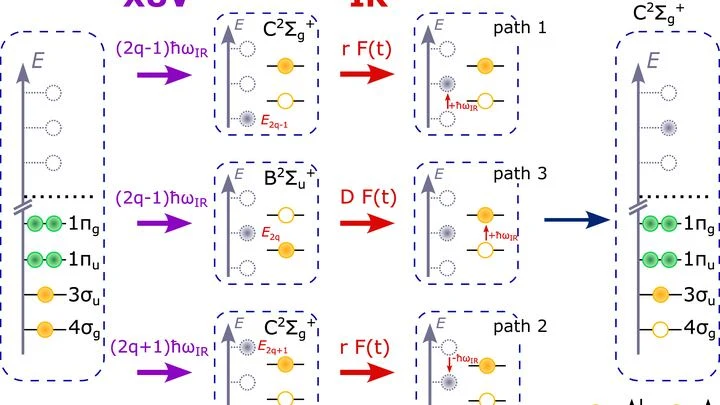
A high-speed camera capable of capturing the motion of electrons is an attosecond interferometer. It sends two laser pulses at a substance with a tiny delay. The first, ultraviolet, acts like a flash, knocking an electron out of the molecule. The second, infrared, like an invisible hand, gently nudges or slows this electron in flight.
A deuterium molecule, two atoms of heavy hydrogen, falls apart under a laser pulse. One electron is ripped away, leaving an ion behind. At that moment, they are still linked: the direction of one immediately tells you which way the other went. This link is called quantum entanglement.
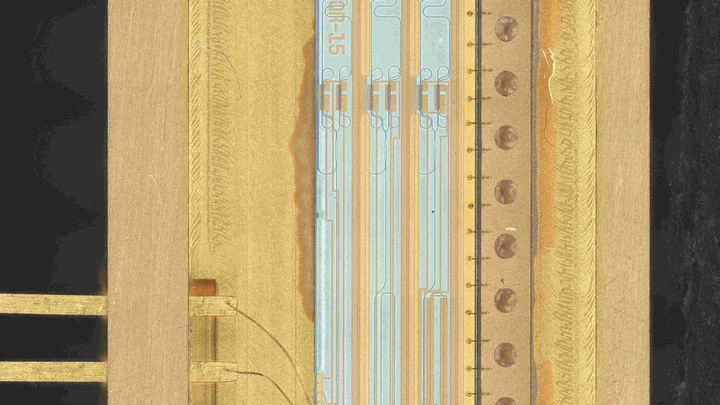
Light can act as a courier carrying secret messages. But to ensure the courier doesn't lose a single letter, you need to meet and check it very quickly. The new chip made from a thin film of lithium niobate is like a turnstile that opens and closes in billionths of a second, letting light pulses through at just the right moment.
An ordinary envelope has a rectangular shape, and the letter inside does not change the envelope's properties. With photons, particles of light, the situation is different: their 'shape' in time can vary, and this shape itself carries information.
Two pendulums on a stable table swing independently. If you place them on a shaky surface, vibrations synchronize their motion. The same principle worked on a silicon chip with photons.
Scientists created two sources of light that emit pairs of particles.
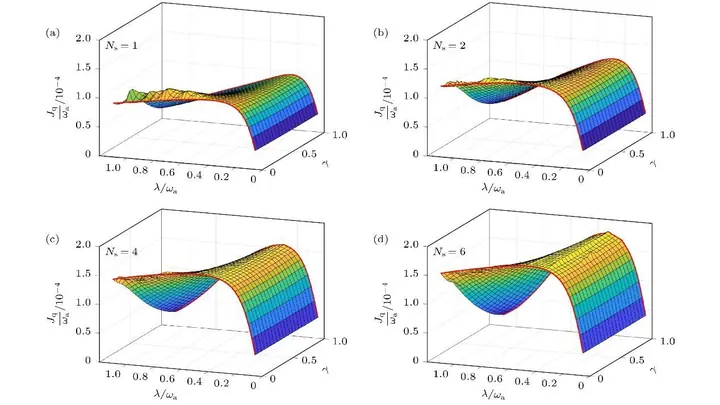
Light and atoms, like dancers, can move in sync or out of step. When their interaction is anisotropic (that is, direction-dependent) the dance gets trickier. In a new study, physicists considered a model where many atoms (qubits) collectively interact with an anisotropic light field, and each component is connected to a thermal reservoir.
Two coins are flipped in different cities, but they always land the same way. Physicists call this entanglement: particles behave as if an invisible thread connects them. But what if the thread isn't instantaneous, just very fast — still not faster than light? Then some signal could slip between measurements, and the coincidences would be explained without any magic.
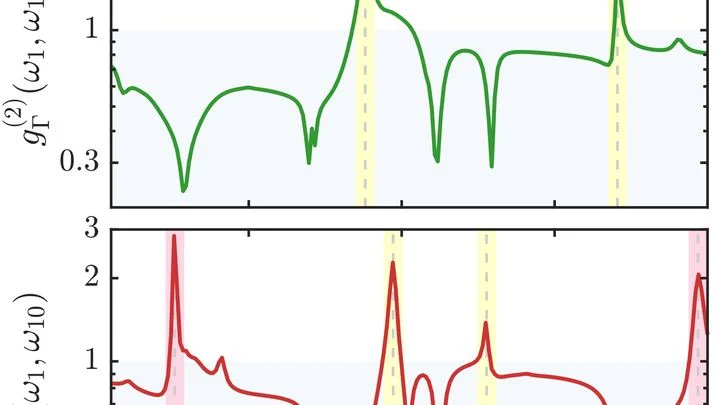
A quantum dot is like a tiny lamp that turns on and off at the command of a laser, emitting exactly one photon at a time. But this light has a quirk: the photons don't interact with each other; they fly independently, like random drops from a faucet.
Entangled photons are like two couriers marching in lockstep: their quantum states, particularly polarization, are synchronized so that measuring one instantly determines the state of the other, even at a distance. In a material, this synchronization gets disrupted.
In a dark room, an atom and light are locked together in a mirrored box. The box is so small that the atom cannot simply release light: they constantly exchange energy, like two dancers who never let go of each other's hands.
In quantum theory, a particle can run along two paths at once. When measured, we catch it on just one. According to Niels Bohr, all other possibilities vanish instantly — like a branch snapped off a trunk. Yet Hugh Everett insisted: the tree of reality grows all its branches at once, and we only see the one we’re on.
A good chef tastes the soup and adds a pinch of salt. Ordinary scales won't notice that pinch, but sensitive ones will. In the quantum world, pairs of entangled particles play the role of such scales. It was previously thought that the entanglement had to be as strong as possible, otherwise precision wouldn't improve.
Ordinary messages can be intercepted without anyone noticing. Physicists have come up with a way to create a shared secret that instantly breaks if someone so much as glances at it. Instead of paper, they use single particles of light. This quantum communication exploits a rule: any measurement changes a quantum object.
Two photons fly out of a tiny box, and behave like twins who always wear matching outfits. Turn one, and the other instantly turns the same way, even if they are kilometers apart. This is no magic trick but quantum entanglement: a connection between particles that defies distance.
Researchers have built a compact source of such pairs.
A light beam sent from Earth to a satellite scatters in the atmosphere, like a flashlight in fog. To keep the signal intact, you need short-wavelength light that spreads less. Such light is born in special crystals, but shrinking them to chip size is tough.
A grain-of-sand-sized device: a tiny mirror-dish holds a single rubidium atom and collects the glow it emits under a laser beam. The trapped light particles are sent into an optical fiber — the whole setup is precise and stays aligned even when shaken.
Two photons, like two halves of the same coin, fly tens of kilometers apart but remain linked: measure one, and you instantly know the state of the other. This property is called entanglement, and it underpins quantum communication.
Inside a tiny mirrored cavity, smaller than the thickness of a hair, light is trapped and bounces off the walls many times. If you place a material that can absorb and emit light inside, the light particles (photons) start to 'dress' in excitations of the material — this is how polariton modes are born.
Imagine two synthetic diamonds, each acting as a high-precision tuning fork. Inside the crystal lattice of each diamond sits a carbon-13 atom: this is a quantum bit, or qubit, the minimal unit of quantum information.
Entangled photons are like twins: what affects one instantly affects the other, even if they are separated by kilometers. Until recently, observing such a connection required detectors that counted each photon individually in pitch darkness. Physicists simplified the task by swapping them out for a regular scientific camera.
The idea of quantum teleportation was proposed by Charles Bennett and realized by Anton Zeilinger. It uses entanglement — when two particles are in sync, like two sheets of paper that instantly copy the same drawing. But earlier, the "ink" would blur, ruining the blueprint.
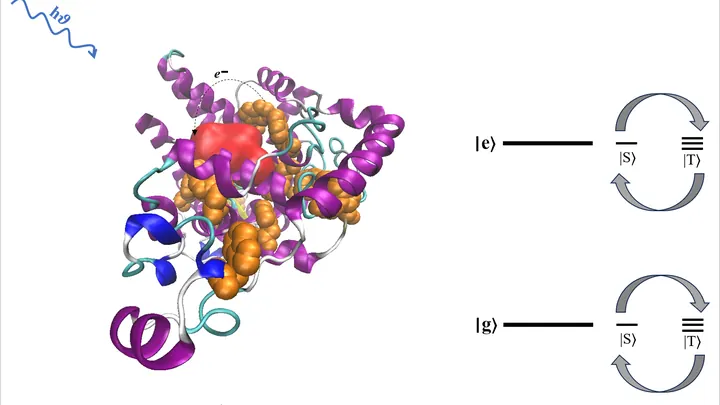
Birds migrate using the magnetic field. In their eyes, there's a protein called cryptochrome. It captures sunlight, especially blue light, and triggers a reaction. Absorption of light leads to the formation of a particle pair that is acutely sensitive to magnetic fields.