concept

feynman

Richard Feynman was a physicist who proposed the idea of quantum computers for simulating quantum systems.
49 related articles

Description

Richard Feynman was a theoretical physicist who, in 1981, proposed the idea of a quantum computer as a machine specifically designed to simulate quantum systems. He argued that classical computers would inevitably struggle with the exponential complexity of quantum mechanics, and that the only way to truly understand nature was to build a computer that operated on quantum principles. His insight laid the foundation for the entire field of quantum computing, shifting it from a purely mathematical curiosity to a practical engineering goal.

History

Richard Feynman introduced the concept in a 1981 keynote speech at the MIT Computer Science and Artificial Intelligence Laboratory, and later in a 1982 paper titled 'Simulating Physics with Computers.'

How it works

Feynman's key observation was that the number of variables needed to describe a quantum system grows exponentially with its size. A classical computer trying to simulate even a modest number of interacting particles would run out of memory and time. A quantum computer, by contrast, uses quantum bits (qubits) that can exist in superpositions of states, allowing it to represent and process this exponential information in a natural, parallel way. This makes it a fundamentally different tool, not just a faster classical computer.

In practice

Feynman's idea directly drives today's efforts to build quantum simulators and quantum computers for chemistry, materials science, and fundamental physics, as seen in the development of quantum processors that model molecular behavior and exotic magnetic states.

Fun fact

Feynman also contributed to the Manhattan Project and won the Nobel Prize in Physics in 1965 for his work on quantum electrodynamics, a theory he helped formulate using his own path-integral approach.


Concept graph →

Related articles · 49

Quantum Physics2026-08-111 minarXiv:2608.10663express
Quantum Bridge Between Nodes
An ordinary random network is like a road map: to connect four cities with a complex interchange, you need to lay down many highways. In the quantum world, things are different.
Quantum Physics2026-07-312 minarXiv:2607.29582express
Quantum First Aid for Power Grids
An electrical grid stuffed with power electronics resembles a huge orchestra without a conductor. Each converter, each line adds its own note, and sometimes the instruments start playing out of tune.
Quantum Physics2026-07-211 minarXiv:2607.18805express
A Black Hole on Your Desk
A black hole's horizon is not a wall but rather a one-way membrane. Anything that crosses it disappears forever. Stephen Hawking showed that this boundary should glow faintly, emitting particles. But catching such radiation from a real black hole is impossible: it's too far and too dim. Physicists have found a workaround: build a "toy" black hole out of magnetic atoms.
cs.SE2026-07-112 minarXiv:2607.10347express
Quantum System Confuses Blueprints, but Engineers Don't
Quantum devices are no longer lab curiosities. They are assembled, tuned, and repaired like ordinary hardware — except inside them, it's not just current but intricate tangles of particles that can exist in multiple states at once. Engineers draw schematics, programmers write code, physicists calculate effects.
Quantum Physics2026-06-251 minarXiv:2606.27224express
Giant Atoms Solve an Unsolvable Quantum Puzzle
A network of tiny magnets seeks the state with the lowest total energy: that's roughly what the quantum Max Cut problem looks like, one of the toughest in physics. Scientists have been hunting for its solution since the days of Werner Heisenberg.
General Relativity2026-06-182 minarXiv:2606.20975express
Quantum Computer Solves Einstein's Equations for the First Time
Strike a tuning fork with a mallet — it vibrates, and the sound gradually fades. A black hole behaves much the same way when disturbed: it emits gravitational waves — ripples in spacetime itself — and then settles down.
Quantum Gases2026-06-172 minarXiv:2606.19444express
How to See Invisible Fermions with Chameleon Atoms
The quantum world is full of transformations. Sometimes a system made of one type of particle starts behaving as if it harbors completely different ones. For example, in a chain of bosons, sociable particles that like to crowd into the same state, fermions from the Standard Model may unexpectedly appear, even though they usually keep to themselves.
Wet Water and a Thinking Processor
In the 1990s, philosopher John Searle devised a thought experiment: a person sits in a room and, without knowing Chinese, follows instructions to produce correct answers in Chinese. From the outside, it seems they understand the language, but inside, it's just mechanical rule-following.
Materials2026-06-081 minarXiv:2606.09422express
Paimon: AI Chef in the World of Atoms
Computational studies of material behavior have long suffered from two extremes: either fast but inaccurate models, or accurate but slow physical calculations. Modern programs, trained on data, have nearly resolved this dilemma — now the bottleneck is not computing power, but human routine: setting up simulations and checking results. Paimon works like an autonomous chef.
Quantum Physics2026-05-292 minarXiv:2606.00254express
Quantum Dance in a Protective Cocoon
A quantum computer is like an orchestra: each musician plays their own part, but the slightest noise from the audience can throw off the whole ensemble. The particles that store information easily lose their coherence from thermal jolts or stray magnetic fields.
General Relativity2026-05-281 minarXiv:2605.30405express
Universe as a Precise Mechanism: No 'Boltzmann Brains'
An eternal Universe where the measure of disorder (энтропия) grows is, for most of its time, a homogeneous void. In it, complex structures occasionally assemble by chance, such as fleeting consciousnesses — ‘мозги Больцмана’.
Clock Without Hands: Can Time Emerge from Eternity?
An old mechanical alarm clock ticks on the shelf. You hear the steady sound, see the hands moving, and you're certain time is passing. But if you take the clock apart, you won't find a single part labeled "time." Only springs and gears.
Quantum Physics2026-05-191 minarXiv:2605.19706express
Quantum Droplets: Precision Unattainable
The quantum world is usually drawn with points, but real instruments only see blurry spots. Heisenberg and von Neumann long suspected: precision is unattainable.
Quantum Physics2026-05-161 minarXiv:2605.16978express
Getting the Most Out of a Weak Signal
Dip your finger into water once, and from that single sensation, try to guess its temperature. In the quantum world, such one-shot measurements happen all the time, except you have to guess invisible parameters: say, the squeezing strength of a laser beam.
Quantum Physics2026-05-103 minarXiv:2605.09325express
Three Emitters Instead of a Laser Battery
Before assembling a huge puzzle, you need to stamp out the pieces — otherwise the picture won't come together. In fusion-based quantum computers, the role of such pieces is played by tiny clumps of light — photonic resource states. They are collided and measured to gradually grow the computational fabric.
Quantum Physics2026-04-302 minarXiv:2605.00205express
Quantum and the Cell: Three Roads at the Crossroads
Three craftsmen work in the same workshop. The first tries to figure out whether tiny hourglasses are built into nature's own machinery. The second attaches a laser pointer to a microscope to see details invisible to the naked eye. The third, conversely, takes living threads and carefully weaves them into fragile quantum circuits.
Quantum Physics2026-04-291 minarXiv:2604.26813express
The Magic That Electrons Stole
Quantum computers promise to solve problems that regular computers can't. But where is the line? The authors of a new study stumbled upon a surprising case: electrons paired up behave like a well-behaved orchestra. Even if you add a bit of "magic"—a special quantum resource: their behavior remains predictable.
Mesoscale2026-04-211 minarXiv:2604.19304express
Magnetic Walls — The Key to Quantum Computers
Imagine a line of dominoes: when the first one falls, it pushes its neighbor, and a wave rushes down the chain. The boundary between fallen and standing dominoes is a perfect image of a magnetic wall. In microscopic magnetic films, these walls separate zones with different magnetizations.
Quantum Physics2026-04-081 minarXiv:2604.07639express
Quantum Rainbow: How a Tiny Computer Sorts Mountains of Data
A classical computer sorts data like a person meticulously sifting through grains of sand of different colors. A quantum processor takes its cue from nature: just as a droplet of water splits sunlight into a rainbow, revealing all hues at once, this new algorithm instantly grasps the essence of vast information arrays.
Quantum Physics2026-04-071 minarXiv:2604.06322express
Quantum Computers Will Challenge Gravity
The biggest puzzle in physics is how to reconcile spacetime curvature with quantum mechanics. At the Planck length, billions of billions times smaller than an atom, the rules break down. This frontier was discovered by Max Planck.
Quantum Physics2026-03-201 minarXiv:2603.20372express
Quantum Physics2026-02-061 minarXiv:2602.06544express
Light Learns to Count
Light races through a maze of mirrors and beam splitters, but at the end of its journey, it doesn't just flash on a detector: it transforms itself. In the new photonic computer, nonlinear modules have been added to the familiar linear circuits, and now light can perform any quantum operation, not just a subset.
Quantum Physics2026-02-021 minarXiv:2602.02077express
Clocks That Tick Quantumly
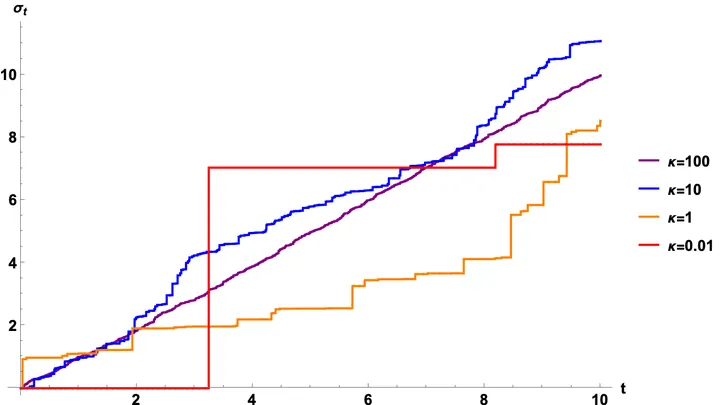
A regular wall clock runs smoothly, but quantum clocks are a different story. They tick at random moments, and each tick can have a different duration. On average, if you watch such a clock for a long time, it will show the correct time. But at any given moment, its hand might jump forward by an unexpected amount.
Quantum Physics2026-01-291 minarXiv:2601.22091express
Quantum Computer Tries on a Diamond
In a diamond crystal, a tiny defect sometimes occurs: a nitrogen atom takes the place of a carbon atom, and nearby a lattice site is empty. Electrons in this spot behave like a spinning top that can rotate in different directions. These 'spinning tops' are ready-made cells for future quantum computers and ultra-sensitive sensors.
Quantum Physics2026-01-242 minarXiv:2601.17465express
Quantum sensor learns from its mistakes
The magnetic field you want to measure is like a melody played in a noisy hall. A quantum sensor is a microphone that can pick up the faintest notes, but it also hears more than just the music: rustles, creaks, the breathing of neighbors. All of that mixes into the signal and spoils the recording.
Quantum Physics2026-01-221 minarXiv:2601.15677express
Quantum Physics2026-01-131 minarXiv:2601.08213express
How a Computer Reads Qubits in an Instant
A quantum bit, or qubit, is like a coin spinning on a table, able to be both heads and tails at once. For the computer to know what came up, you have to stop the coin and look. Previously, this stopping was done with a delay: data was read out, taken to a regular computer for processing, and only then was the result known.
Quantum Physics2026-01-121 minarXiv:2601.07825express
Quantum Computing with Sound Waves
Inside a tiny crystal, sound is trapped like light in a mirrored room. It bounces off the walls and forms standing waves — a multitude of harmonic oscillations, each with its own frequency. Physicists have learned to use these oscillations as qubits — the basic units of quantum information.
Quantum Physics2026-01-121 minarXiv:2601.08068express
Quantum computers save not just time, but also energy
When making popcorn, a microwave uses electricity only to heat the kernels. A gas stove heats the entire burner and the air around it. The same difference applies between a photonic quantum chip and a classical supercomputer when solving a problem devised by Scott Aaronson.
Quantum Physics2025-12-201 minarXiv:2512.18400express
The Quantum Coin: Bohr & von Neumann's Solution
A quantum particle, an inhabitant of the elementary particle world, resembles a coin spinning in the air: neither heads nor tails, but a blend of possibilities. Yet when it lands on the table, the outcome becomes definite. What serves as the table in a measurement?
Quantum Physics2025-12-031 minarXiv:2512.03659express
Quantum Elections: No One Will Know Your Vote
There's always a risk that someone will peek at your ballot during an election. Physicists have come up with a solution: anonymous voting safeguarded not by people, but by the laws of nature. Their 'magic ballot box' operates with light particles — photons.
Quantum Physics2025-12-011 minarXiv:2512.01982express
Seven Truths That Can't Coexist in the Quantum World
We are used to thinking that events have causes, objects exist independently, and signals cannot outpace the speed of light. Quantum mechanics, which describes the Standard Model of particles, challenges all these assumptions at once — as if a recipe couldn't use all seven ingredients.
Quantum Physics2025-10-301 minarXiv:2510.26547express
Quantum Leap: A Day Instead of 22 Years
Turning CO₂ into fuel is like finding the one perfect way to pack billions of items into a suitcase. A classical computer tries options one after another, taking decades, while a quantum computer sees all combinations at once.
Quantum Physics2025-10-291 minarXiv:2510.25838express
Quantum Chip Outperforms Supercomputers: Two Hours vs. Years
The task resembles a giant maze with a single exit among billions of dead ends. A conventional computer checks each corridor step by step — taking centuries. A quantum processor launches a wave that seeps through all paths at once. The correct route echoes back, amplifying, and the answer is found in hours. That’s exactly how the “peak” circuits worked in the new experiment.
Quantum Physics2025-10-151 minarXiv:2510.13247express
Quantum Mind? Can't Do Without the Classical
Intelligent action begins with a plan. Just as an architect needs blueprints to evaluate options, any agent with will needs to repeatedly copy data about reality.
Two Arrows of Time from Timelessness
Time in quantum mechanics is like a shadow on a wall: we see its motion, but we cannot grasp the shadow itself. The Schrödinger equation describes how a system's state changes, but time enters it as an external parameter that nothing measures.
Mental Entanglement: The Quantum Language of Neural Networks
In 1935, Erwin Schrödinger, peering into the equations of quantum mechanics, saw something strange: two particles could be linked so tightly that the state of one instantly determines the state of the other, even if they are separated by kilometers.
Quantum Conductor: Entangled Photons Take the Concert Stage
In September 2024, the concert hall in Linz had more than just an orchestra on stage. Next to the musicians, a setup was generating pairs of entangled photons: a laser with a wavelength of 405 nm passed through a nonlinear crystal and split into two photons at 810 nm, which flew off to two measurement stations, Alice and Bob.
Vortices on the Quantum Stage
Two vortex rings launched one after the other pass through each other and swap places. This dance, first seen in the 19th century with smoke rings, has now been reproduced on a quantum processor. Vortices are the actors on a quantum stage where time plays the role of an extra dimension.