Cosmic Chemistry: New Lines in the Tarantula Nebula's Glow express
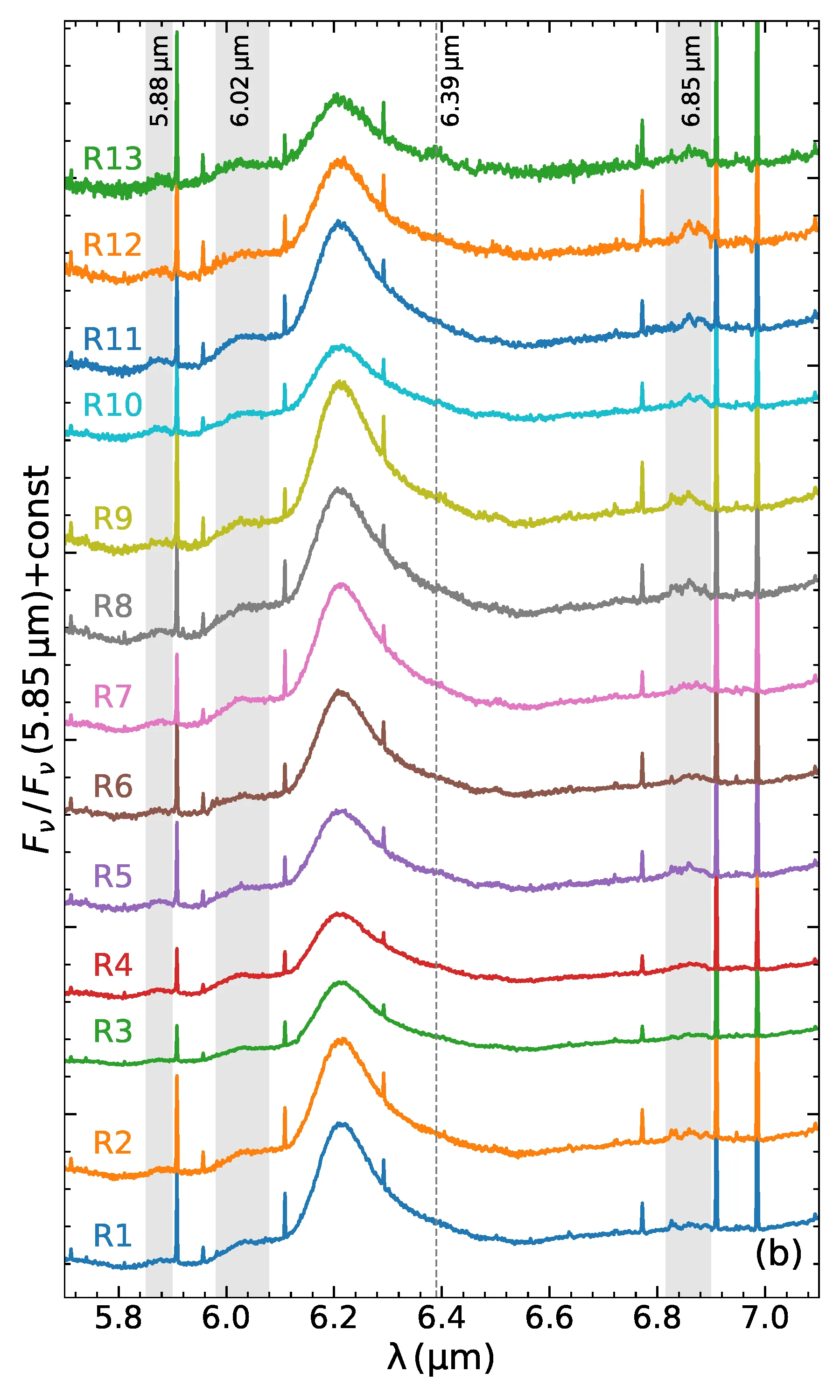
The Tarantula Nebula is a giant stellar nursery in a neighboring galaxy. Hundreds of thousands of stars are born there, and their light illuminates clouds of dust. This dust glows in the infrared, and its spectrum shows mysterious bands. For a long time, astronomers debated which molecules produce them. Now, the James Webb Space Telescope has allowed us to examine these bands in unprecedented detail. It turns out the dust contains not only the familiar aromatic compounds but also aliphatic ones: those found in fats and oils.
In the nebula's spectrum, a line was found at a wavelength of 4.65 micrometers. It arises when an atom of deuterium, heavy hydrogen, vibrates within a molecule. This means part of the dust is enriched in deuterium. Additionally, in the region of 6.85 micrometers, three narrow substructures are visible that no one had noticed before. They indicate that the aliphatic chains in the dust have different structures. It's like finding both saturated and unsaturated fats in the same piece of butter.
This discovery is important for understanding how complex organic molecules appear in space. Aliphatic compounds are building blocks for larger structures, including those needed for life. The Tarantula Nebula turns out to be a natural laboratory where these processes are happening right now. And the Webb telescope lets us watch them in real time.
Deuterium is hydrogen with an extra neutron. If you drank a glass of heavy water, where all the hydrogen is replaced by deuterium, your body would slow down: chemical reactions involving deuterium proceed 6–10 times less readily.
In Poul Anderson's novel 'Tau Zero', the crew of a spacecraft watches stars and complex molecules form in nebulae, and these processes turn out to be the key to humanity's survival.