Atomic Shower for a Levitating Sphere express
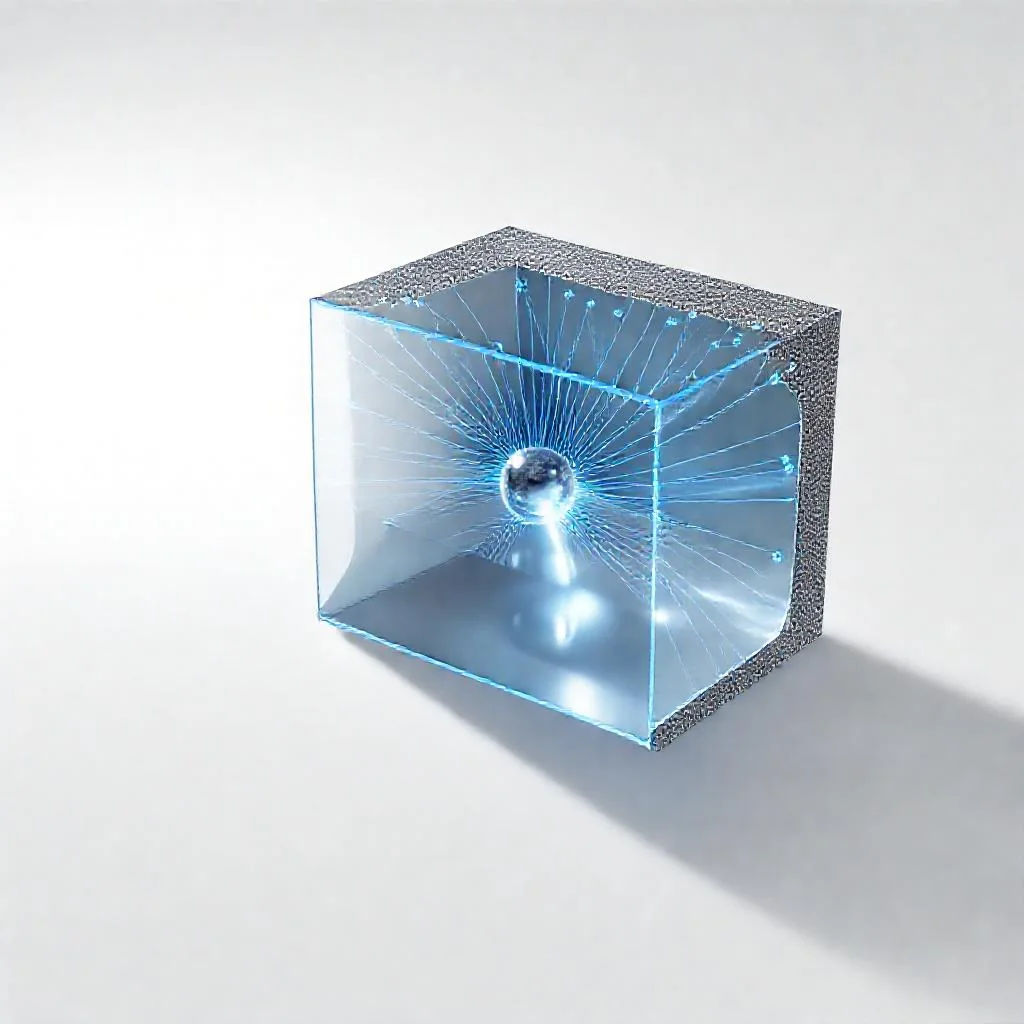
A billiard ball hangs in midair. Tiny peas shoot at it from a blowgun. Each hit is barely perceptible, but if the ball is very light and barely trembles from heat, you can make out individual nudges. That's essentially the setup: a glass sphere the size of a bacterium levitates in a vacuum while a narrow beam of xenon atoms flies at it.
The sphere is cooled to its quantum ground state: its own jitter nearly comes to a halt. The xenon atoms are accelerated to supersonic speeds and released in short bursts, like a paintball marker on full auto. When an atom strikes the sphere, the sphere receives a momentum kick of less than 50 keV/c, as if a mosquito pushed a soccer ball, but billions of times weaker. The instrument catches such kicks with 96% confidence.
The main achievement is distinguishing kicks from the atomic beam against random hits by residual gas molecules in the vacuum chamber. It's like hearing a soft knock on the door over street noise. Now researchers can study how the force between an atom and a surface changes as they nearly touch. Such levitating spheres could also become ultrasensitive scales for single impacts — from cosmic particles or molecules, for instance.
So the billiard ball turns into a microphone that hears a single dust mote fall.
Original abstract
as written by the authors arXiv:2608.17656v1
Using supersonic expansion, we create a time-gated, directional beam of Xe atoms with a narrow momentum distribution and detect their collisions with a levitated nanosphere cooled to its quantum ground state. We observe individual momentum kicks below 50 keV/c with 96% confidence and distinguish directional momentum transfer from the atomic beam against the background of thermal collisions. Our experiments constitute a first step toward the exploration of distance-dependent short-range interactions between atoms and levitated systems, as well as toward the use of levitated platforms for impulsive force sensing in previously unexplored parameter regimes.
The sphere in the experiment is a billion times lighter than a grain of sand, yet its position is tracked to within fractions of a nanometer — smaller than an atom.
In Stanisław Lem's novel Solaris, the ocean responds to the slightest perturbations — levitating spheres similarly sense the touch of a single atom.