Immortal Stars with Black Holes Inside: How Gas Accelerates Mergers in Galactic Centers ✛
At the center of a galaxy, where a supermassive black hole spins a disk of scorching gas around itself, giant stars sometimes form. They are unlike ordinary stars: the disk continuously feeds them with matter, and a star can grow to hundreds of solar masses, staying bright as long as the gas flow lasts. Such a star is like a sponge soaking up water: it lives while it is being filled. If a stellar-mass black hole falls into this sponge, something extraordinary begins.
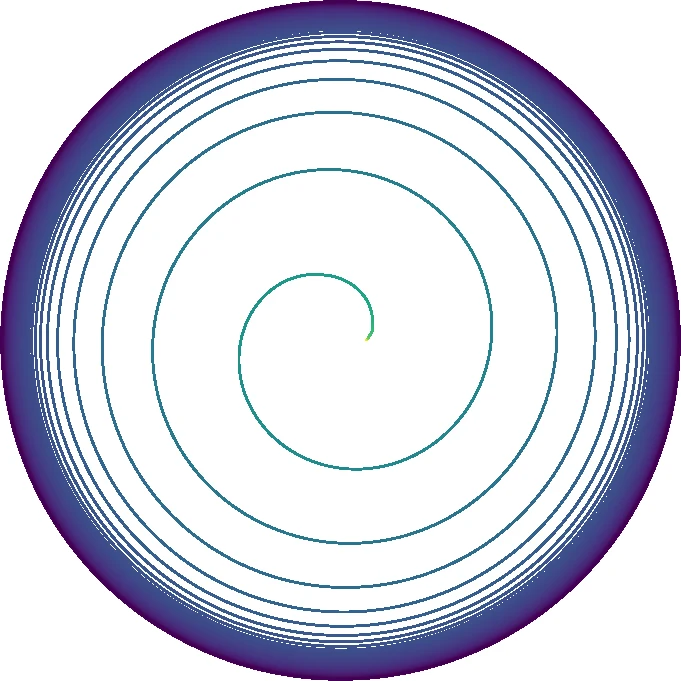
The black hole, once inside the star, does not immediately fall to the center. The surrounding gas slows its motion just as viscous honey slows a falling lead shot. This gas drag makes the black hole spiral inward, gradually approaching the star's core. The journey from the surface to the center takes about a tenth of a year — an instant on cosmic timescales. If a second black hole enters the star, they meet in the core and form a tight pair.
The pair of black holes inside the star behaves like two drops of mercury dropped into oil. The surrounding gas does more than just slow them down: it extracts energy from their orbital motion, driving the black holes closer together. The merger time shrinks from millions of years to one hour. Gravitational waves from such a merger would be visible to LIGO–Virgo–KAGRA detectors, but the signal has a peculiarity: at frequencies that LISA can hear, it is suppressed, and in the decihertz range, it is phase-shifted. The future DECIGO detector will be able to distinguish this signature.
Each giant star undergoes only one or two such mergers. After that, the gas inside it heats up or the star is destroyed, so hierarchical growth of black holes to intermediate masses is limited. This explains why the population of mergers detected by LIGO–Virgo–KAGRA shows an excess of events with positive effective spin: black holes that merged inside a star inherit its rotation.
Let's return to the sponge soaking up gas. A giant star in an active galactic nucleus disk is not just a passive reservoir. It becomes a natural merger accelerator, where gas plays the role of an invisible hand bringing black holes together in hours. This mechanism may have already left a mark in the data of gravitational-wave observatories, but to see it, we need next-generation detectors sensitive to decihertz frequencies. Then we could peer inside these stellar cocoons and see how pairs of black holes are born.
An immortal star with a radius of 12.5 solar radii contains gas with a core density of 16 g/cm^3—that's like 16 sugar cubes in a volume of one cubic centimeter. A black hole falling into such a core travels from the surface to the center in a time comparable to one orbit of Earth around the Sun, yet it makes hundreds of turns.
In Dan Simmons's novel 'Hyperion', the TechnoCore uses black holes to manipulate spacetime. Here, black holes inside stars act as natural merger accelerators, but the idea of compact objects hidden in dense environments and influencing the fate of a system resonates.