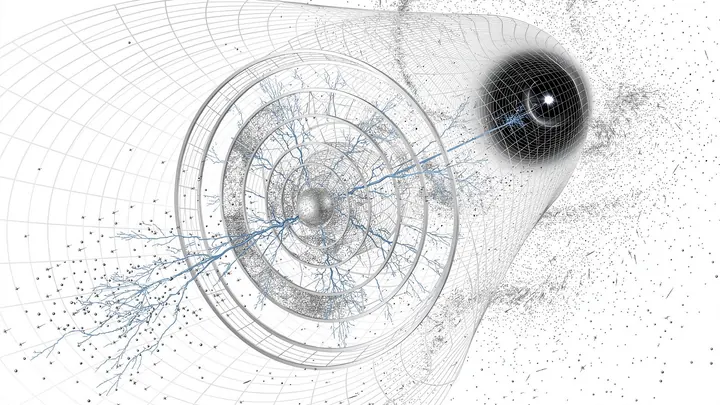
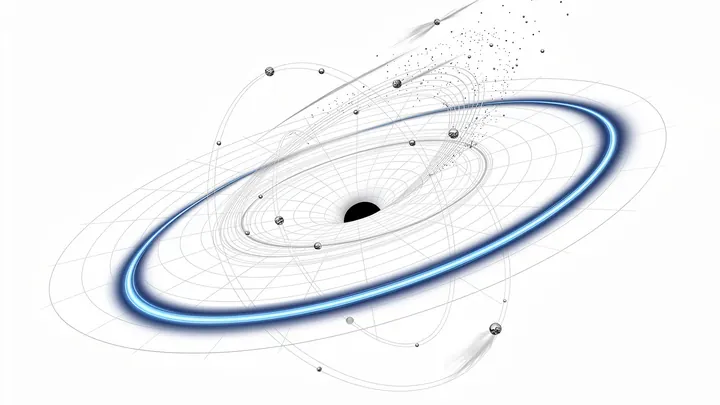
An active galaxy is a galaxy whose center, or nucleus, shines far more brightly than the combined light of its billions of stars. This extraordinary luminosity is not produced by stellar fusion but by matter spiraling into a supermassive black hole, which can have a mass millions to billions of times that of the Sun. As gas and dust fall toward the black hole, they form a hot, rapidly spinning accretion disk, where friction and magnetic forces heat the material to millions of degrees, releasing immense energy across the electromagnetic spectrum, from radio waves to X-rays and gamma rays.
History
The concept emerged in the mid-20th century with the discovery of quasars in 1963 by Maarten Schmidt, who identified their redshift as cosmological. The connection to supermassive black holes was established in the 1970s, notably by Donald Lynden-Bell and Martin Rees.
How it works
The engine of an active galaxy is the accretion disk around a supermassive black hole. Material drawn in by gravity loses angular momentum and spirals inward, heating up as it goes. The intense radiation and relativistic jets—collimated streams of plasmaejected along the black hole's spin axis—can outshine the entire host galaxy. The activity is regulated by the supply of fuel and by magnetic fields, which can either channel matter inward or launch powerful winds that push gas away, sometimes shutting off the accretion and making the galaxy 'sleep' until new material arrives.
In practice
Active galaxies serve as natural laboratories for studying extreme gravity, jet physics, and the co-evolution of black holes and their host galaxies, and they are used as beacons to probe the distant universe.
Fun fact
The Milky Way's own supermassive black hole, Sagittarius A*, is currently quiet, but it shows signs of having been active in the recent past, and astronomers have witnessed it 'waking up' with increased flaring.
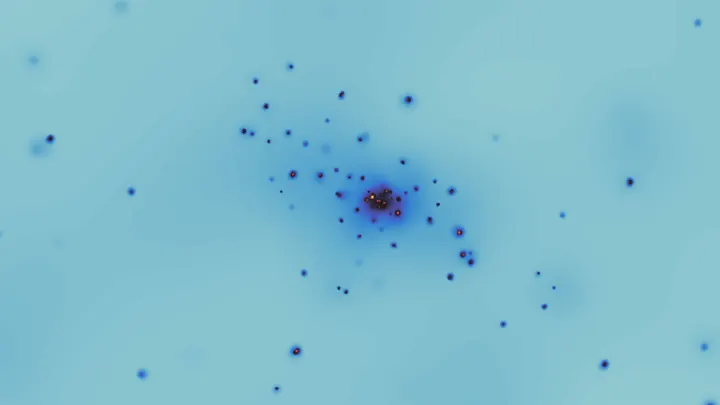
A little monster hides in a dwarf galaxy, and its neighbor feeds it. The satellite galaxy is slowly merging with a massive companion, and gas from the outer regions falls toward the center, where a black hole sits. By cosmic standards, it is not large: only 800 to 5000 solar masses, but its appetite is ferocious.
At the center of nearly every large galaxy sits a supermassive black hole. It doesn't just devour infalling gas; it also blasts some of it back out in powerful jets. These jets act like giant pistons, shoving the surrounding gas and heating it. Astronomers have long suspected that this is how black holes keep galaxies from cooling into cold star factories.
In active galactic nuclei, supermassive black holes are surrounded by a dense ring of dust that acts like a curtain: it hides everything happening at the center. If a star ventures too close to the black hole, tidal forces tear it apart, and the resulting flare is usually visible in optical and X-ray light.
At the center of a galaxy, where a supermassive black hole spins a disk of scorching gas around itself, giant stars sometimes form. They are unlike ordinary stars: the disk continuously feeds them with matter, and a star can grow to hundreds of solar masses, staying bright as long as the gas flow lasts.
A black hole with a mass of 35,000 Suns drifts through a galaxy's gas like a barge through fog. Its gravity rakes the material ahead of it, leaving a dense trail behind — a wake of gas. Some of that gas gets pulled into the black hole, and it grows.
At a concert, moving through a dense crowd is tough — the tighter the pack, the less you want to move. That's how active matter usually behaves: swarms of bacteria or robot flocks freeze in tight quarters. But one research group found the opposite effect.
In the distant Cigar Galaxy, there is an unusual beacon. It doesn't shine in the usual sense: its rays are born in a scorching cloud around a black hole that is devouring matter from a companion star. Such objects are called ultraluminous X-ray sources. Their X-ray brilliance is so intense that it outshines entire galaxies.
This cloud, the corona, is like a boiling cauldron.
Imagine a factory capable of producing a million parts per hour, yet it only makes a hundred. That's roughly how our Universe behaves when viewed through the lens of entropy — a measure of disorder that, according to physics, must only increase. The main "machines" of this factory are supermassive black holes.
A marathon lasting 13 billion years started with different weights. A hundred solar masses — lighter than some gas clouds. A hundred thousand — gravitational dominance, comparable to an elephant among kittens. That's what black hole seeds looked like, ones that by our time should have turned into supermassive giants.
A gas disk with a mass of four hundred thousand suns encircles the black hole at the center of the Milky Way. Its gravity works like a gravitational rudder: slowly but inexorably turning the orbits of binary stars, driving them into the region where tidal forces tear the pair apart.
The fastest wind in the Universe travels at 0,58 times the speed of light. It covers the distance from Earth to the Moon in two seconds. This wind is not a jet stream but a broad flow of gas erupting from the center of a galaxy. Not all black holes work the same: some create such hurricanes, while others produce narrow plasma beams.
Eight hundred million years after the Big Bang, and at the heart of a young galaxy a monstrous engine is already throbbing. A black hole with a mass of ten billion suns devours matter so greedily that its radiation should outshine everything around it. But outside, silence.
The cosmic spectacle unfolds on the stage of Galaxy галактики Centaurus A. In the lead role: a supermassive сверхмассивная чёрная дыра with a powerful jet that pierces space for hundreds of thousands of light-years.
At the center of the Milky Way, where the supermassive black hole Sagittarius A* reigns supreme (its metric first derived by Karl Schwarzschild), star S4714 makes a dizzying voyage.
A black hole is not just a vacuum cleaner. It glows faintly, emitting particles — this idea was proposed by Jacob Bekenstein, who connected the hole's temperature to its degree of disorder. Detecting such radiation in space is incredibly difficult.
In 1933, Fritz Zwicky first spoke of an invisible mass holding galaxy clusters together. Decades later, Vera Rubin mapped galactic rotation, revealing the ghostly presence of dark matter. Today we know it pervades the cosmos, but its particle nature remains elusive.
In the boundless night of space, galaxies come together in a slow gravitational dance, merging into one. Such collisions are not head-on impacts but rather like fingers moving slowly through water, leaving swirls and tails behind.
The heart of many galaxies is a supermassive black hole. It doesn't just sit at the center; it occasionally flares brightly as it swallows surrounding gas.
Massive gas outflows from active galactic nuclei are a key regulator of galactic evolution. They sweep out the interstellar medium, quench star formation, and dictate the growth of supermassive black holes.
A vast city lights new streetlamps every night. But then a hurricane sweeps in, rips all the fuel from the warehouses, and the lamps go out one by one. Something similar has been spotted by astronomers in a galaxy whose light has traveled 12.5 billion years to reach us.
Cosmic black holes at the centers of galaxies are like giant banyan trees: their aerial root‑filaments stretch for kiloparsecs to harvest nourishing matter. For decades astronomers have debated: how does cooling gas from cluster atmospheres fall into the sphere of influence of a supermassive hole?
The city has long been asleep: not a single lit window, not a single new house. Only in the very center, in one lone building, someone forgot to turn off a spotlight. That's what a galaxy looks like when stars are no longer born, yet its central black hole still shines.
A powerful vacuum cleaner sucks in not only dust but also its own collection bag. That's roughly how a black hole behaves at the center of a 'red dot'—a distant galaxy where the glow comes not from the hole itself but from its dense gas shroud. This shroud is so thick it resembles a puffed-up cool star. And, like many stars, it has a magnetic field.
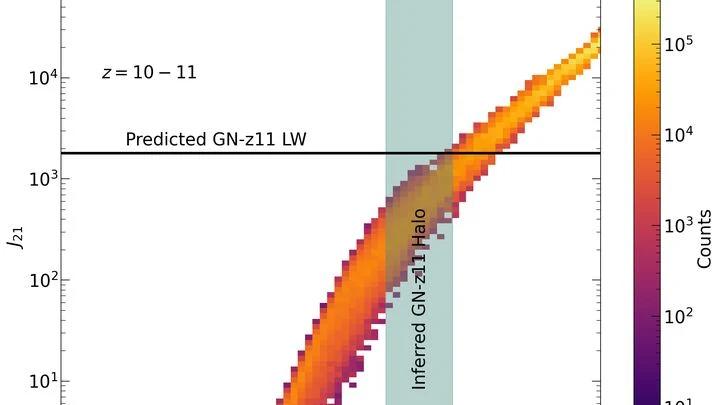
A bonfire built of pure alcohol burns hot and gives off almost no smoke. That's roughly how the first stars shone: they contained no heavy elements, only hydrogen and helium left over from the Big Bang. The James Webb Space Telescope may have caught one such "bonfire" in the galaxy GN-z11.
At the center of the Milky Way lies the supermassive black hole Sagittarius A*. It is four million times more massive than the Sun, but by cosmic standards it behaves quietly: it only occasionally flares up when it swallows a clump of gas.
A fountain shoots from the center of the city at a speed thousands of times faster than a courier bike. Such a 'fountain'—a stream of gas accelerated to 5500 kilometers per second — has been spotted by astronomers in the galaxy GLIMPSED-329380.
Tiny black holes, born right after the birth of the universe, are supposed to evaporate — shedding mass as invisible particles. This was predicted by Stephen Hawking, and this 'Hawking evaporation' contributed to the expansion of the young cosmos.
Dark matter is an invisible substance that keeps galaxies from flying apart. If its particles occasionally decay near the Sun, they shoot out streams of fast particles, like invisible hammers striking light. Each impact turns a particle of sunlight into a gamma ray — a super-powerful flash that telescopes can spot.
Astronomers used the infrared telescope and the old Hubble to discover a gaping void in the center of a galaxy in the Abell 402 cluster, as if an invisible tugboat had pulled billions of stars out of there. The missing mass equals two billion suns: it's not a cloud but a real lack of stars.
Two non-spinning black holes at the moment of merger give birth to gravitational waves — ripples in the very fabric of spacetime, captured by instruments developed with the help of Kip Thorne.
Dough rises faster when it already contains yeast. Similarly, galaxies may have assembled faster if they already had black holes inside. Astrophysicists considered a scenario where the universe contained primordial black holes from the very beginning — objects that could have formed in the first instants after the Big Bang.
Deep in the constellation Ophiuchus lies the galaxy NGC 6447. Until recently, it was quiet and unremarkable, like a house with its windows dark. But over the past 14 years, something has ignited at its center, and now it's visible in infrared light.
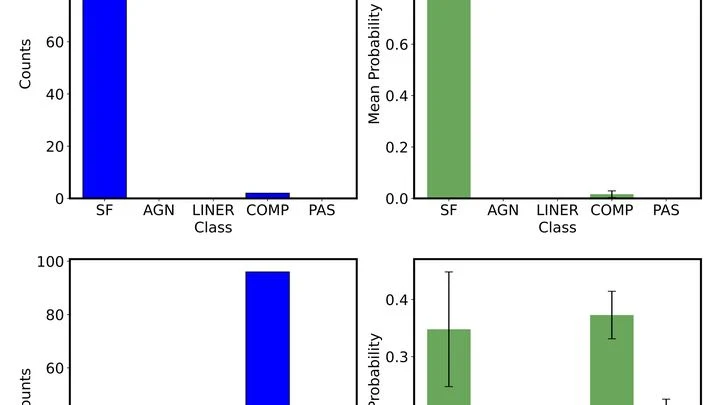
A galaxy is not just a sprinkle of stars. At the center of many, something shines brighter than billions of suns: hot gas falling into a black hole. The color of this glow reveals what kind of life the galaxy leads — quietly birthing stars or violently consuming matter.
One night in 2008, something in the core of the distant galaxy J1047+5907 flared sharply in X-rays. That's how the neighborhood of a supermassive black hole sometimes behaves: a scorching cloud of gas above it suddenly blasts out a powerful stream of light. The black hole itself emits nothing, but its surroundings can light up like a neon sign.
The night sky is full of beacons, but some shine in a way that makes them nearly invisible. Astronomers have discovered a new class of objects: ultrasoft X-ray sources. They are so "cool" by X-ray standards that their emission falls at the boundary between ultraviolet and soft X-rays, where ordinary telescopes are almost blind.
A quasar is a supermassive black hole at the center of a galaxy that devours matter and shines brighter than all the stars around it. Some of that energy goes into radio emission, which, it was thought, could heat or expel cold gas — the raw material for new stars.
At the center of galaxy VV 340a lies a supermassive black hole — an object with gravity so strong that even light cannot escape it. It emits a relativistic jet: a narrow stream of matter accelerated to near-light speeds.
Twenty years ago, an X-ray image of the Arches cluster resembled a photo of a person in thick fog: the cluster itself was drowned in the glow of a neighboring cloud. The cloud acted like a mirror, reflecting hard radiation from the vicinity of the black hole, and that reflection swamped the faint signal from the stars.