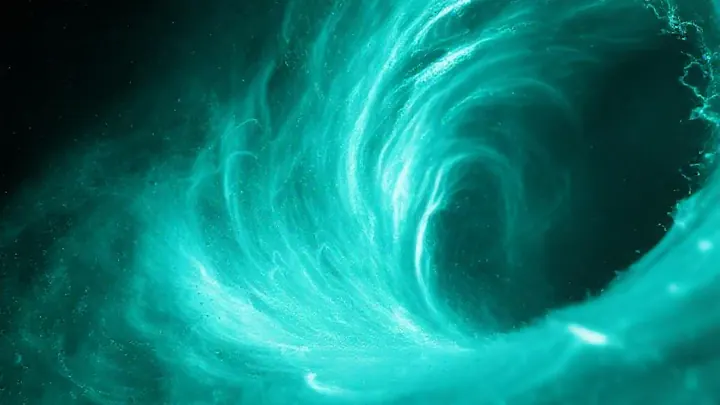
Gravitational interaction in accretion disks refers to the mutual gravitational influence between the disk of matter spiraling into a central object (like a black hole or neutron star) and other bodies, such as companion stars, planets, or dark matter particles. These interactions can shape the disk's structure, cause warping or precession, and even drive the migration of embedded objects. In binary systems, the gravitational pull of a companion star can truncate the disk or induce periodic variations in its brightness.
History
The study of accretion disk dynamics dates back to the 1970s with the development of the standard thin disk model by Shakura and Sunyaev. The role of external gravitational perturbations was recognized early on in the context of binary X-ray sources.
How it works
The gravitational force from an external object perturbs the orbits of particles in the disk, leading to density waves, resonances, and torques that transfer angular momentum. For example, a companion star can create a gap in the disk if its gravitational influence is strong enough, or it can cause the disk to precess like a spinning top. Dark matter interactions, though weaker, could leave subtle signatures in the disk's dynamics or in the timing of signals from the central object.
In practice
These interactions are crucial for interpreting observations of X-ray binaries and active galactic nuclei, where periodic variations in light curves can reveal the presence of companion objects or the disk's response to gravitational perturbations.
Fun fact
In some systems, the gravitational interaction between a black hole's accretion disk and a misaligned companion star can cause the disk to warp and precess, leading to quasi-periodic oscillations in X-ray emission.
At the center of a galaxy, where a supermassive black hole spins a disk of scorching gas around itself, giant stars sometimes form. They are unlike ordinary stars: the disk continuously feeds them with matter, and a star can grow to hundreds of solar masses, staying bright as long as the gas flow lasts.
The star AB Aur is young, about 4 million years old. Around it swirls a dense disk of gas and dust. Recently, a long gas stream, a flow of material from the surrounding cloud, crashed into it.
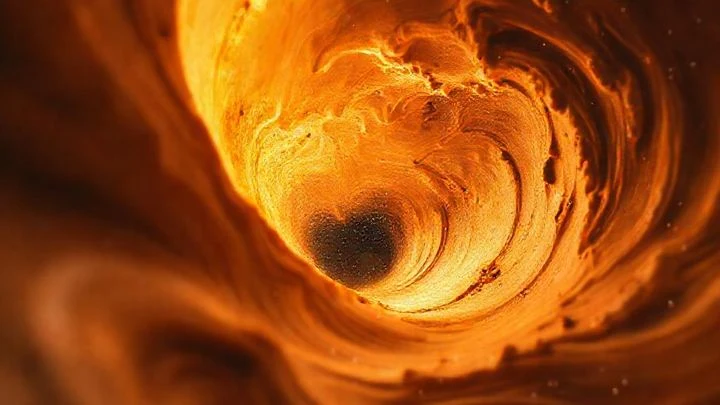
Hot gas spirals inward, falling onto an invisible superdense object. Such a disk resembles a giant whirlpool, but it is often tilted: its axis does not align with the rotation axis of the central body. The gravity of the massive object makes the disk wobble slightly, like a spinning top losing its balance.
In the first moments after the Big Bang, the universe was filled with a hot, nearly uniform plasma. But in some places, the density could randomly be slightly higher. If such a clump gained critical mass, it collapsed into a black hole: this is how primordial black holes were born.
At the heart of nearly every large galaxy shines an active nucleus — a supermassive black hole surrounded by a flat, rotating disk of incandescent gas. The disk itself flickers, but astrophysicists suspect that within it lurks a whole swarm of small, stellar-mass black holes.
At the center of a distant galaxy, a supermassive black hole is surrounded by a flat, rotating disk of gas and dust — a giant cosmic funnel of matter. A small compact object, such as another stellar-mass black hole, may find itself in this disk.
A giant black hole tore apart a star, leaving behind a lopsided disk of scorching gas — like a vinyl record warped by the heat. Now a tiny black hole (or a star) zips around and repeatedly pierces that disk. Each puncture is a bright X-ray flare.
Around an invisible fire, glowing gas swirls. The fire itself is hidden, but its outline can be guessed from the way the flames dance. That's roughly how astronomers 'see' black holes — not the object itself, but the superheated matter that, before plunging into the abyss, accelerates to enormous speeds and shines.
The universe is full of invisible substance that governs the movement of galaxies. In the 1970s, astronomer Vera Rubin showed: without dark matter, stars on the outskirts would have long since flown apart. But what it's made of remains unknown.
At the center of almost every large galaxy lurks something supermassive and dark. Most often, that something is thought to be a black hole — a region where gravity is so strong that even light cannot escape. But what if it's not a black hole, but a dense ball of ultralight particles — a boson star?
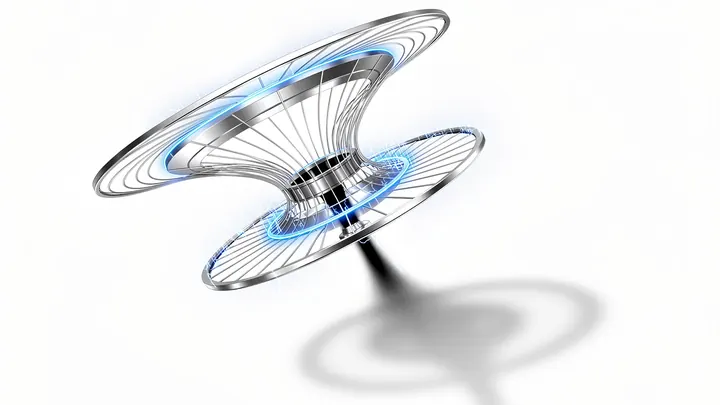
The shadows of supermassive objects at the centers of galaxies, M87 and the Milky Way, have become icons of modern astrophysics. But what if these shadows are not from absorption, but passage? The equations of Einstein allow for traversable wormholes — tunnels in the fabric of spacetime.
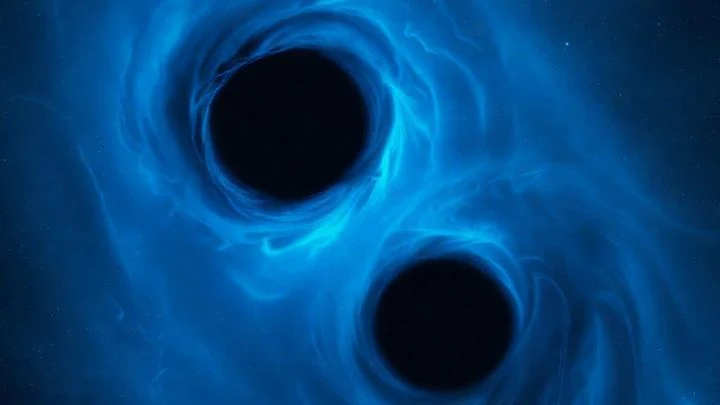
Two black holes, orbiting each other, behave like a boat rowing with stars. Each passing star is flung away, like a stroke of an oar, and transfers momentum to the pair. For a long time, it was thought this simply brings the black holes closer. But new analysis has shown: by flinging stars unevenly, the system pushes itself sideways, spins, and tilts the orbit.
Light passing by a massive body bends around it, like a stream of cars swerving around a deep pothole in the road. The steeper the pothole's slopes, the more the trajectories curve, and the fewer straight paths remain to the observer. That's how a black hole's shadow is born: a region from which light can no longer escape.
A spinning top on a table wobbles: its axis is tilted, and the motion becomes unsteady. Black holes surrounded by a disk of gas and dust behave similarly. If the rotation axes of the black hole and the disk do not align, the whole system begins to vibrate, producing ripples in spacetime — gravitational waves.
Light from the star HD 163296 passes through the surrounding gas-and-dust disk like a flashlight beam through murky water. The disk's particles scatter the light, giving it a special property — polarization: the waves begin to oscillate in a single plane, like a rope shaken strictly up and down.
Two tiny magnetic vortices, called skyrmions, drift across a thin film. As they approach each other, the force between them isn't a simple attraction or repulsion, but an alternation of the two, as if two floats on water were converging and diverging, obeying an invisible wave.
At the centers of almost all galaxies lurk black holes — invisible giants. When two galaxies collide, their black holes become a pair doomed to dance around each other. But to merge into one, they must close the gap from vast distances to just kilometers, in the final instant unleashing a burst of gravitational waves.
At the centers of many galaxies lurk supermassive black holes, surrounded by disks of gas, cosmic dust, and stars. Their collisions can spawn gravitational waves — ripples in spacetime.
Pour a handful of dry sand: it will spread into a neat cone. Now grab a box of star-shaped pasta: the pile will stand almost vertical. Why? It's all about particle shape.
Physicists built cylindrical piles from particles of different geometries — from smooth spheres to 'polypods' with several arms, like a sea star.