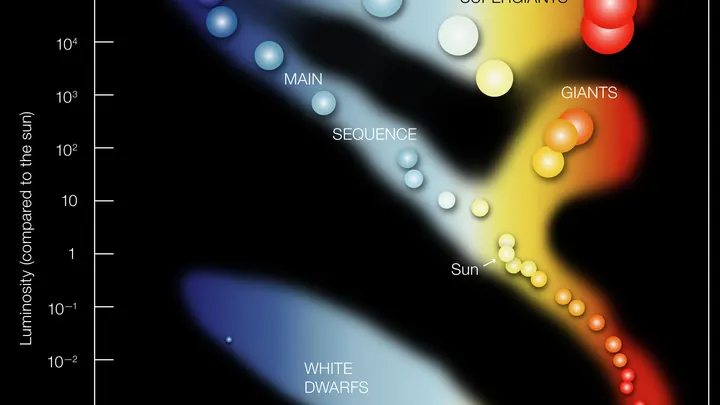
The stellar interior is the region of a star where nuclear fusion reactions occur, generating the energy that makes stars shine. It is a place of extreme conditions: temperatures in the millions of degrees, pressures billions of times that of Earth's atmosphere, and densities that can be thousands of times that of water. The structure of a star's interior is a delicate balance between the inward pull of gravity and the outward pressure from the energy released by fusion. Understanding stellar interiors is crucial for explaining how stars evolve, how they produce heavier elements, and how they end their lives as white dwarfs, neutron stars, or black holes.
History
The idea that stars are powered by nuclear fusion was developed in the 1920s and 1930s, primarily by Arthur Eddington, who first proposed that stars get their energy from the fusion of hydrogen into helium, and later by Hans Bethe, who worked out the detailed nuclear reaction chains (the proton-proton chain and the CNO cycle) in 1938-1939.
How it works
In the core of a star, hydrogen nuclei (protons) are squeezed together with such force that they overcome their electrostatic repulsion and undergo nuclear fusion, primarily converting hydrogen into helium. This process releases a tremendous amount of energy in the form of gamma rays and kinetic energy of the particles. This energy gradually works its way outward, taking thousands to millions of years to reach the surface. The outward pressure from this energy flux counteracts the gravitational collapse, keeping the star in a stable equilibrium known as hydrostatic equilibrium. The specific fusion processes and the transport of energy depend on the star's mass and its evolutionary stage.
In practice
The study of stellar interiors is fundamental to astrophysics, enabling us to model stellar evolution, predict the nucleosynthesis of elements, and interpret observations of stellar oscillations (asteroseismology) to probe the internal structure of stars. This knowledge is also applied to understanding the properties of exoplanets and the habitability of their systems.
Fun fact
The energy produced in the Sun's core takes about 100,000 years to travel to the surface, meaning the light we see today was actually generated in the core long before the last ice age.
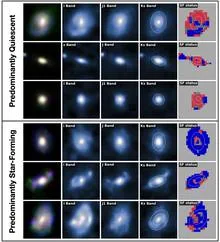
A ground-based image of a distant galaxy looks like a view through frosted glass: the atmosphere smears details, hiding the internal structure. Astronomers have long wanted to know where exactly star formation shuts off in galaxies, but ground-based telescopes could not resolve the subtle color gradients.
At the center of a galaxy, where a supermassive black hole spins a disk of scorching gas around itself, giant stars sometimes form. They are unlike ordinary stars: the disk continuously feeds them with matter, and a star can grow to hundreds of solar masses, staying bright as long as the gas flow lasts.
An interpreter gets distracted by every rustle in the hall, and a one-hour meeting stretches into two. A neutron star compresses a solar mass into a sphere the size of a city, and the matter in its core is denser than an atomic nucleus. Physicists cannot probe its structure in the lab: the required pressures are unattainable.
A neutron star is the ultra-dense remnant of a supernova: the mass of the Sun packed into a sphere the size of a city. For billions of years, it travels through space, gathering around itself invisible matter, dark matter, which emits no light but pulls with gravity.
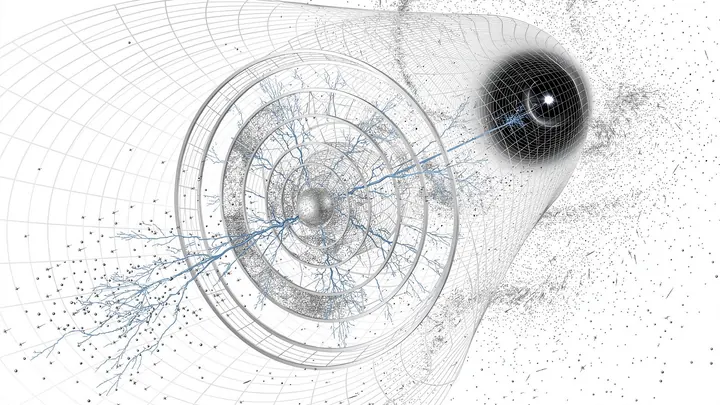
A stellarator fusion reactor resembles an intricately twisted magnetic cocoon. Its job is to confine superheated plasma so that hydrogen nuclei fuse and release energy. But the cocoon's three-dimensional shape creates gaps: some particles escape, especially the fastest ones, which carry most of the heat.
A heaping teaspoon, and the scale reads a billion tons. That's roughly what a teaspoon of neutron star matter would weigh if you could scoop it up and put it on a scale. Such objects are born after a supernova explosion: the star's core collapses into a sphere the size of a city, and the density exceeds that of an atomic nucleus.
At the center of the Milky Way, where the supermassive black hole Sagittarius A* reigns supreme (its metric first derived by Karl Schwarzschild), star S4714 makes a dizzying voyage.
Drop a stone into a pond, and ripples spread outward. Something similar happens inside compact clumps of dark matter when they encounter a special medium — a scalar field. This field, which pervades everything around us, can spontaneously intensify in the depths of such objects, much like ripples on water growing ever taller and more pronounced.
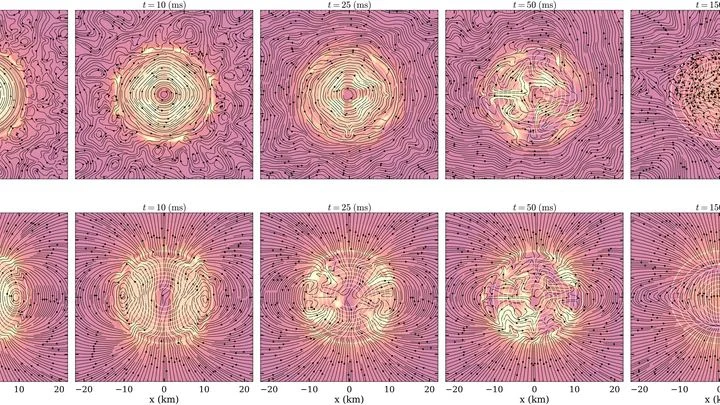
A neutron star is a sphere the size of a city but with the mass of an entire Sun. Its magnetic field can tear atoms apart from thousands of kilometers away. Yet until now, it was a mystery how this field is arranged inside: whether it is twisted into tight ropes or more like neat lines radiating from the poles.
Imagine a packed dance floor where dancers glide without any friction — passing through each other without a touch. That's a superfluid. In a neutron star's crust, neutrons could behave this way, but a rigid lattice of ions gets in the way, like suddenly sticking the dance floor full of pillars.
The outer crust of a neutron star is like a layered cake, where each layer is a strictly defined filling. It's a crystalline lattice of atomic nuclei immersed in a sea of electrons. The deeper you go, the stronger the pressure, and the heavier the nuclei that can exist there without falling apart.
A neutron star is the dead core of a massive star, crushed to the size of a city. A teaspoon of its material weighs as much as a mountain. Dark matter particles fly through such a dense medium almost unimpeded, but occasionally they do hit neutrons and get stuck, like bullets bogging down in deep sand.
A neutron star is the remnant of an exploded star, compressed to the size of a city. On its surface, a thermonuclear fire sometimes erupts: accumulated gas explodes like a giant hydrogen bomb. After the burst, ash remains — a mixture of heavy elements that rises to the surface and forms a hot atmosphere.
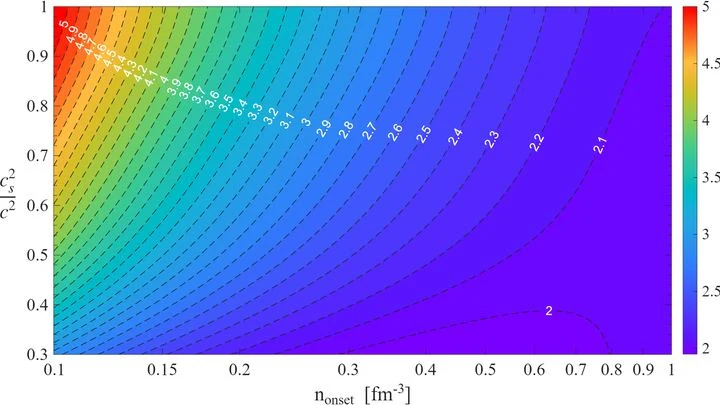
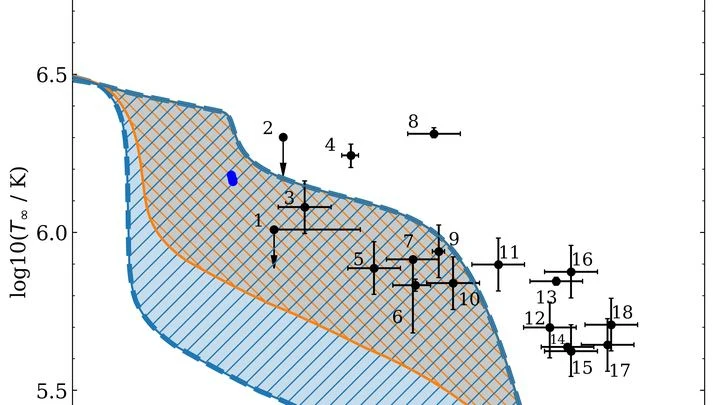
The density at the center of a neutron star is so extreme that a teaspoon of its material would weigh as much as a mountain. Physicists have long tried to figure out how massive such a star can get before it collapses into a black hole.
A neutron star is the remnant of an exploded star, compressed to the size of a city. In its core, matter is packed so densely that a teaspoon of such material would weigh as much as a mountain. At such densities, as predicted by the theory of strong interactions, particles acquire 'twins'—parity partners.
Deep inside a massive star, two carbon nuclei collide and merge into a single magnesium nucleus. This process determines how quickly the star burns its fuel and which chemical elements it manages to create. But calculating such a fusion on paper has proven incredibly difficult: nuclei are not billiard balls but quantum systems that can rearrange themselves in many ways.
If you build a giant blanket around a star, you get a Dyson sphere. It absorbs all the radiation and glows in invisible heat rays. No such sphere has been seen yet, but astronomers know: to find it, look for this thermal glow.
At the center of our Galaxy lies a dense forest of dust and gas. Starlight barely penetrates this thicket, like a flashlight in fog. But it is precisely there, in this dense cloud, that new stars are born.
Scientists decided to look into this fog. They took light from 15 bright stars that shine through cold clouds.
Visible matter is a drop in the sea of cosmic soup. The foundation of the Universe is made of invisible dark matter, whose gravity keeps galaxies from flying apart. The best candidate for this role is sterile neutrinos, ghost particles connected to us only by the thinnest of bridges.