A Pressure Cooker with Three Settings: How Disk Gas Forged the First Rocks ✛
Three cabinets full of rocks. In one, metallic grains and the gray mineral enstatite; in the second, the same grains but with rusty streaks; in the third, layered clays swollen with water. All three sets were pulled from meteorites that fell to Earth: chondrites. They were born in the same gas-and-dust disk around the young Sun, yet somehow turned out so different. Previously, the thinking was that the disk had regions with different amounts of oxygen. The new model says the gas was the same everywhere; it just cooled at different rates.
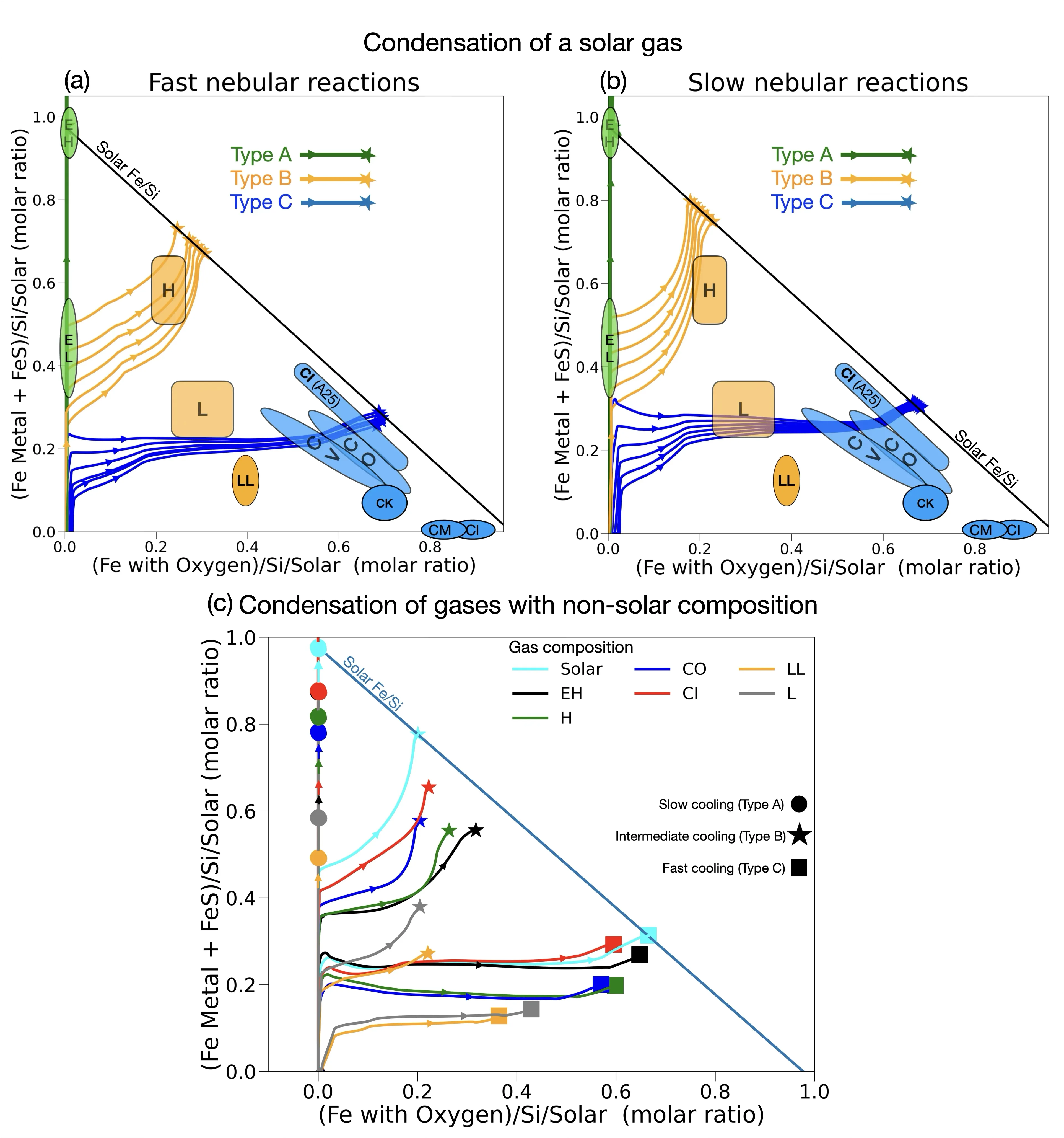
The authors built a numerical code, KineCond, that tracks every step of condensation: how solid particles fall out of hot gas (from 2000 down to 130 kelvins). Gas-phase reactions are kept in equilibrium, while gas–grain reactions proceed kinetically, meaning with realistic rates, without assuming instantaneous equilibrium. The network includes 39 condensation/evaporation reactions and 38 gas–mineral reactions. Pressure was varied from $10^{-9}$ to $10^{-2}$ bar, and cooling time from 0.01 to 1000 years. Owing to a lack of experimental data, reaction rates were varied (fast, moderate, slow), and the evaporation efficiency was set to 0.1.
The result was unexpected: the condensation sequence did not change smoothly but split into three sharply distinct types of mineralogies. Type A (high pressure, slow cooling) resembles enstatite chondrites: metallic iron and enstatite, with no oxidized iron. Type C (low pressure, fast cooling) yields oxidized phases, such as fayalite, magnetite, troilite, and phyllosilicates, coexisting with high-temperature CAI minerals. Type B is transitional, with metal, troilite, and fayalite. On the Urey–Craig diagram, the final compositions cluster near the EC, OC, and CC chondrite fields. Meanwhile, the calculated oxygen fugacity for types A, B, and C is ∆IW ~ -4, -2, and -0.5, respectively, spanning the range of estimates for equilibrated chondrites, even though the gas remained highly reducing at the moment of condensation (∆IW ~ -6...-7).
This result removes the need for large-scale variations in redox conditions in the protoplanetary disk, which are difficult to realize physically. The model also naturally explains the preservation of high-temperature CAI minerals without invoking an artificial isolation factor. After all, during rapid cooling, water does not condense into ice: oxygen goes into the hydroxyl groups of phyllosilicates. Such minerals contain up to 1–2 wt.% water without any external water being added.
The three cabinets of rocks turned out not to be different kitchens, but one recipe with different cooking times. Low heat, and the pot yields metal without rust. High heat, and the same pot becomes coated with clay and rust. Medium heat gives a mix of both. The gas in the disk was one, but it cooled differently in different places. Thus local conditions gave rise to all the diversity of chondrites.
In the model, under ultra-fast cooling, water does not condense as ice: oxygen is incorporated into hydroxyl groups in phyllosilicates. Such minerals can contain up to 1–2 wt.% water without any external addition of water.