Nonequilibrium Condensation of the First Solids in the Solar System ✛
Context
This work fits into research on the origin of mineralogical diversity in chondrites, which are primitive meteorites that preserve material from the early solar system. Related papers in the archive examine the thermal history of chondrules, primary amorphous silicates, isotopic evidence for rapid condensation, and the role of late infall of material. The broader thematic group includes the protoplanetary disk, organic molecules in space, molecular clouds, and star formation. This paper stands out because it is the first to systematically model nonequilibrium kinetic condensation over a wide range of pressures and cooling rates, whereas most previous models relied on equilibrium condensation sequences.
Methods
The authors created a numerical code, KineCond, that calculates time-dependent condensation and evaporation of gas of solar composition as it cools from 2000 to 130 K in a closed system. Gas-phase reactions are maintained at equilibrium, while gas–grain reactions proceed kinetically. The network includes 39 congruent condensation/evaporation reactions and 38 gas–mineral reactions. Pressures from $10^{-9}$ to $10^{-2}$ bar and cooling times from 0.01 to 1000 years were explored. Due to a lack of experimental data, reaction rates were varied (fast, moderate, slow), and the evaporation efficiency was set to 0.1.
Results
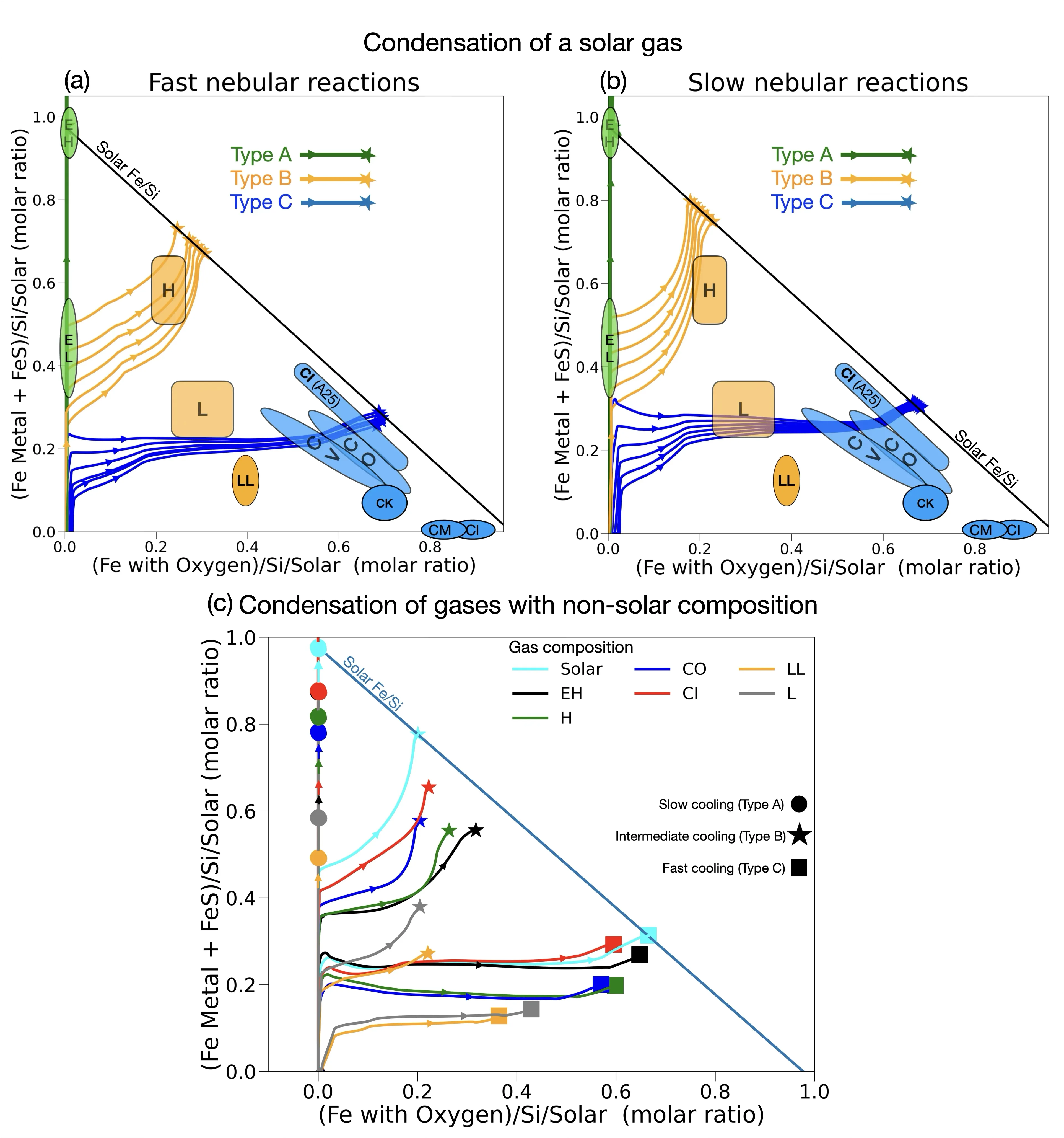
The model shows that the condensation sequence does not change smoothly with pressure and cooling time; instead, it forms three sharply distinct mineralogy types. Type A (high pressure, slow cooling) resembles enstatite chondrites: metallic iron and enstatite, with no oxidized iron. Type C (low pressure, fast cooling) yields oxidized phases, including fayalite, magnetite, troilite, and phyllosilicates, coexisting with high-temperature CAI minerals. Type B is transitional, with metal, troilite, and fayalite. On a Urey–Craig diagram, the final compositions cluster near the EC, OC, and CC chondrite fields. The calculated oxygen fugacity for types A, B, and C is ΔIW ≈ -4, -2, and -0.5, respectively, covering the range of estimates for equilibrated chondrites, even though the gas remained highly reduced at the time of condensation (ΔIW ≈ -6 to -7).
Implications
Unlike neighboring works that focus on individual components (chondrules, matrix, refractory inclusions) or isotopic anomalies, this paper proposes a single mechanism that generates all three chondrite classes solely through local condensation kinetics. This removes the need for large-scale redox variations in the protoplanetary disk, which are physically difficult to realize. The model also naturally explains the preservation of high-temperature CAI minerals without invoking an artificial isolation factor.
Future development
The topic could evolve toward incorporating open systems, variations in gas composition (C/O, Fe/Si), gas–dust separation, and aerodynamic sorting. Accounting for these processes would help explain chondrite subgroups (H, L, LL), which are not yet reproduced. It is also important to obtain experimental data on gas–mineral reaction rates to reduce uncertainty.
Impact
The results will influence models of planetary system formation and the interpretation of protoplanetary disk observations, particularly regarding the link between condensation conditions and the composition of planetesimals.
Next steps
The next step will be modeling open systems with variable gas composition and testing predictions against isotopic data from real meteorites.
Key open problems
This work is directly related to the unresolved problem of the origin of chemical diversity in chondrites and, more broadly, to how local conditions in the protoplanetary disk determine the composition of planetary bodies. It remains an open question why chondrite subgroups (e.g., H, L, LL) show systematic differences that kinetic condensation in a closed system cannot explain.
The knowledge machine's view
This section is addressed to the author of the paper and their colleagues. Neighbouring works were found by meaning-based search across our archive, not by word overlap. We do not review: we show the field around the work.
What the work does
The paper presents a kinetic model, KineCond, that calculates the nonequilibrium condensation of gas of solar composition during cooling. The authors show that varying pressure and cooling rate leads to three sharply distinct types of mineralogies, corresponding to enstatite, ordinary, and carbonaceous chondrites.
Where its strength is
The strength of the work is that it offers a single mechanism that produces all three classes of chondrites solely through local condensation kinetics, without invoking large-scale variations in redox conditions.
Where it could go next
- It might be interesting to compare the model results with data on late influx of material into the outer Solar System: the archive has a related paper on cometary delivery that could have influenced the composition of primitive bodies.based on: Comet Spice: How a Late Influx of Matter Reshaped the Outer Solar System arXiv:2606.04529v1
- The archive also contains an analysis of observations of cosmic crystal formation in stellar environments; perhaps their approach to analyzing condensation conditions could help extend the model's applicability to other astrophysical contexts.based on: The Stellar Forge: A First Glimpse at the Birth of Cosmic Crystals arXiv:2607.27765v1
Worth trying
- Test how the inclusion of late influx of material with a different isotopic composition would affect the predicted mineralogies.
- Compare model cooling times with estimates from observations of crystalline silicate formation in protoplanetary disks.
Why this may matter
If the proposed mechanism is confirmed, it could become the basis for a unified picture of chondrite origin and remove the need for difficult-to-achieve global variations in redox conditions in the protoplanetary disk.
Nearby works in our archive
- Oxygen Memory of Chondrulessimilarity 0.54
- How Hydrogen and Magma Create Water Deep Inside Planetssimilarity 0.53
- The Swirling Dance of Neutron Starssimilarity 0.51
- Resistance Inside a Spinning Spheresimilarity 0.51
- Stone Clusters from the Early Solar Systemsimilarity 0.51
- Meteors with an Unusual Composition: Asteroids without Chondrulessimilarity 0.50
- The Stellar Forge: A First Glimpse at the Birth of Cosmic Crystalssimilarity 0.50
- Comet Spice: How a Late Influx of Matter Reshaped the Outer Solar Systemsimilarity 0.50
The archive is sparse around this work: the closest review is only 0.54, against a usual 0.64. It looks like few have drilled nearby.
In the model, under ultra-fast cooling, water does not condense as ice: oxygen is incorporated into hydroxyl groups in phyllosilicates. Such minerals can contain up to 1–2 wt.% water without any external addition of water.
Key numbers
- pressure: from 10-9 to 10-2 bar
- cooling time: from 0.01 to 1000 years
- starting temperature: 2000 K
- final temperature: 130 K
- number of condensation reactions: 39
- number of gas–mineral reactions: 38