The Navigator Who Recalculates the Route on the Fly ✛
A navigator with a paper chart plots the route before setting sail. If the ocean changes—the current shifts, the wind picks up—the chart stays the same. The ship follows an outdated path, and the crew has to correct the course by hand. For years, plasma shape control in tokamaks worked exactly like that: the virtual contours linking shape errors to coil currents were precomputed for a few reference states and remained fixed throughout the discharge.
On the MAST Upgrade device, a different navigator was tested for the first time. A neural network emulator, trained on 100,000 synthetic equilibria, received the plasma state every 5–5.6 milliseconds and returned the Jacobian matrix—a table of shape sensitivities to currents in twelve poloidal coils. The shape controller, running at 10 kHz, immediately recalculated the virtual contours and applied corrections. The navigator stopped consulting the paper chart and began plotting the route based on the actual water.
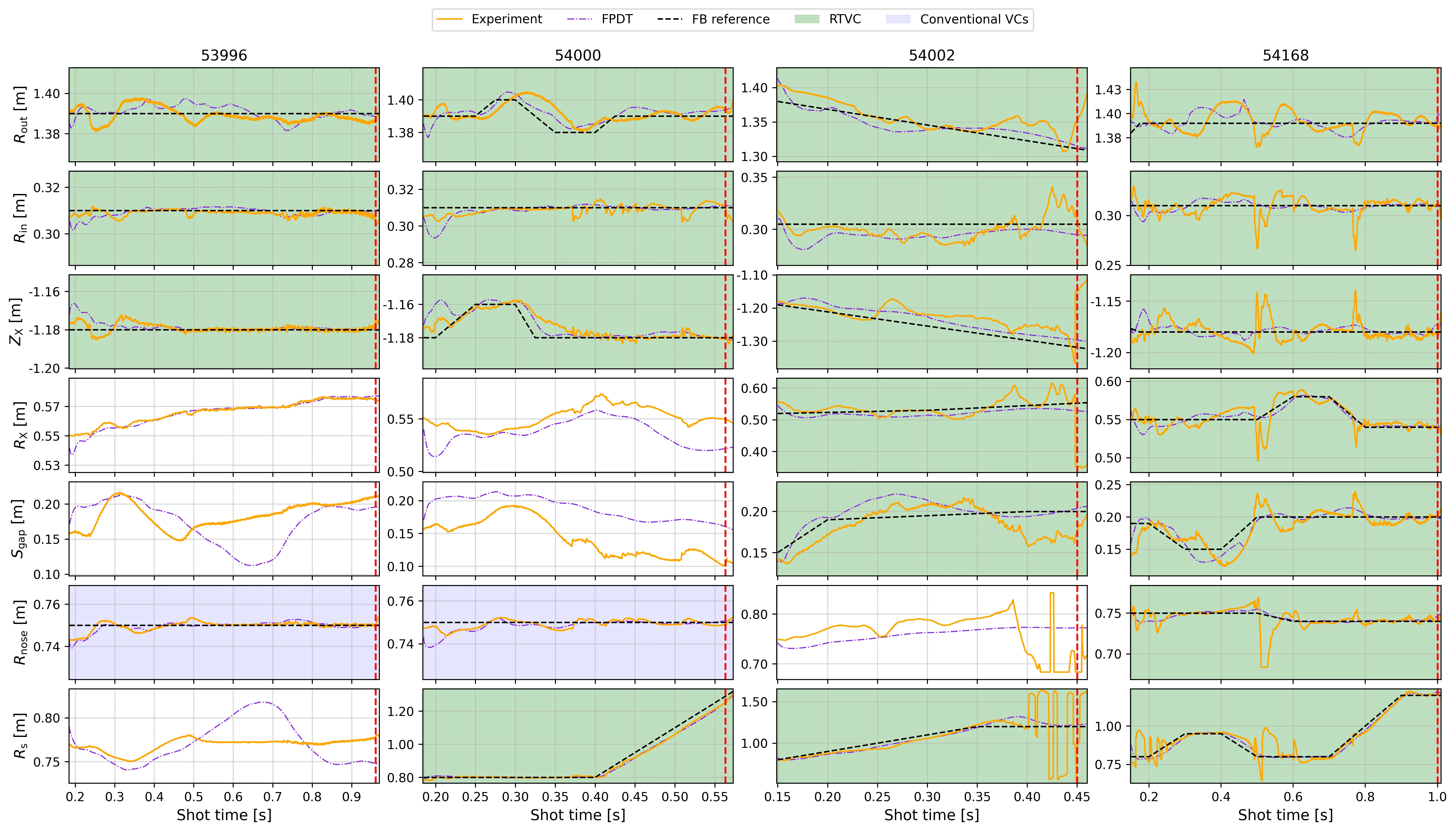
The experiments covered four discharges with different tasks. In one, a constant shape was maintained; in another, trapezoidal perturbations of the radius and X-point position—the place where the magnetic field vanishes—were tracked. In the third, the divertor leg was moved from 0.8 to 1.4 meters. In the fourth, all seven shape parameters were controlled simultaneously. The same emulator handled all scenarios without retuning.
Not everything went smoothly. In the discharge with simultaneous control of all seven parameters, the matrix was ill-conditioned: the norm of the virtual contour vectors reached $10^5$ A/m, which amplified noise and made tracking less smooth. It was as if the navigator received a chart with blurred contour lines—the route was plotted, but with a tremor. Nevertheless, the approach proved its viability: virtual contours updated by the neural network in real time are compatible with the existing control system architecture.
Previously, operators manually tied precomputed contours to discharge phases. Now a single emulator replaces that routine and adapts to unexpected plasma deviations. This approach could simplify experiment preparation on existing tokamaks and, in the future, on reactors. The navigator who recalculates the route on the fly turned out to be more reliable than the paper chart.
The neural network emulators were trained on 100,000 synthetic equilibria generated over several days on a high-performance cluster, whereas manually calculating that many virtual circuits would have taken years.