Neural networks control plasma shape in real time on a tokamak ✛
Context
Plasma shape control is critical for tokamak operation: safety and achieving high performance depend on it. Traditionally, virtual circuits (sets of coefficients linking shape errors to coil currents) are precomputed for a few reference equilibria and manually assigned to discharge phases. This is labor-intensive and poorly adapts to unexpected plasma deviations. In recent years, machine learning approaches have been actively developed, but most either replace the controller entirely or require training for each scenario. This work occupies a niche between these extremes: it preserves the familiar control structure but makes it adaptive. Related papers on the archive explore adjacent topics: real-time plasma control with machine learning, quantum simulations, and neural network models of materials, but this article is the first to experimentally demonstrate updating virtual circuits on a working tokamak.
Methods
On the MAST Upgrade tokamak, neural network emulators predicted seven plasma shape parameters from currents in twelve active poloidal field coils, total plasma current, and several current profile parameters. The emulators were trained on a large library of synthetic equilibria generated with the FreeGSNKE code. In real time, every 5–5.6 milliseconds, the inference server received the current state and returned the Jacobian matrix (shape sensitivity to coil currents) computed by finite differences. The plasma control system calculated the pseudo-inverse matrix and replaced the corresponding columns in the virtual circuit matrix. The shape controller ran at 10 kHz. Before active experiments, checks were performed on reproducing archived discharges and in a passive 'piggyback' mode, where the system recorded its commands but did not control the plasma.
Results
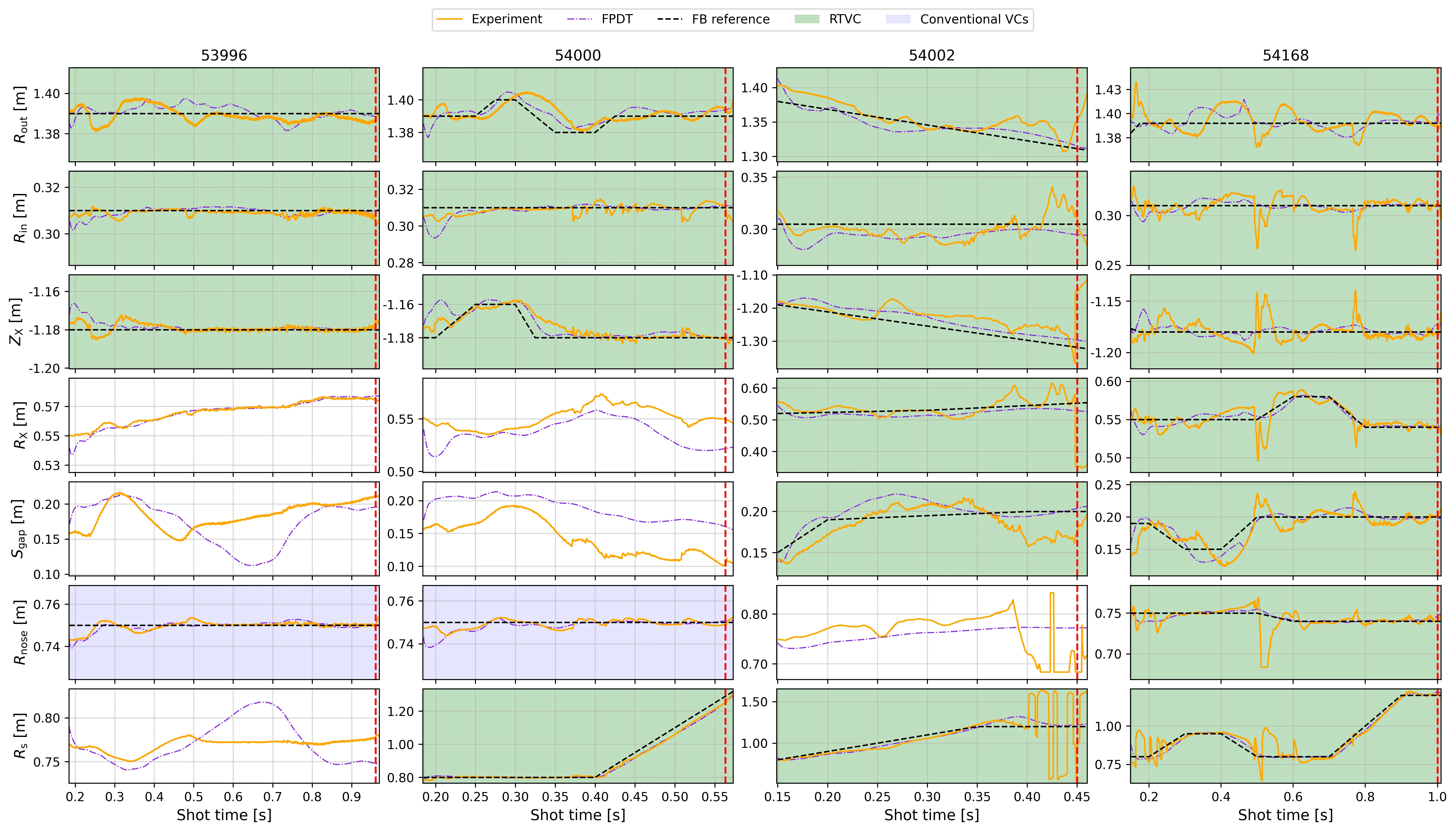
Experiments on four discharges showed that virtual circuits updated by the neural network in real time can perform various plasma shape control tasks. In discharge 53996 with constant shape, the parameters remained close to the requested values throughout the controlled phase. In discharge 54000, trapezoidal perturbations of the radius and X-point position were successfully tracked, as well as controlled divertor leg movement from 0.8 to 1.4 meters. Discharge 54002 demonstrated a transition to an elongated configuration with the leg nearly in Super-X configuration, although at the end of the discharge control was lost due to interaction with the plasma 'nose'. Discharge 54168, where all seven parameters were controlled simultaneously, revealed a problem of poor matrix conditioning: the norm of the virtual circuit vectors reached values of order $10^5$ A/m, leading to noise amplification and less smooth tracking. Nevertheless, in all cases the same neural network was used without retuning for the specific scenario.
Implications
This work experimentally confirms for the first time that real-time updates of plasma response linearizations can be a practical extension of traditional shape control in tokamaks. Unlike related works that either replace the controller entirely or apply reinforcement learning, here the interpretable virtual circuit structure familiar to operators is preserved. This lowers the barrier to adoption and allows gradual increases in autonomy. Furthermore, the same emulator works across different scenarios without retuning, simplifying experiment preparation.
Future development
The next step will be to include currents induced in passive structures and real-time estimates of the plasma current profile in the emulator state. This should improve the accuracy of linearizations during rapid changes. It is also planned to replace the Moore–Penrose pseudo-inverse with a regularized or damped inversion to avoid amplification in nearly degenerate shape directions. In the long term, this approach could completely eliminate manual preparation of phase schedules for virtual circuits.
Impact
The method can be transferred to other tokamaks, including future reactors, where adaptive control without complex manual tuning is important. It can also simplify scenario development for experiments with varying plasma shape.
Next steps
Conduct a systematic comparison with traditional virtual circuits in a dedicated experimental campaign. Extend validation to a wider range of operating regimes and test performance with real-time current profile estimates.
Key open problems
This work is directly related to the problem of reliable plasma shape control under uncertainty and rapid changes. It does not solve fundamental plasma physics questions, but it removes a practical limitation associated with labor-intensive manual controller tuning, which is important for future long pulses and reactor regimes.
The knowledge machine's view
This section is addressed to the author of the paper and their colleagues. Neighbouring works were found by meaning-based search across our archive, not by word overlap. We do not review: we show the field around the work.
What the work does
In experiments on MAST Upgrade, virtual plasma shape control loops were updated in real time using neural network response emulators for the first time. Trained on a wide range of equilibria, the emulators predicted the Jacobian matrix, which was used to recalculate the control loops every 5–5.6 ms. The experiments covered constant shape holding, perturbations, divertor leg movement, and a strongly varying configuration, confirming compatibility with the existing control architecture.
Where its strength is
The strength of this work lies in preserving the familiar controller structure while making it adaptive without per-scenario retuning. The experimental demonstration on an operating tokamak sets it apart from most studies that are limited to simulations.
Where it could go next
- It might be interesting to see how the machine learning approaches for real-time plasma control reviewed in a neighboring paper relate to your virtual loop update method; perhaps there are techniques there for improving robustness or reducing computational load.based on: Real-Time Plasma: How Machine Learning Controls a Tokamak arXiv:2601.12378
- A nearby paper on digital vision for a fusion reactor could offer ideas for integrating diagnostic data in real time to complement the emulators with plasma state information.based on: Digital Vision for a Fusion Reactor arXiv:2607.04390
- An archive paper analyzes how turbulence affects plasma confinement; perhaps your adaptive shape control scheme could be extended to account for such effects in real time.based on: Plasma on a Leash: How Turbulence Holds the Heat arXiv:2603.03123
Worth trying
- Test pseudo-inverse regularization to mitigate the ill-conditioning problem observed in discharge 54168.
- Investigate whether virtual control loops can be updated at a variable frequency depending on how fast the plasma is changing.
- Use emulators not only for shape but also for predicting vertical instability, so that control can be corrected proactively.
Why this may matter
Adaptive virtual control loops could simplify experiment preparation and improve control robustness in non-standard scenarios, which is important for future reactors where manual tuning of control loops for each discharge is impractical.
Nearby works in our archive
- Real-Time Plasma: How Machine Learning Controls a Tokamaksimilarity 0.54
- Plasma on a Leash: How Turbulence Holds the Heatsimilarity 0.53
- Movies for the Nanoworld: Watching Atoms in Motionsimilarity 0.48
- Why It's So Hard to Simulate a Quantum Computersimilarity 0.48
- Digital Vision for a Fusion Reactorsimilarity 0.48
- Alpha Particles Under Control: A Vacuum Platform for Precision Radiobiologysimilarity 0.47
The archive is sparse around this work: the closest review is only 0.54, against a usual 0.64. It looks like few have drilled nearby.
The neural network emulators were trained on 100,000 synthetic equilibria generated over several days on a high-performance cluster, whereas manually calculating that many virtual circuits would have taken years.
Key numbers
- shape controller frequency: 10 kHz
- virtual circuit update period: 5–5.6 ms
- number of active poloidal field coils: 12
- number of controlled shape parameters: 7
- norm of virtual circuit vectors in nominal regime: (1–2)×105 A/m