A Semiconductor's Whisper Beneath a Superconductor's Hum ✛
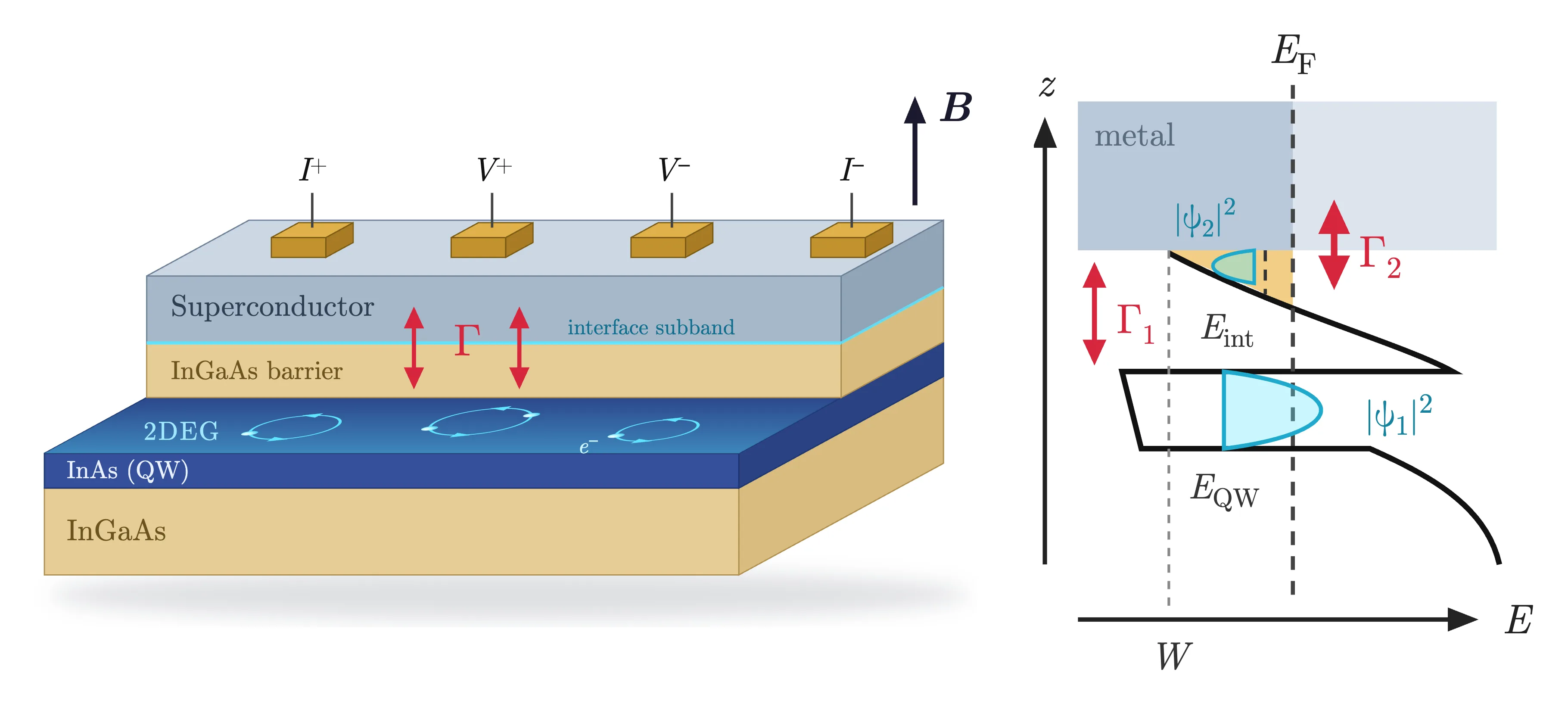
A thin layer of indium arsenide lies hidden under a superconducting film, like a voice beneath the noise of a crowd. In such a hybrid, current takes the path of least resistance and flows almost entirely through the metal, leaving the semiconductor inaudible to standard probes. But when a strong magnetic field is applied, quantum oscillations awaken in the buried layer: periodic resistance fluctuations reminiscent of rhythmic breathing. That whisper is what the researchers managed to hear.
The physicists deposited six different metals onto an InGaAs/InAs/InGaAs heterostructure: aluminum, tin, vanadium, niobium, tantalum, and rhenium. Deposition occurred at 7 K to keep the interface sharp. The samples were then placed in magnetic fields up to 14 T, and resistance was measured at temperatures from 1.8 to 20 K. Even when current flowed mostly through the metal, oscillations from the semiconductor well broke through. To extract parameters from these oscillations, the amplitude had to be multiplied by a correction factor accounting for the fraction of current shunted by the metal.
Each film created an additional subband at the interface with the semiconductor, a separate channel for electrons. For refractory metals (tantalum, niobium, vanadium, rhenium), this channel was shallow, whereas for aluminum and tin it was deep. Meanwhile, the main quantum well remained largely unchanged: its oscillation frequency stayed around 5 T, and the electron mass and g-factor (a number describing the electron's magnetic moment) deviated from the uncovered sample by no more than 10%. Most surprisingly, the quantum lifetime, the time during which an electron retains its quantum state, did not shorten under any film. Aluminum and tin even extended it.
The coupling between the well and the metal proved weak: the upper bound on the coupling energy ranged from 0.18 to 0.6 meV depending on the metal. This means that the superconducting gap, the energy gap that the metal induces in the semiconductor, reaches only 0.3 to 0.8 of its full magnitude. Previously, such parameters remained unknown because the metal shunted the current, preventing standard measurements. Now quantum oscillations have allowed a peek beneath the film without destroying the hybrid.
These numbers are not just for the record; they matter for practical applications. Hybrid qubits and devices based on Majorana states require precise knowledge of the semiconductor's normal state: its mass, g-factor, and mobility. This work shows that a superconducting film does not necessarily degrade the semiconductor; sometimes it acts as a protective shield. A whisper that once seemed imperceptible can now not only be heard but also parsed word by word.
An aluminum film just 2.3 nm thick (only 10 atomic layers) not only fails to damage the quantum well, but increases its quantum lifetime by 60% compared to the uncovered sample.