Quantum oscillations beneath a superconductor ✛
Context
This work sits at the fringe among superconductor hybrid studies: nearby are works on superconductivity in gold and copper, quantum computers, magnetic textures, and superfluidity. Most neighbors study superconductivity in the metal itself or in simple heterostructures, but no one has looked beneath a superconducting film into the semiconductor using quantum oscillations. This article fills the gap: it measures the semiconductor's normal state in an intact hybrid, which was previously impossible due to shunting.
Methods
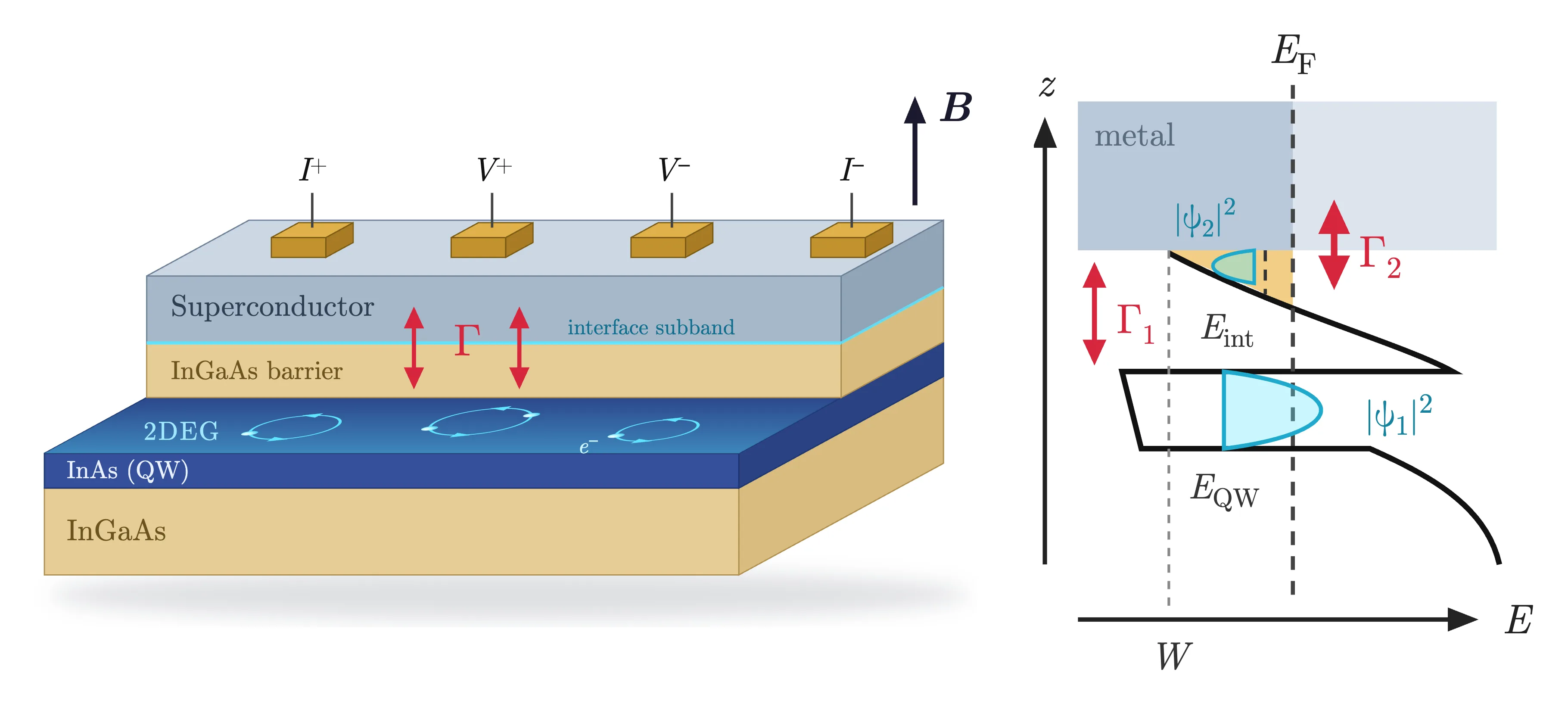
Six metals were evaporated onto an InGaAs/InAs/InGaAs heterostructure at 7 K to avoid interfacial intermixing. Then four-terminal magnetoresistance was measured in fields up to 14 T at temperatures of 1.8-20 K. Shubnikov-de Haas oscillations arise in the two-dimensional electron gas of the well, even when current mostly flows through the metal. To extract parameters, Dingle analysis with a shunt correction was used: the oscillation amplitude is multiplied by a factor depending on transport mobility and magnetic field.
Results
Each metal creates an interface subband whose density falls into one of two classes: 11-13 T for refractory metals (Ta, Nb, V, Re) and 25-27 T for Al and Sn. The main well subband frequency remains around 5 T. The cyclotron mass of the well under all films is 0.040-0.044 me, and the g-factor |g| = 4.9 ± 0.2, matching the uncovered well within 10%. The quantum lifetime of the well is not shortened by any film, and Al and Sn even lengthen it. The upper bound on well-metal coupling is 0.18-0.6 meV, which limits the induced gap to 0.3-0.8 of the parent gap.
Implications
Unlike neighboring works that study superconductivity in the metal itself or in simple structures, here for the first time the semiconductor parameters beneath a superconductor are measured without destroying the hybrid. This allows separating the contributions of disorder and hybridization to the quantum lifetime and provides normal-state parameters that tunneling spectroscopy renormalizes but cannot measure. The work establishes that a superconducting film does not necessarily degrade the semiconductor, and sometimes acts as a protective screen.
Future development
The method can be applied to other platforms, such as Ge/SiGe or van der Waals stacks, where quantum oscillations survive metallization. Further studies could vary the barrier between the well and the metal to control hybridization and screening. It is also promising to measure oscillations in the superconducting state at low temperatures to directly observe the effect of the gap on quantum oscillations.
Impact
The results are important for developing hybrid qubits, especially those based on Majorana states, where precise semiconductor parameters are critical. They are also useful for superconducting electronics and spintronics, where the g-factor and spin-orbit interaction determine functionality.
Next steps
The next step is to measure quantum oscillations at temperatures below the critical temperature, when the metal is superconducting, to test the effect of the gap on subbands. It is also worth investigating the dependence on barrier thickness and alloy composition to optimize the well-metal coupling.
Key open problems
The work directly addresses an unresolved problem in condensed matter physics: how to accurately describe superconductor-semiconductor hybridization without fitting parameters. It also touches on the role of disorder in the topological protection of Majorana states, where the quantum lifetime is a key limitation.
The knowledge machine's view
This section is addressed to the author of the paper and their colleagues. Neighbouring works were found by meaning-based search across our archive, not by word overlap. We do not review: we show the field around the work.
What the work does
We measured Shubnikov–de Haas quantum oscillations in a buried InAs quantum well beneath superconducting films of Al, Sn, V, Nb, Ta, and Re. We determined the carrier density, cyclotron mass, g-factor, mobility, subband occupancies, and quantum lifetime. The well parameters remain unchanged within 10%, and Al and Sn enhance the quantum lifetime.
Where its strength is
The method extracts the normal-state parameters of the semiconductor in an intact hybrid, despite current shunting by the metal. This allows separating the contributions of disorder and hybridization to the quantum lifetime.
Where it could go next
- It may be interesting to compare these parameters with results from aluminum hybrids where qubit fidelity was studied: there, interface cleanliness and quantum lifetime matter.based on: Aluminum That Doesn't Make Mistakes arXiv:2602.17249
- A related work on superconductivity in gold and copper examines how the interface affects superconducting properties; similar approaches might apply to analyzing the coupling between the well and the film.based on: How to Make Gold and Copper Conduct Without Resistance arXiv:2606.03663
- It would be interesting to compare with a study of fractional charge in a quantum well: there, two-dimensional electron gas parameters are also important, and your data could help interpret those results.based on: Fractional Charge from a Quantum Well arXiv:2602.08468
Worth trying
- Test whether the quantum lifetime survives annealing or changes in deposition temperature.
- Measure oscillations in a tilted magnetic field to determine the g-factor anisotropy.
- Compare the data with band-structure calculations to assess interface hybridization.
Why this may matter
The normal-state parameters of the semiconductor under a superconductor are crucial for designing hybrid devices such as qubits and topological structures, where interface control is critical.
Nearby works in our archive
- Light Trapped in a Wiresimilarity 0.57
- How to Make Gold and Copper Conduct Without Resistancesimilarity 0.53
- Aluminum That Doesn't Make Mistakessimilarity 0.53
- Superconductivity Returns Under Pressuresimilarity 0.53
- How the Geometry of Electron Orbits Gives Rise to Superconductivitysimilarity 0.52
- Fractional Charge from a Quantum Wellsimilarity 0.52
The archive is sparse around this work: the closest review is only 0.57, against a usual 0.64. It looks like few have drilled nearby.
An aluminum film just 2.3 nm thick (only 10 atomic layers) not only fails to damage the quantum well, but increases its quantum lifetime by 60% compared to the uncovered sample.
Key numbers
- main subband frequency: 5.2 T
- interface subband density under Al: 1.2-1.3×1012 cm^-2
- well g-factor: 4.9 ± 0.2
- upper bound on well-Al coupling: 0.18 meV
- induced gap: 0.3-0.8 of parent gap