A Fast Interpreter for Light in Ice ✛
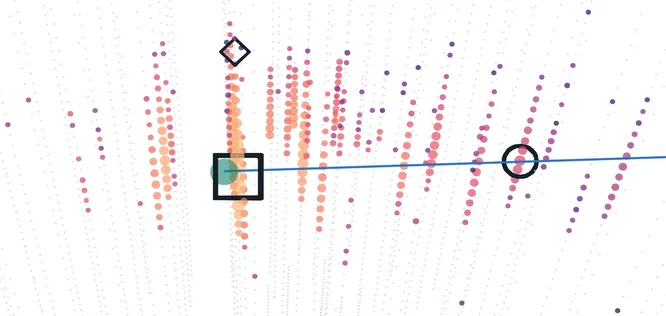
An interpreter at a meeting can write down every word and later check it against the original, or they can learn the language and paraphrase the essence on the spot. Previously, scientists working with the IceCube neutrino telescope did the former: they modeled the path of every photon born in the ice to each of the 5160 sensors. This took up to 100,000 hours of powerful GPU time, because ice is inhomogeneous and light scatters off bubbles and dust.
The candela neural network, created at Harvard and MIT, took the approach of a good interpreter: it learned the language of ice. You give it the coordinates of the light source and the sensor, and it instantly tells you how much light will arrive and when. To do this, the network was trained on 65,536 examples generated by the old slow method. Now, an event that used to take about a second is processed by candela in 10–20 milliseconds, which is 50–100 times faster.
This is not just a speedup. Because the network can compute derivatives, it is possible to directly fit neutrino parameters and calibrate ice properties. This means the IceCube telescope will be able to answer more precisely the question of where the most energetic neutrinos in the Universe come from. The interpreter has learned the language, and now the meeting proceeds a hundred times faster.
IceCube ice at depths of 1.5–2.5 km is so transparent that photons can travel hundreds of meters, scattering off bubbles and dust. The candela network learns exactly this 'memory' of the ice: it predicts not only how much light will arrive but also when, with nanosecond precision.