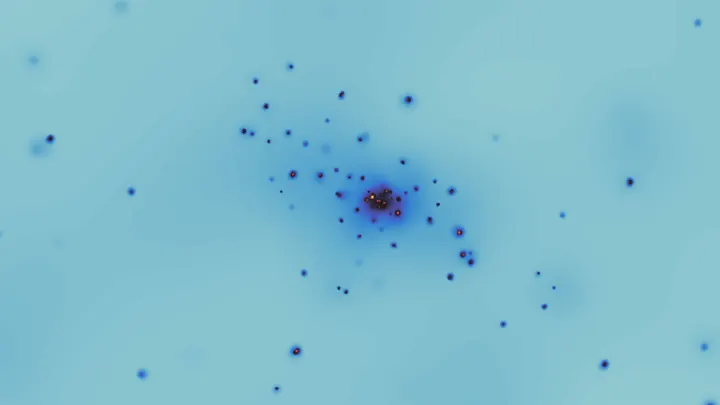
An infraredtelescope is an instrument designed to detect infrared radiation — light with wavelengths longer than visible light but shorter than radio waves. Because infrared can penetrate dust clouds that block visible light, these telescopes reveal regions of star formation, the centers of galaxies, and cool objects like brown dwarfs and exoplanets that emit little visible light. They are essential for studying the thermal emission of celestial bodies, from planets in our solar system to distant galaxies.
History
The first infraredastronomical observations were made in the 1800s using simple thermometers, but the field truly developed in the 1960s with the advent of sensitive infrared detectors. Space-based infrared telescopes like IRAS (1983) and the Spitzer Space Telescope (2003) overcame atmospheric absorption, opening the infrared sky fully.
How it works
Infraredtelescopes use specialized detectors, often cooled to very low temperatures to reduce their own thermal noise. The telescope's mirrors and optics are also designed to minimize infrared emission. Some designs use uncooled detectors with advanced materials that operate at room temperature, trading some sensitivity for simplicity and lower cost. The collected infrared light is focused onto a detector array, producing an image or spectrum that reveals the temperature and composition of the observed object.
In practice
Infraredtelescopes are used to study star formation, exoplanet atmospheres, and the early universe, as well as to detect cool, faint objects like brown dwarfs. They also monitor asteroids and comets, and are used in Earth observation for weather and climate studies.
Fun fact
The James Webb Space Telescope, the most powerful infrared telescope ever launched, must be kept at a temperature below 50 Kelvin (−223°C) to avoid its own heat overwhelming the faint infrared signals from distant galaxies.
Imagine an interpreter at a meeting where everyone speaks a language they don't know. At first, they have to listen to every word, write it down verbatim, and then check against the original. That's how simulations for the IceCube neutrino telescope work: they track every photon born in the Antarctic ice, traveling hundreds of meters to hit a sensor.
Every morning, a janitor sweeps leaves into a pile. The Sun, as it travels through the galaxy, does something similar: its gravity gathers diffuse interstellar gas into an invisible cone — a giant funnel.
In the dark outskirts of our Galaxy, far from bright star clusters, millions of black holes lurk. They are invisible: they don't shine and don't noticeably accrete matter. Conventional search methods, designed for dense stellar fields, are useless here. A different approach is needed.
Astronomers have proposed using the very fabric of space as a detector.
A star wrapped in an invisible blanket warms up more than it should. That's exactly how ten red dwarfs look, which astronomers from the Hephaistos project have been monitoring. These stars lie within 300 parsecs (about 1000 light-years) of us and emit far more infrared energy than their modest sizes can explain.
In the silent ocean of the Galaxy, mature civilizations have likely long chosen an unexpected strategy: instead of loud beacons, they scatter quiet fireflies — autonomous interstellar laser beacons, drifting in the void and dropping microsecond flashes. These 'seeds of contact' are not tied to their home stars and do not drown in their glow.
Dark matter detectors are essentially incredibly sensitive microphones, capable of hearing a whisper amid the roar of a rock concert. Their job is to catch the rare nudges from hypothetical dark matter particles, which are thought to occasionally collide with atomic nuclei of ordinary matter.
The ionosphere at an altitude of 70 kilometers acts like a giant mirror for radio waves. Ground antennas constantly beam signals into it and listen for the reflection. When a solar flare occurs on the Sun, a stream of X-rays reaches Earth in 8 minutes and compresses the lower layer of the ionosphere.
Light leaves a trace even when there is almost none of it. A single photon, a tiny bundle of energy, strikes a silicon wafer and knocks out a handful of electrons. The trouble is that the handful is too small to notice. You need an amplifier.
Usually, the signal is amplified by applying a voltage to metal contacts on the detector's surface.
When an exoplanet briefly eclipses its star, starlight passes through its air and absorbs its chemical taste. This technique, the transit method, is the core of how the James Webb telescope works.
In galaxy clusters, invisible dark matter serves as the framework holding star systems together. Its shape is betrayed by a faint glow — stars ripped from galaxies by tidal forces. This stellar 'broth' fills the cluster like a liquid taking the shape of its container: it envelops the clumps of dark matter, creating a precise cast of their outlines.
A pot of boiling water sits on the stove: the higher the heat, the hotter the water and the more steam escapes. Hot gas in galaxy clusters behaves much the same way. But in small galaxy groups, this "steam" leaks out faster than you'd expect from the temperature alone.
If you build a giant blanket around a star, you get a Dyson sphere. It absorbs all the radiation and glows in invisible heat rays. No such sphere has been seen yet, but astronomers know: to find it, look for this thermal glow.
A blazing furnace in a workshop or the hot exhaust of a turbine is not just heat: it's light, invisible to the human eye. Regular solar panels catch visible light, but here you need a receiver for invisible thermal radiation.
In the dark cloud L43, where stars are born, dust grains twirl like tiny compasses. Light from a young star pushes them, while the magnetic field lines them up in a specific direction. When a grain is turned sideways to us, its heat reaches us polarized, like light passing through a narrow slit.
A storm is brewing somewhere far away, and the Geiger counter is already clicking more often. That's how cosmic rays, a stream of charged particles from deep space, make themselves known. When they slam into the atmosphere, they create showers of secondary particles, including muons: heavy cousins of electrons that can reach the ground.
Astronomers caught the young planet AU Mic b in the act of hiding behind its star. The Spitzer telescope tracked its infrared glow: as the planet slipped behind, the system's total light dimmed slightly. The dip was just 171 parts per million, like a single drop of ink in ten buckets of water.
A distant red object usually means one thing: we're seeing a dust veil over a scorching disk falling into a black hole. But when the James Webb split its light into shades, a shadow appeared inside — just like steam from boiling water intercepts rays.
The night sky is full of beacons, but some shine in a way that makes them nearly invisible. Astronomers have discovered a new class of objects: ultrasoft X-ray sources. They are so "cool" by X-ray standards that their emission falls at the boundary between ultraviolet and soft X-rays, where ordinary telescopes are almost blind.
A boiling cauldron: steam rises, water churns, and the temperature varies from point to point. So it is in space: the gas clouds around young stars are not smooth spheres but a seething mixture with vortices and density fluctuations. Astronomers long treated such clouds as homogeneous, but this simplification can skew conclusions.
Light from a streetlamp passing through blinds flickers: the stripes shift, and brightness rises and falls. From that rhythm, you can guess how wide the lamp is. The new method for measuring stars works similarly: instead of capturing a sharp image, astronomers monitor the "twinkling" of light collected by two or more telescopes simultaneously.
The cosmos is full of objects that lacked the mass to become stars. These 'failed stars'—brown dwarfs — resemble campfire embers that never ignited, just slowly smoldering and cooling.
Astronomers nicknamed them 'little red dots' — distant galaxies where a giant black hole hides at the center, wrapped in a thick layer of hydrogen. This packaging isn't just camouflage; it's a natural cannon. The black hole sucks in matter, but some of it is spat back out in narrow jets.
The LCLS-II X-ray laser in California fires short, powerful flashes, like a strobe light at a disco. Between flashes, there are dark pauses lasting 26.9 nanoseconds (billionths of a second).
Thanks to gravitational lens — an effect predicted by Fritz Zwicky, where a galaxy cluster acts like a magnifying glass — the James Webb Space Telescope spotted two red dots in a galaxy 800 million years after the Big Bang.