A neutrino telescope is a large-scale detector designed to observe high-energy neutrinos originating from cosmic sources. Neutrinos are nearly massless, electrically neutral particles that interact only via the weak force, making them extremely difficult to detect. These telescopes are typically built deep underwater or in ice, using the surrounding medium as a detection volume. When a neutrino interacts with a nucleus, it produces a charged lepton (like a muon) that travels faster than light in the medium, emitting Cherenkov radiation, which is then detected by an array of photomultiplier tubes.
History
The idea was proposed in the 1960s by Kenneth Greisen and others, but the first large-scale implementation was the DUMAND project (1976), which failed. The first successful deep underwater telescope was the Baikal Neutrino Telescope (NT200) in 1998, followed by AMANDA (2000) and then IceCube (2010).
How it works
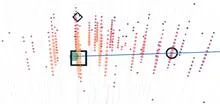
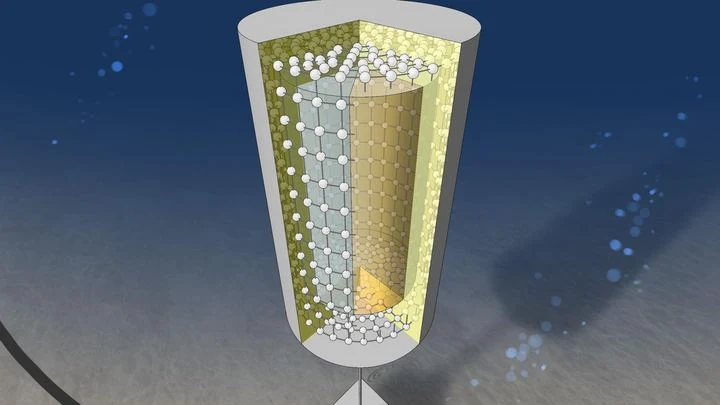
The detector consists of a three-dimensional grid of optical sensors (photomultiplier tubes) deployed in a transparent medium like Antarctic ice (IceCube) or lake water (Baikal-GVD). When a high-energy neutrino interacts, it creates a cascade of particles, and the charged ones emit Cherenkov light. The timing and pattern of light hits on the sensors allow reconstruction of the neutrino's direction and energy. The Earth itself is used as a filter: neutrinos can pass through the planet, so a telescope looking through the Earth sees only neutrinos, not other cosmic rays.
In practice
Neutrino telescopes are used to study high-energy astrophysical processes, such as active galactic nuclei, gamma-ray bursts, and supernovae. They also probe fundamental physics, like neutrino oscillations and searches for dark matter.
Fun fact
The article 'Нейтринная охота в водах Байкала' describes how the Baikal-GVD telescope, despite not yet detecting a cosmic neutrino signal, has set the most stringent limits on certain neutrino fluxes, proving that the absence of a signal can be as informative as a detection.
Imagine an interpreter at a meeting where everyone speaks a language they don't know. At first, they have to listen to every word, write it down verbatim, and then check against the original. That's how simulations for the IceCube neutrino telescope work: they track every photon born in the Antarctic ice, traveling hundreds of meters to hit a sensor.
The blue glow in water around a nuclear reactor is light born when a charged particle outruns light in that medium. The effect was discovered by Pavel Cherenkov in 1934, with the theory provided by Igor Tamm and Ilya Frank.
In July 1969, as Apollo 11 flew toward the Moon, astronauts noticed something unusual: brief flashes of light that appeared even with their eyes closed. At first, this was attributed to fatigue, but the flashes recurred in different crews. Gradually, it became clear: cosmic rays were to blame — tiny particles hurtling through space at tremendous speeds.
Buried in Antarctic ice, there's a detector the size of a cubic kilometer. It doesn't catch light but ghostly particles — neutrinos. Yet sometimes, a different beast might flash through: a pair of muons born together and flying apart in a wide fan. No known particle of ordinary matter can paint that pattern.
Measuring distances in the universe is no easy task. Almost all methods rely on light, which can be absorbed by dust, scattered, or distorted along the way. It's like trying to spot a distant lighthouse through fog and haze. Neutrinos are a different story. These ghostly particles pass through anything without noticing obstacles.
In the first moments after the Big Bang, the universe was a searing 'soup' of particles. As it cooled, phase transitions occurred — much like water turning to ice. At one such moment, magnetic monopoles of dark matter could have been born: tiny clumps of field with a single magnetic pole.
Solar neutrinos are tiny particles born in the Sun's core by the trillions every second. They pass through Earth almost without noticing it, and for a long time they were considered absolutely stable. But perhaps they too can "age"—decaying imperceptibly, vanishing on their way to us.
The 21-kilometer ring near Protvino was once planned to accelerate protons. Today, the same tunnel could host a very different machine — a muon collider. The muon is a heavy cousin of the electron, and that's its strength. On a curve, an electron radiates like a searchlight, losing precious energy. A muon radiates a billion times less.
In the depths of the ocean, where light never reaches, a plan is taking shape to capture particles that barely interact with anything. Geoneutrinos, tiny messengers from the scorching mantle, are emitted during the decay of uranium and thorium. Their flux carries information about how much heat lies hidden beneath our feet.
Dark matter detectors are essentially incredibly sensitive microphones, capable of hearing a whisper amid the roar of a rock concert. Their job is to catch the rare nudges from hypothetical dark matter particles, which are thought to occasionally collide with atomic nuclei of ordinary matter.
When a massive star dies, its core collapses, and a supernova explosion occurs. The cataclysm births streams of particles — like ripples from a thrown stone. The first to arrive are swift neutrinos, which pierce the Earth, hardly interacting. Then, hours later, ghost particles with a tiny charge appear.
An old photograph taken at the moment of the universe's birth has been carrying its light to us for nearly 14 billion years. This snapshot is the cosmic microwave background, the cooled echo of the Big Bang. It captures the tiny inhomogeneities from which galaxies later grew.
The story began almost a century ago, when Edwin Hubble showed that galaxies are receding, and Fritz Zwicky and Vera Rubin later realized: to explain their motions, invisible mass is needed — dark matter.
A stone falls into a pond, and ripples spread across the water. Likewise, light from distant galaxies spreads in all directions — calmly and steadily. But at the center of some galaxies, it's not a stone but a veritable cannon: it fires particles with monstrous force. Astronomers call such objects HSP BL Lac.
An invisible fence blocks the strait. You can't climb over it or dive under it: it's not made of steel, but of a stream of particles penetrating the water column. That's one way to describe the idea of detecting nuclear submarines by their antineutrino emission.
A neutron star is the dead core of a massive star, crushed to the size of a city. A teaspoon of its material weighs as much as a mountain. Dark matter particles fly through such a dense medium almost unimpeded, but occasionally they do hit neutrons and get stuck, like bullets bogging down in deep sand.
Conventional dark matter detectors are like a soccer goalkeeper waiting for a powerful shot while the ball barely rolls. The invisible particles filling our galaxy often move too slowly to be noticed by sensitive sensors.
If an atomic nucleus is a family, then in an ordinary helium house live two protons and two neutrons, holding hands tightly. Now imagine that one family member is an oddball who loves to wander far from home.
Neutrinos are tiny particles that pass through the planet's bulk like light through a windowpane. Every second, billions of them fly through your pinky fingernail, but catching even one is no easy feat. To do it, scientists dug a two-kilometer-deep mine in Canada and installed the SNO+ detector.
Deep beneath our feet, within the planet's bulk, radioactive elements are slowly decaying. This process spawns tiny particles — geoneutrinos. They pass through the crust, mantle, and core, barely interacting with anything.
A gamma-ray spectrum looks like a picket fence: each line is the precise energy a nucleus released as a photon. But sometimes ghosts appear in that fence — faint lines shifted by the same amount from the main ones. Such a shift could mean that part of the energy went into creating a light particle we cannot yet see directly.
Neutrinos — elementary particles rightly dubbed “ghosts”—barely interact with matter, making their detection a formidable challenge. The existence of neutrinos was predicted by Wolfgang Pauli, and the name was coined by Enrico Fermi.
Deep within the Antarctic ice, at depths where sunlight never reaches, antennas hang suspended. They listen not for sounds but for radio waves, waiting for a signal from a particle that is nearly impossible to catch. A neutrino passes through the Earth like a bullet through fog, but occasionally, very rarely, it grazes an ice atom.
A dark matter detector is like a room where you're trying to hear a whisper while static electricity crackles nearby. This crackle is produced by radon atoms — a radioactive gas that seeps out from materials and air.
Cosmic particles with energies millions of times greater than anything our accelerators can produce slam into the atmosphere and create a shower of secondary particles. This shower emits radio waves that antennas on the ground pick up. But the signal is weak: it's swamped by the radio noise of our galaxy and the receivers' own noise.
The helium in a party balloon is the very gas that makes it float. But long before balloons, helium appeared in the first minutes after the Big Bang. Its exact abundance in the universe is like a fingerprint: it tells you how many kinds of neutrinos (ghostly particles that pass through walls) exist.
In an underground hall at Fermilab, a huge tank holds liquid argon — a transparent fluid at minus 186 degrees. When an invisible neutrino flies into the tank, it occasionally strikes an argon nucleus, and a short track of charged particles flashes.
In a tank of pure water, particles traveling faster than light in that medium leave bluish flashes, like a plane breaking the sound barrier creates a sonic boom. From these flashes, you can tell what kind of visitor passed through: a gamma quantum or a neutron. This is no idle task: at borders and warehouses, you need to quickly distinguish a harmless radioactive cargo from weapon-usable material.
When a massive star runs out of fuel, it collapses and explodes as a supernova. An instant before the catastrophe, neutrinos — ghostly particles — burst from the core. They rush through the star and interstellar space like the smell of smoke, heralding a fire that will only ignite minutes or even days later.
Astronomers nicknamed them 'little red dots' — distant galaxies where a giant black hole hides at the center, wrapped in a thick layer of hydrogen. This packaging isn't just camouflage; it's a natural cannon. The black hole sucks in matter, but some of it is spat back out in narrow jets.
Neutrinos are ghost particles: predicted by the Standard Model, they barely interact with matter. Catching them is like trying to hear a whisper in the roar of a waterfall.
Cosmic neutrinos are ghost particles, passing freely through the Earth. The IceCube telescope in the ice of Antarctica once caught such a neutrino, and it matched an infrared flare. That flare turned out to be the moment a black hole tore a star apart in a distant galaxy.
Cosmic rays are charged particles that fly to us from the depths of the Galaxy. If you plot how many particles arrive at each energy, the line runs smooth, then suddenly drops sharply.
High above Earth, a satellite flies, and inside it is an instrument the size of a small wardrobe. It catches particles that have been racing through the galaxy for billions of years and finally slam into the detector. Such particles are called cosmic rays, and they bring news of distant stellar explosions.